



> Interviews
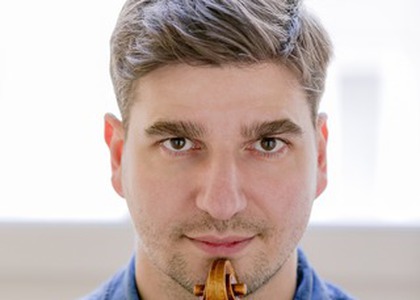
Interview with violinist Vlad Stănculeasa
Vlad Stănculeasa, one of the most brilliant Romanian violinists of his generation, has returned to Romania to perform as a soloist tomorrow evening at the Radio Hall. In addition to his solo, teaching, and chamber music activities, Vlad Stănculeasa is currently the concertmaster of three European ensembles: the Rotterdam Philharmonic, the Bochumer Symphoniker, and the Gstaad Festival Orchestra of the prestigious Yehudi Menuhin International Festival. Between rehearsals and preparations, Vlad Stănculeasa was glad to offer us an interview:
You will perform Alexander Glazunov's Concerto for Violin and Orchestra. It is a deeply romantic piece, which can be both a technical and a lyrical challenge alike. How do you see it?
You are absolutely right. It is a highly developed combination of the almost childlike lyricism of the violin, exaggerated romanticism, and virtuosity, which it comes with some new elements-double strings, balalaika-style pizzicato, and endless arpeggios towards the end of the piece. The performer must find the energy to move from these states in a natural and virtuosic way alike, of course - because that is also part of the piece, after all. It is written in a very violinist way, and yet, Glazunov manages to integrate the violin into this superb Russian orchestration and apparatus, which sounds very, very specific, in my opinion. It is a sunny, beautiful work that leaves you feeling good after listening to it; so the naturalness, simplicity, and fluidity of the performance are a priority for me.
I read that you had a random encounter with Sergiu Celibidache's assistant, which led you to investigate the phenomenological approach to music, and subsequently led you to studying orchestral conducting. How do you view music now?
I have always aimed to grow as a person and as a musician. And by growing, I think that we can talk about self-awareness. Being self-aware is a very important aspect of my development, and the fact that I had the opportunity to meet Konrad von Abel only further widened my horizons, refined the way that I perceive things and the observant spirit of what happens when music touches us. Studying conducting was a fairly natural consequence of aim to progress, of course. I gained a lot by getting closer to the general score, by understanding what a gesture of the conductor's hand means, and expressing without compromise the music we have to play, especially from my point of view as a concertmaster, the position I hold on a daily basis by entering the world of conducting. Even my graduation thesis was called: "The Concertmaster's Right Hand and The Conductor's Gesture." I hope that my research into this topic has helped me to become a concertmaster who, through playing the violin, manages to bring as many people as possible together in the orchestra, because that is what we do - we are there to help the orchestra and to use everything we have and all the means at our disposal to unite the people who are playing at the same time.
How do you feel about returning to Romania and performing at the Radio Hall?
It's a very special feeling, a mix of melancholy and a little bit of stress, so to speak. You see your old colleagues again, but you're still at home and you're very well-received. The emotions are stronger here than in other places - which has its good points - but it also means that I have to fight harder to get my message to the audience through the music. I am delighted to see the Radio Orchestra in such good shape and playing very well, with a beautiful, big, full, high-quality sound and a natural, beautiful seriousness, which it certainly helps in preparing this repertoire, and I'd like to congratulate the National Radio Orchestra for this. I would have liked to have had a little more time to walk around my beloved Bucharest, but this time everything is a bit rushed... I am very, very happy to return to Bucharest though, as always. Romania is generally a country that has a very natural and highly developed affinity for musical sounds. Music feels good here, so I am happy perform together with my old colleagues.
Translated by Andrada-Teodora Ivanov,
University of Bucharest, Faculty of Foreign Languages and Literatures, MTTLC, year I
Corrected by Silvia Petrescu


