


> Interviews
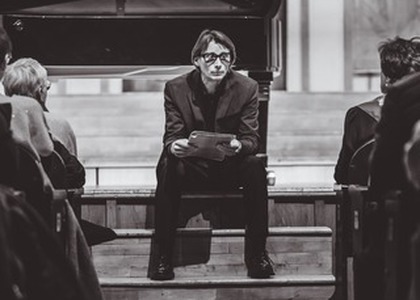
Interview with actor Marius Manole on the National Tour "The Other Voice. Forgotten Exiles of the Piano"
On Tuesday, December 2nd, 2025, the Radio Hall in Bucharest hosts the final show of the National Tour "The Other Voice. Forgotten Exiles of the Piano," featuring pianist Mihai Ritivoiu and actor Marius Manole. The event brings three great Romanian pianists back into the spotlight: Dinu Lipatti, Mîndru Katz, and Radu Lupu. The performance alternates musical moments with readings, voiced by actor Marius Manole, of dramatic letters discovered in the CNSAS archives, sent by the three pianists to their parents. We find out more details from the renowned theatre professional in this interview with Ioana Țintea.
Mr. Marius Manole, on Tuesday, December 2nd, you will be on the stage of the Radio Hall alongside pianist Mihai Ritivoiu, in the final performance of the Tour "The Other Voice. Forgotten Exiles of the Piano." How would you describe this artistic experience in a few words?
Moving, profound, a revival of some great pianists whom, sadly, we Romanians do not appreciate to their true value.
I am genuinely happy to have the opportunity to give voice, to be the voice of these great pianists, in a performance that isn't even a performance-although it intends to be one, it's not a performance, it's an evocation-reading, thoughts accompanied by the music of Mihai, who is a pianist I adore and whom I am delighted to meet on stage.
It is, in fact, a meeting of the soul. I think that is the best description of the performance.
What first attracted you to this project, and what was your initial thought when you received the invitation from the Opus Association?
Personally, I am in a period of discovering our great poets and artists who left Romania during the communist era. I feel it is time now, precisely because we are living in some very dangerous times and because we know that history virulently turns against us if we do not know it and if we fail to avoid repeating the mistakes of the past.
I am in a phase where I am reading, for example, Ana Blandiana's Journal or Gabriela Adameșteanu's Romantic Years, where I discover great personalities who made history abroad, such as Ioan Petre Culianu or many artists, many writers whom I genuinely did not know-my generation doesn't really know them.
These three great pianists belong to this same gallery; we certainly know a little about them, but we do not know the struggles they endured, what their thoughts were, what they went through when they were forced to stay away from their country, away from their parents, away from their teachers.
I believe we must recover the past, and we must recover it quickly, so as not to repeat the mistakes we have made. I repeat, we are in a very turbulent, very dangerous period of our lives, and I think my generation is responsible for bringing these voices to light and passing them on to those who follow us, the younger generations who are even less interested than we were in our past and our history.
How did you feel when you first read the letters of the three Romanian pianists in exile, and what was your encounter with this material like?
Radu Lupu's letter moved me the most, I admit. I don't know why; it contains so much pain. I discovered an artist with so many doubts, insecurities, but with such a great love for music and what he did, and the perfection he aspired to moved me deeply. As an actor, I somehow recognized the doubts, the fears, and the emotions before every performance. He had paralyzing anxiety and did not consider himself worthy to appear before people, and he struggled with this, studying as best he could. He was an artist who needed a lot of peace, as artists do, but he was truly ultrasensitive. The moment he informs his parents that he will not return to Romania, and doesn't even know if he will ever see them again, moved me greatly; it moves me greatly in the performance too. I try very hard not to be pathetic on stage, but sometimes emotion transcends our analytical thinking.
So, they moved me very much when I encountered these letters. And Mîndru Katz's letter, because we also have a letter from him... and Lipatti's letter, who had to speak in the third person, because they knew these letters would be intercepted by the Securitate, because they knew these letters would be opened, and especially they didn't know if these letters would reach their parents or not, because these letters are for them, and in each of them, we find the pain of the son, the pain of the child who is separating, perhaps forever, from their parents, teachers, friends, and all the people who helped them.
How was the dialogue constructed between your readings and the musical moments interpreted by pianist Mihai Ritivoiu?
Very naturally, because Mihai also read the letters and allowed himself to be inspired by them, finding the music that he felt suited each of these great pianists. We also have contemporary music.
It was a good connection for both of us. I am impressed by how he plays the piano. He is impressed by the letters I read. Therefore, I believe that when two artists admire each other on stage, it is the perfect combination, the miraculous equation that helps the audience enter the emotion of the performance more easily.
It's a reading-performance, and it surprised me. We had two shows in Pitești and Cluj. I admit I am an actor, and I like action on stage, and I constantly think that the audience needs to be kept engaged. Well, I was surprised that people stayed in the hall and quietly listened to these letters. They allowed themselves to be impressed, to be moved by these letters, and perhaps everyone, as we read these letters, prays internally that Romania will never again go through this kind of regime, that it will not have the misfortune of falling into the hands of people who keep our people, our values, and our artists away from us.
You are one of the most powerful voices in Romanian theatre today and a presence with resonance in society. What message would you like to convey to the audience attending this performance at the Radio Hall?
To have patience and tolerance, to come with an open heart and an open mind, to have empathy and try to put themselves in the shoes of these three great pianists and understand their suffering, appreciate their effort, and especially to each promise themselves that somewhere, when they get home, sometime, when they have a moment, they will listen to these pianists.
And if it so happens that there are parents in the audience, to tell their children about what they learned on the evening of December 2nd at the Radio Hall.
Translated by Miruna-Camelia Baicu,
University of Bucharest, Faculty of Foreign Languages and Literatures, MTTLC, year II
Corrected by Silvia Petrescu


