


> Interviews
Interview with jazzman and composer AG Weinberger
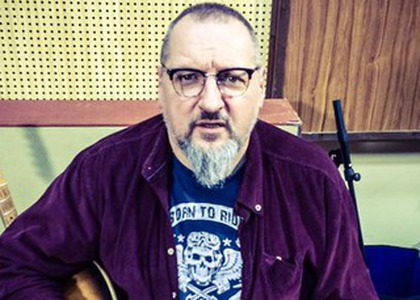
The renowned jazzman and composer AG Weinberger has signed the score of Concerto No. 1 for Cello and Orchestra, performed for the very first time at the Radio Chamber Orchestra's concert on Wednesday, February 25th, 2006. The orchestra will perform under the baton of Hyunsik Shin, with cellist Răzvan Suma as soloist, at the Radio Hall.
You attended the National University of Music in Bucharest at a mature age, when you were already enjoying national and international recognition. You said in a previous interview that the Romanian conservatory is extremely well-regarded. So I would like to ask you what influence did your college years have on you?
They have organized my life and brought a sense of purpose to it. Indeed, I started studying at the age of 46 because I felt that this segment, this section of my entire edifice, which would place me at the starting line, was missing. It was only when I finished college that I actually began my musical career, because I discovered my voice and I learned how to use those aesthetic, stylistic, even philosophical tools that can help me express myself coherently.
You also said that you felt the need to compose, in addition to your work as a performer. In recent decades, you have composed music in several styles, such as jazz and rock, but also stage music for theater. How did composition find its way into your life? And why did you feel the need to express yourself in established genres and forms of classical music, such as the symphonic poem or the concerto?
It is all about scope. As we move forward in life, we accumulate experiences, information, feelings, and the capacity for self-reflection. And any source of knowledge only enriches this endeavor. Even now, I am not settling into one place, I continue to learn all sorts of things, but for a musician it is natural to have all these tools of expression at your finger tips. I don't really believe in musical genres because I think that musical genres create a barrier between groups of people.
I have to believe in musical styles, because they are the raw material we work with, but not in genres. So what if, in the 21st century, someone writes for a string orchestra? So what if, in the 21st century, someone also plays the electric guitar, expressing themselves in a different aesthetic, one that is much more direct and much more simple for the audience? Why shouldn't I allow myself to offer a sound architecture that requires more than just a simple presence? Why not challenge the audience to self-reflection? Why not bring it out? Why not trigger the thirst for self-knowledge?
Who or what defines these limits for a musician?
Only the musician in question, right?
The musician in question. I grew up in a family where the thirst for knowledge was a natural state of being. And this reflex, if I may say so, is still within me today, and I hope it will remain so until my last moments.
The pandemic was a period of artistic effervescence for you in the field of composition. Could you tell us about this period?
Well, as we all know, we were all stuck at home. What were we supposed to do? What could we do? So I played around with instruments and different types of software and I applied for various grants offered by different cultural institutions or, rather, by various administrators of these funds. And, paradoxically and rather strangely, I applied in several countries, because any European citizen can apply to any cultural fund, of any member of the European Union, and I won.
That is how these symphonic poems you mentioned came about. I composed three such works between 2020 and 2021, with funding from the member states of the European Union. So, financial-wise, things went much better for me, because I had nowhere to spend the money anyway, and at least this gave me some peace of mind, at the existential level.
But there isn't a single day in my life when I don't write something, even if it's just an idea or something I consider mediocre, but which I might eventually develop into a generative cell for something larger. And then comes the craft I learned at school. Because inspiration is temporary, isn't it? Then comes the craft, because we are craftsmen, as the word "artist" suggests, which has its roots in Latin and means craft.
You also mentioned that Bela Bartok was a compositional model for you. How would you describe your work from a stylistic point of view?
Post, post, post, neo, post, post, post, neo, neo, post... After this string of attributes, you can add whatever you want. Whether it is romantic, classical, modern, minimalist, serialist, and so on. Anyway, in the 21st century, there is really no clear line or strand, which is good because all these styles or genres that music history has gone through have now become just tools for composition.
So, in a single work, we can find, let's say, a 12-measure tonal structure, after which the musical text immediately shifts to serialism, six measures. Why not? We are, if you will, like those famous Michelin-starred master chefs who can make any kind of dish, any kind of food. A kind of fusion. Isn't this, in fact, the dialectical essence of the 21st century man, this fusion of moralities and aesthetics? Isn't this why we now have no point of reference? Isn't this why human society is falling apart? Isn't this why we are in Kali Yuga? You can feel that something is wrong, something is changing.
We are in a thermodynamic, moral, and cognitive conflict. So what kind of style does an artist, a composer, or a painter represent today in this ocean of oddities?
The history of art and music shows us that each genre or musical style is linked to a cultural era that lasted 60, 70, or 100 years. Today, something changes every day. So what are we looking for? Perhaps this is the message of our times, to return to our inner selves and discover that vocabulary that helps us embrace who we are.
Thus, this is a description of my style.
Yes, you somehow anticipated my next question - is your music an expression of the contemporary world? You said yes, but is it also an expression of an ideal?
The ideal should have been validated by something. Now, we don't even have these validation instances anymore. So, what do we call ideal? We are in a dilution of human society. It is probably a transitional stage and something more solid will come from now on. But, at this moment, we are in a moral and cognitive decay.
The ideal? Well, I think the ideal is the world within ourselves. Just like that, in our discretion, in our singularity, but let's not confuse it with the technological singularity that has already entered our antechamber, with these software programs and these AIs that will gradually take over many things.
This brings us to the concert on February 25th, 2026, at the Radio Hall, where the first concerto you dedicated to the cello will be premiered. How did your collaboration with Răzvan Suma begin, and how did it lead to this concert?
Răzvan and I have known each other for several years. I had been writing this concerto since 2024, and during a conversation, I said to him, "Look, I have something here, would you like to take a look at this work? Maybe what I have written is nonsense, I am not a cellist..." And a few days later he said, "All right, do you want me to play it for you?" Of course I accepted, and that's how we got here.
Finally, what should the audience know about your Concerto No. 1 for Cello and Orchestra, which you had signed before coming to the concert at the Radio Hall on Wednesday, February 25th?
I would refrain from giving them any clues precisely so as not to generate prejudices. This work has a single purpose, that is to generate that cathartic state of mind. You will see that no part has a specific cadence or ending. Everything remains like a breeze, like a surfer riding the waves, but not towards the shore, but out to the open sea, somewhere where it will dissolve into the ancestral at some point.
I wouldn't advise anyone to come with any preconceived ideas or expectations. I no longer have any expectations myself,I let myself be surprised by the textural velvety quality of the work. Now that I've heard this music live - until now I only knew the sound generated by the software - it sounds really good when you listen to a live orchestra.
I think it creates a sense of well-being, but with a question mark. And in fact, I think that is our purpose as composers. To generate a sense of doubt, to encourage the audience to think broadly and to use the immense gift we have been given by the creator, self-reflection.
Translated by Diana Sitaru,
University of Bucharest, Faculty of Foreign Languages and Literatures, MTTLC, year II
Corrected by Silvia Petrescu


