



> Interviews
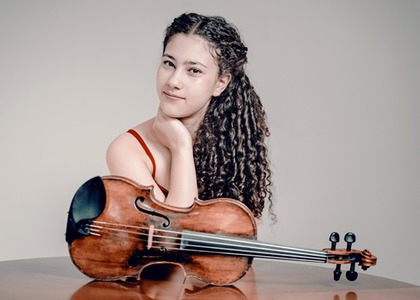
Mariam Abouzahra: "This award opens a door into the ICMA family"
Although she is only seventeen years old, Mariam Abouzahra's playing reveals an inner maturity and crystal-clear musicality that has convinced the most important decision-makers in the international industry: in 2026, she will receive the Discovery Award of the International Classical Music Awards (ICMA). Born in Germany to an Egyptian-Hungarian family, the young violinist is currently honing her skills in Vienna, but through her performances, she is already a regular fixture on world stages. Ahead of the gala concert in Bamberg, Máté Ur spoke with her on behalf of Papageno-the Hungarian representative of the ICMA jury-about professional mentors, international presence, and the communal power of music.
You were born into a family of musicians; your parents are pianists, and your sister, Amira, is also an acclaimed violinist. As a child, how self-evident was it that you would choose this path as well?
Music was my primary reality. As a child, I naively thought that everyone in the world played music-that it was the natural way of being. I was three years old when I first picked up a violin. Quite simply, I wanted to be like my sister, Amira. I saw her creating music together with my parents, and I wanted to be part of that special, wordless dialogue. Today, I am walking my own path, but those common roots remain defining.
You were born in Germany, you have Hungarian-Egyptian roots, and you are currently studying in Vienna. How does this diverse cultural background shape your artistic development?
My daily life is vibrantly international. My mother spoke to me in Hungarian, so that is the primary medium of my thoughts. Although I have never lived in Hungary or Egypt full-time, I consider both countries my home, and this duality is reflected in my calendar: in the near future, I will have numerous performances in Italy, Hungary, Germany, and Egypt. I feel that this diversity provides a kind of inner freedom, which also aids in artistic interpretation.
Since 2019, you have been studying with Dora Schwarzberg at the University of Music and Performing Arts Vienna, but Hungarian masters also play a key role in your professional growth.
Yes, we moved to Vienna when I was ten because of her. Dora combines the discipline of the old Russian school with a modern musical perspective. At the same time, the professional network back in Hungary is extremely important to me: I learned a lot from Gábor Homoki, and I have been working with András Keller since I was ten. With Concerto Budapest, we have performed cornerstones of the repertoire together, such as the violin and double concertos of Brahms, Tchaikovsky, Mozart, and Paganini-these concerts fundamentally shaped my musical thinking. Meeting Gábor Takács-Nagy at the Verbier Festival was also a milestone; I have since performed with him. Additionally, István Várdai has been mentoring me since 2018; I've learned an immense amount from him, and he has invited me to several joint performances.
Who have been the most influential figures in your development so far?
My mother has been by my side from the beginning, and today we are increasingly becoming chamber music partners. I learned from her that specific Hungarian musical attitude-that depth associated with Ferenc Rados and György Kurtág-without which I would approach the instrument differently today. Furthermore, it is an exceptional privilege for me to have been a recurring guest soloist for years with major Hungarian ensembles such as Concerto Budapest, the Franz Liszt Chamber Orchestra, and the MÁV Symphony Orchestra.
The ICMA jury awarded you the Discovery Award this year. What does this prestigious recognition mean to you?
The ICMA Discovery Award is decided by representatives of Europe's leading music media, including Papageno, so this is a huge honor for me. This award opens a door into the "ICMA family" and validates the artistic work I have done so far. To me, this is not just an encouragement for the future, but a recognition of my international presence and professional results, providing continuous opportunities on the world's stages.
At the Bamberg Gala on March 18, you will play the final movement of Brahms' Violin Concerto. Was this a conscious choice?
I have delved deeply into the analysis of the piece and its internal connections; in fact, I dedicated one of my high school thesis papers to exploring this very masterpiece." The references within the work and its Hungarian-style pulse are very close to my heart. I feel that through this piece, I can represent myself most sincerely at this festive concert. Alongside it, Bartók's Solo Sonata is the other pillar of my repertoire because I feel that through it, I can best "speak" the Hungarian musical language.
How do you see your future?
My vision is clear: I am continuously building my repertoire, and my goal is to become an increasingly integral part of the international circuit as a soloist. Besides that, chamber music plays a central role in my life, and I have many invitations in this field. The most special moments, of course, are when I get to play with my sister, Amira: we understand each other without words, from a single breath.
With the intense pace, 6-8 hours of daily practice, and touring, do you have time for relaxation?
I love exploring new cultures wherever my concerts take me. I meet many friends on these trips who occasionally visit me in Vienna. When I am at home, Amira and I often organize "musical evenings" for our friends, where the focus is on the joy of playing together. And if there is still a little free time left after all that, I enjoy baking-though culinary arts are just a pleasant hobby; my real life and calling take place on the stage.


