


> Interviews
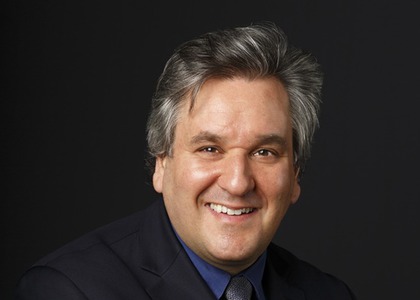
Antonio Pappano on his new life with the London Symphony Orchestra - and what makes a good conductor
The London Symphony Orchestra's record label LSO Live is Label of the Year at the International Classical Music Awards. Kai Luehrs-Kaiser from the ICMA Jury member Das Orchester made the following interview with the LSO's new Chief Conductor Antonio Pappano.
Mr. Pappano, for the first time in your career, you find yourself without an opera house. Do you like it?
I must admit, it's a strange feeling. I'm used to going to an opera house every day and working there, in a very physical sense. My rhythm is completely different now. Without an opera house, and with a symphony orchestra instead, everything is much more hectic. I have to conduct different works all the time. Since I practice a lot and am used to preparing intensively, I feel as if I were still at university. On the other hand, my relationship with the Royal Opera House is still very good. We are in the middle of a new Ring with Barrie Kosky as director. And with the London Symphony Orchestra, I do operas in concert form.
Is the idea of a permanent opera house dead for you?
I am now 65 years old. I'm not sure I would have the desire and energy to embark on a new adventure. Well, the desire I probably have. After all, I did it for 35 years. The question is not entirely unexpected. All I can say is that I am and always will be, above all, a theater person.
With the London Symphony Orchestra, you have one of the most versatile and technically accomplished orchestras in the world at your disposal. Your best yet. Is there anything you need to prove - or want to prove - with this orchestra?
There always is. The LSO has a certain inner drive that is its calling card, so to speak. Nevertheless, I have to find the sound for the orchestra or adjust it as I see fit. I also have to make sure that we have the right persuasive power. No small responsibility! In Great Britain, all orchestras have the versatility you mentioned. That's because of the system. It has developed a certain strength in these orchestras that is essential for their survival. The LSO embodies this in its most superior form. However, versatility can also be limiting. I admit that I have never done anything without conscientious and extensive rehearsals. Now I have to prove that I fit in with a system that is geared towards fewer rehearsals.
The principal conductors of the London Symphony Orchestra have included such illustrious names as Arthur Nikisch, Thomas Beecham, Pierre Monteux, and Claudio Abbado. Which of your predecessors do you admire most?
Oh, there were a few more. Colin Davis was one of the most influential conductors for 12 years. Claudio Abbado is remembered here as an enormous perfectionist. The musicians also rave about Valery Gergiev, who - despite all the chaos during rehearsals - must have conducted some of the most exciting concerts. Incidentally, even Edward Elgar was once the principal conductor of this orchestra. But the most important one for me is my immediate predecessor, Simon Rattle. He opened up the repertoire.
You know what Christoph von Dohnányi said at the Cleveland Orchestra: "When I conduct a good concert, George Szell gets the good reviews; when I conduct a bad one, I get the bad reviews." Which of your predecessors do you fear the most?
I can't even think about that.
Why not?
You always fear yourself the most. Because it's all me, if I may say so. You can't use any predecessor as an excuse, and you can't let anyone else confuse you.
Every orchestra has gaps in its repertoire. Even the LSO?
Certainly. The LSO has undoubtedly performed all of Ralph Vaughan Williams' symphonies at some point in its history. We are only now doing a cycle. For years, it was more likely that a Mahler or Shostakovich symphony would be included in the program than Vaughan Williams' Ninth. You haven't done the Bernstein symphonies in ages. Rossini would be important. Because he trains the fingertips, and that benefits classical music as well as the sense of esprit.
The LSO has reportedly made the most records of any orchestra, many of them during the André Previn era. Is that still worthwhile today?
That's a question you'll have to ask the management. For my part, I believe we have to do it. It documents the orchestra's progress. If you choose the works well, recordings are still a meaningful and worthwhile endeavor today.
Which of your own recordings are you proud of?
All my recordings are fantastic. (Laughs loudly.) Well, I would actually mention the opera recordings I made with the LSO in the past: La Rondine, but also Werther, Trovatore, and parts of Trittico. Mostly with Angela Gheorghiu in the lead role. My favorite is Il tabarro with Maria Guleghina and Neil Shicoff. That was fantastic. I also like the recordings where I'm sitting at the piano, especially with Ian Bostridge. They're important to me.
Genuine opera conductors are either stricter than others, like Toscanini was, or more spontaneous, like Thielemann is. How can you tell that you're an opera man?
From practicing a lot. I think about the pieces a lot, I have to say. Not in an intellectual sense, but in the way I learned to do during my six years with Daniel Barenboim. It's a mixture of head and heart that counts. The fact that I think in terms of sound also has to do with opera. Because it has to do with balance, and that is a very important quality in opera, if you want to hear the singers. With a large orchestra, that is of course much more difficult to achieve.
Could you briefly explain how you ensure transparency in an orchestra?
First of all, it depends on the number of musicians. It's no art to sound transparent with a chamber orchestra. It's downright laughable. The answer would be: transparency is achieved by articulating differently in the various registers and voices. If you don't pay attention to that, all you get is a crema.
What if the orchestral accompaniment sounds completely insignificant, as in bel canto, for example?
There is no such thing as insignificant accompaniment. The accompaniment, as trivial as it may seem, is the water under the little boat that it carries. That is also something I learned in opera. The accompaniment keeps the boat moving.
Music today is a business - one that provides security and also sets limits in the form of routine. What do you think of routine?
Routine, quite simply, is the end of the show. The problem today is that the technical level of orchestras is so high that this is used as an excuse to deny you a sufficient number of rehearsals. Then routine sets in. Then you're trapped.
So it's important to rehearse "properly."
Exactly. And the biggest difficulty for young conductors today is learning how to rehearse properly. Let's be honest: not all conductors are good at rehearsing. But the golden way to 'lose' an orchestra, to squander its trust, is still through poor rehearsal style.
You have good conducting technique. Some great conductors, such as Furtwängler, but also Thielemann, did not or do not have it. What does conducting technique mean?
I have good conducting technique?! No one has ever told me that before. Thank you! I mean it seriously. I don't have good technique. At the beginning of every rehearsal period, I have to rediscover my movements. I didn't learn it. For me, there is no such thing as a classical conducting technique. That's why rehearsals are so important. My method is to put myself in the shoes of each musician and ask myself what he or she needs from me. I now even admit to my lack of technique. I don't even use a baton anymore.
Who had the best conducting technique of the last 50 years?
Any of my colleagues would give you the same answer to that question: Lorin Maazel. I even asked him about it once. Maazel told me that it took him 17 years to develop this technique. It consisted of releasing every tension in his body. And he succeeded. He became so relaxed that none of the musicians tensed up either. When he conducted, neither his breathing nor his bowing was disturbed. He was incredibly relaxed. Of course, Carlos Kleiber had the most incredible technique. No other conductor made the music bubble like he did.
You are an extremely affable, perhaps even the friendliest conductor of all. How is that possible? You're not allowed to be like that!
The explanation is rather personal: I hate myself when I'm in a negative mood. Talent is preparation, authority is charisma. You earn the respect of musicians through preparation. You don't need to shout loudly for all that.
What happens when you do lose your temper?
Well, then it comes to an eruption. You can feel it coming, much like Toscanini's outbursts of anger were always predictable. In my profession, you have to repeat things a lot. You repeat the pieces, you repeat the advice and instructions. You repeat yourself. That sometimes leads to impatience on my part. Besides, it's all about emotions, after all. How am I supposed to keep myself in check? I try to be collegial, that's all. But I still need a vision. The stronger it is, the better the orchestra will be.
Bio:
Antonio Pappano, born in 1959 in Epping (Essex) as the son of an Italian singing teacher, grew up in the USA. In Bayreuth, he was assistant to Daniel Barenboim. In 1992, he became music director of the La Monnaie opera house in Brussels, then of the Royal Opera House Covent Garden from 2002 to 2024. Since last season, he has been Simon Rattle's successor at the London Symphony Orchestra.


