

> Interviews
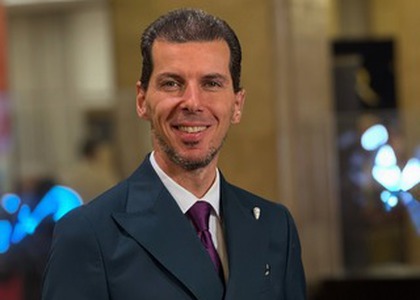
Interview with Marius Constantinescu, journalist and cultural show producer
Marius Constantinescu, you wrote the volume titled Îți place opera? ("Do you like opera?"), which is also the title of the book you'll tell us about today. How did this volume come to be?
It was simple, now that I think about it. Basically, I just responded to a request by the Humanitas Publishing House, the Humanitas Junior Collection, specifically, coordinated by Iustina Croitoru, who was insistent enough, skilled and elegant enough in her insistence that she convinced me to commit to this book, which was initially conceived for an audience that I don't usually appeal to, young to very young people.
And then, somehow, we met halfway and I suggested a book that should be for readers that are young at heart, first, and legally, second, an audience that's interested regardless of paste experiences, to discover or rediscover pieces of the fascinating universe that is opera.
What can the readers of this book discover? What sort of encounter with opera do you propose to them?
An encounter that is deeply subjective, an encounter mediated depending on my personal history and my personal preferences when it comes to opera. On the other hand, it's also an encounter with some of the fundamental landmarks of this performance art, a complete art, we'd call it. It might be one of the most complex, if not the most complex of performance arts. So, we could say there's a few milestones, or beacons shining their light on the genre's objective and subjective history.
I imagine that the illustrations by Ana Alfianu will significantly contribute to the way your reader will understand and feel the lyrical universe. How did your collaboration go and what can you tell me about the book's visual identity?
Ana Alfianu was one of the sine qua non arguments when I started to develop this volume, because I'd known about her talent as an illustrator for a long time, and that's not all, I knew about the sensibility that expressed itself so convincingly in her writing too.
In other words, the moment I knew Ana Alfianu would create the illustrations for this volume, I was convinced that it has a purpose, and maybe a future.
Of the 10 titles in this volume, is there any specific one you would consider ideal for a first encounter with lyric genre?
Without a doubt, and I've said this before whenever I was asked where a beginner should start navigating the world of opera. My choice will always be Giacomo Puccini's La bohème, because it's a story about humanity, about youth, about normalcy and life, including the ending that's inherent to life, a story that can be convincing to anyone, any time, anywhere, as long as it's presented believably and the core idea of the libretto and music remain in the area of youth and simplicity.
Why should we read? How does reading help us in everyday life?
It's hard for me to say how reading helps because I can't imagine how not reading would help. So, basically, my answer is a denial of the statement. I think we, as people, are closer and closer to the definition, or at least my definition, of human and humanity, as long as we read, as long as we're always reading. And this doesn't mean we should be walking around on the street with our nose buried in a book, okay? This means that we should always be trying to refine our universe, to open up our universe, to see how much can fit between these volatile borders of knowledge and how beneficial it is for us, both in relation to others, but especially in relation to ourselves. If we read, if we're always enriching ourselves, if we're always getting to know the world, and letting ourselves be known by it in turn through reading, whether it is about music or anything else on this Earth, I think we're human as long as we read.
Translated by Alexandra Teodora Ciolacu,
University of Bucharest, Faculty of Foreign Languages and Literatures, MTTLC, year II
Corrected by Silvia Petrescu


