


> Interviews
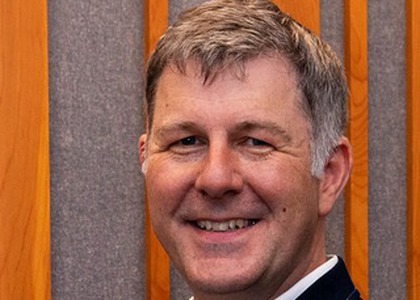
Interview with conductor Timothy Redmond
Conductor Timothy Redmond, a multifaceted artist particularly acclaimed for his work in opera, contemporary music, and music education, will take the podium of the National Radio Orchestra on the evening of Friday, 27th February 2026, for the first time. The programme includes the Piano Concerto in A minor, Op. 16 by Edvard Grieg, with Alexandra Dariescu as soloist, the Symphony No. 4 in E minor, Op. 98 by Johannes Brahms, as well as a lesser-known work - the symphonic poem The Noon Witch, Op. 108 by Antonín Dvořák.
This is your first collaboration with the National Radio Orchestra. How does it feel? How are rehearsals going?
It feels wonderful. Of course, the entire orchestra knows Brahms's Fourth Symphony, but they haven't performed it for several years, so rediscovering it is a real joy. Then we have Dvořák's symphonic poem. It's not a piece that's played very often. Dvořák is one of those composers everyone knows and loves - thanks to the "New World" Symphony and the Cello Concerto, for instance. But there are also scores that are performed less frequently; The Noon Witch (Polednice) is among the last works he wrote for orchestra - a very dark story. In a way, it's a miniature symphony, about twelve minutes long, full of drama, telling a story almost like a soundtrack to a silent film. Extremely imaginative, highly evocative. I believe it's almost a novelty for the orchestra. And it's quite unusual to perform, for the first time, a work by such a famous composer. We'll also be revisiting Grieg's Piano Concerto together with my very good friend Alexandra Dariescu, whom I know the audience here already knows well.
How did your collaboration with Alexandra Dariescu begin?
We were both invited to perform at a New Year's concert many years ago. We hadn't met before that. We played together and got along extraordinarily well, and I immediately invited her to take part in other projects. We've been collaborating ever since. In recent years, we've created two projects together dedicated to young people - one for the Leeds International Piano Competition and another for the London Symphony Orchestra. We've spent a great deal of time together, both on stage and in filming sessions. The first show is called Count Me In and explores the connection between music and mathematics. It has been presented live many times and was also filmed; the Lang Lang Foundation in the United States uses it online. Later, we created a show devoted to the instrumental concerto, produced for the Leeds Competition and the London Symphony Orchestra. It is, of course, a very different kind of project from a traditional concert, but we all know how important it is to inspire the next generation of musicians and music lovers. Our projects are designed to inspire young audiences and introduce them to the joy of classical music. And in both shows, Grieg's Piano Concerto plays a central role. It's wonderful to perform it together again here.
You've already mentioned your deep involvement in educational and youth-focused projects. What motivates you in this direction?
As a child, I was incredibly fortunate to be surrounded by countless opportunities - so many that you might almost have taken them for granted. Over the years, I've seen many of those open doors begin to close. I feel strongly that the education and opportunities I was given should be available to everyone. Whatever I can do - whether working with young musicians or trying to inspire young audiences - is essential to the way I understand my artistic mission. There is another aspect as well: I conduct a great deal of new music, contemporary creations. And I've discovered that presenting an absolutely new work to an adult audience is not very different from introducing any kind of music to a young audience - because, to those ears, everything is new. There is a very clear connection between these two ways of presenting music. I've had the chance to collaborate with extraordinary artists and wonderful organisations around the world in order to turn these ideas into reality.
You frequently conduct contemporary scores. How does this influence your perspective when you return to established works such as Brahms's Fourth Symphony or Grieg's Piano Concerto?
I believe everything forms part of a continuum; nothing exists in isolation. We need to look back into history to understand how things evolve. Brahms impresses through his extraordinarily sophisticated structure and remarkable orchestration. Dvořák is, in a way, visionary; you can clearly see how he inspires Janáček, and from there we are already stepping into the twentieth century. I would say that we can find moments of modernity even in these older works. It is very important to have a deep understanding of a broad spectrum of music. Beyond what we call contemporary music, I've also recorded numerous film scores, which often rely on the idea of familiarity - they are designed to evoke something known and comforting. For me, all these fields are closely interconnected.
What defines your approach as a conductor?
It's all about the music. I'm fascinated by the idea that music reflects human experience and spirit; that it is both an expression of its time and, at the same time, timeless. Today we discover different truths in works written in the nineteenth century than those we perceived fifty years ago - and that's extraordinary. I am curious, open, a collaborative musician. I believe it is essential to be human beings first, musicians second, and only then specialists in our field. Music is about people; it's about bringing them together, in whatever way that may be. I would say that my approach is a profoundly human one.
Translated by Miruna-Camelia Baicu,
University of Bucharest, Faculty of Foreign Languages and Literatures, MTTLC, year II
Corrected by Silvia Petrescu


