



Interview about Sergiu Celibidache with director Jan Schmidt Garre
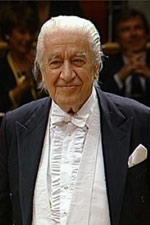 The
documentary Sergiu Celibidache - You don't do anything - You let
it evolve made by Jan Schmidt-Garre was awarded the MIDEM Prize
at the Documentary - DVD section, on January 26 2010 within the ceremony
hosted by the Cannes Festivals Palace. It was a good opportunity to
talk with German director Jan Schmidt-Garre , who was the Romanian
famous conductor's student.
The
documentary Sergiu Celibidache - You don't do anything - You let
it evolve made by Jan Schmidt-Garre was awarded the MIDEM Prize
at the Documentary - DVD section, on January 26 2010 within the ceremony
hosted by the Cannes Festivals Palace. It was a good opportunity to
talk with German director Jan Schmidt-Garre , who was the Romanian
famous conductor's student. How did you meet Sergiu Celibadache and what are your memories about him?
When I first met him, he was the chief conductor of the Munich Philharmonic Orchestra. Munich was the city where I lived a period of time and I could listen to his concerts. Afterwards I met him in private, and then I attended his courses. He worked as a professor very much, especially at Mainz University. He had group seminars and there I attended his courses. And, unexpectedly, the idea of making a movie about him occurred to my mind.
What did you really want to show in this documentary? Are there any particular aspects that you wanted to emphasize? And I am thinking especially about the documentary’s title. I ask you all these things from the perspective of the public that has not yet had the chance to see the documentary.
Yes, indeed, the subtitle is You don't do anything - You let it evolve (Man will nichts, man last es entstehen), a main idea, a key point in the movie and in its whole theory. The musical process that evolves itself in an organic way was always important for him. And such a thing does not necessarily depend only on the orchestra conductor's art, but resides from the logic of the inner evolution of the musical score. That is why the chosen subtitle - You let it evolve - comes to point out an ideal which is extremely hard to be reached, a request, a premise for the further enrichment of music, that should be played accordingly to its interior law.
Celibidache remains a remarkable, super-renown personality, but his musical philosophy offers an inaccessible perspective upon music. How did you try to familiarize the public with his philosophy?
In fact, his philosophy is not such a complicated one. When he delivered his speech to his students, he was not easy to be understood, because his notions were not ordinary and familiar ones, there were concepts used in different contexts than the normal ones. But while talking with him outside the courses and showing your interests in his theories, you could get the most precise explanations. In the documentary, we can see his open-minded character, and his verbosity is a fluent and a plain one, so it was not difficult at all to hand out his philosophy to the public. I really had the chance to mix images from interviews and some of his courses altogether with examples taken from his rehearsals, or demonstrations from his seminars, for example the moment when he worked with a string quartet. Therefore, it can be easily understood what he wanted, and I consider that I have succeeded in revealing all these facts to the public.
How was the co-operation between you and Sergiu Celibidache during the film making period, being known that the Romanian conductor was pretty reluctant to everything that meant recordings? Well, this is true especially about his concerts, which he considered kind of lifeless images, and he was not willing to record them, but when it was about his work involvement, he was totally different, showing great transparency towards it, agreeing with his rehearsals to be made public through TV images, or radio broadcasts, so that the music lover could comprehend his art as much as possible. This is the reason why he was so open-hearted during the film making. As far as I am concerned, when everything was set, everything became possible, and Celibidache was a man who had always kept his word.
What was Celibidache's opinion after having seen the documentary?
He told me: "It is well done. So what are you going to do with it?" That was all. (laughing)
You studied philosophy, film directing, and then you looked for fulfillment in music. Is it possible to discuss about a particular Celibidache approach which may get us closer to the truth in a broader meaning than music?
I believe that his real lesson was a quest for tempering the musician's personality, and looking for the inner "voice" of the musical score to reveal itself, a principle that should be applied in other arts, too. Taking my job as an example, a director should not interfere that much within the plot, but should try to understand its potential so that it can organically develop itself. In this respect, this is his important legacy as a thinker.
What does this MIDEM Prize mean to you, if we take into consideration that it has been awarded after 18 years from the actual film making?
Well, it is really odd and it may be explained due to the fact that it was released on DVD last year. Little did I imagine, when I filmed, that it would have a great impact, as it was my first longer documentary then, but all being said, I am really happy to see that Celibidache's art is still contemporary and praiseworthy. This prize is a great honor for me, because it means recognition and a stimulus for my future work.
Interview by: Ioana Marghita
Translated by Alinda - Gabriela Ivanov
MA Student, MTTLC, Bucharest University


