



Disk of 2024
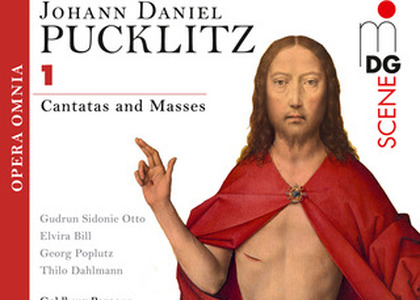
Johann Daniel Pucklitz – Cantatas and Masses – Music Box, November 10th 2025
Johann Daniel Pucklitz - Cantatas and Masses - Music Box, November 10th 2025
I've chosen this album, released on October 3rd, precisely because it brings us repertoire recorded here for the very first time: the masses and cantatas of Johann Daniel Pucklitz, a composer who was born in 1705 in Gdańsk and who died in 1774 in the same city, which is part of Poland today. In fact, Pucklitz's entire musical career unfolded in Gdańsk: he worked with church ensembles, at the city's court, and also organized concerts in private homes.
In March 2022, the Goldberg vocal-instrumental ensemble, conducted by Andrzej Szadejko, released a first disc of Pucklitz's music, featuring the Oratorio secundo, a large-scale vocal-symphonic work. The album received an Opus Klassik award in the category of world-premiere recordings. This served as an incentive for the Polish baroque ensemble to continue exploring Johann Daniel Pucklitz's music. Thus, the project Pucklitz: Opera Omnia was born, its first volume being the one we are listening to today.
On October 3rd, the label Musikproduction Dabringhaus und Grimm released this album containing world-premiere recordings from the oeuvre of Johann Daniel Pucklitz, an 18th century Gdańsk composer whose music reflects the stylistic transition from baroque to classical, passing through the rococo. Pucklitz wrote mostly sacred music, largely because the church was the institution commissioning the most music in the city. He left behind 80 works, 61 of which have survived and are preserved today in the library of the Polish Academy of Sciences in Gdańsk.
Pucklitz's music is inventive, offering melodic, harmonic, and rhythmic solutions that are at times quite unusual; the character of the pieces is closely tied to their narrative text, something particularly evident in the cantatas we are about to hear next. Moreover, the composer employs very rare instruments: the violetta (a small violin), the oboe d'amore, corno da caccia, bombard (a type of early bassoon), and the glass harp. From a compositional perspective, the album truly offers the pleasure of discovery; it would have been ideal, however, to hear it supported by greater ensemble homogeneity, especially in the choral writing.
These world-premiere recordings were made by the Goldberg vocal-instrumental ensemble, conducted by Andrzej Szadejko, with soloists soprano Gudrun Sidonie Otto, mezzo-soprano Elvira Bill, tenor Georg Poplutz, and bass Thilo Dahlmann.


