



Disk of 2024
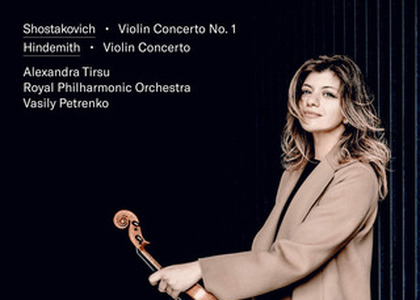
Violinist Alexandra Tirsu, London Royal Philharmonic Orchestra, conductor Vasily Petrenko - Music Box, November 24th, 2025
An album launched on November 14th by the record label Fuga Libera, part of the international group Outhere Music, has as its center stage the Moldavian violinist Alexandra Tirșu, who recorded concerts by Shostakovich and Hindemith alongside the London Royal Philharmonic Orchestra, conducted by Vasily Petrenko.
It is her first portrait album, and I believe it's a successful one. But who is Alexandra Tirșu?
She is 33 years old, born in 1992 in a family of musicians. She started studying the violin at 7 years old in her hometown. She continued at the University of Music and Arts in Vienna and later specialized under the guidance of the famous violinist Janine Jansen. In 2021, she won the 3rd prize and the audience prize at the difficult ARD competition in Munich. She has already performed on major European stages - and in Romania, we were able to listen to her thanks to the Sonoro festival, most recently in the summer of 2025, when she was invited to the Sonoro Conac festival.
She has dual citizenship - Moldovan and Romanian.
For her first album, she chose, as she herself confesses, two concertos that have special significance in her life and career: Concerto No. 1 for violin and orchestra by Dmitri Shostakovich and Concerto for violin and orchestra by Paul Hindemith.
"Shostakovich's Concerto No. 1 has been a part of my life since childhood," Alexandra confesses. "His music resonated with me not only because of its intensity, but also because I grew up surrounded by stories and films about war. My grandfather was a soldier in the Red Army, and those memories, even across generations, have defined the way I hear this music. After the loss of my father, I got a deeper understanding of the pain and absence evoked in the music of this concerto. Shostakovich remains my favorite composer."
Shostakovich wrote Concerto No. 1 for Violin and Orchestra during the difficult times of 1947-1948, isolated from Zhdanov's cultural policy, with the memory of World War II still very much present. The concerto has an unusual structure in 4 parts, the first being a long Notturno. Through its musical language and ethical and aesthetic message, the concerto did not coincide at all with the Soviet politics of the time, so Shostakovich had to wait for better times, which came only after Stalin's death in 1953, and the concerto was premiered only in 1955, with David Oistrakh as soloist.
I would say that it is difficult for a musician who has had no connection to this dark history to fully grasp the character and depth of the Shostakovich Concerto No. 1. Alexandra Țirșu, fragile and yet so powerful, is extremely convincing and moving, partly because she knows personally the drama of those who truly lived through Soviet times, but also because she has a special talent for conveying emotion. An extraordinary achievement, for which she deserves to be congratulated!
The disk represents the expression of some key moments in Alexandra's life, this 33-year-old violinist with a prodigious international career. Just like the time when she became laureate at the ARD Competition in Munich in 2021. That was the moment she discovered the Concerto for violin and orchestra by Paul Hindemith, a piece with similar roots as the Shostakovich Concerto No. 1, even if it has completely different methods of creation.
The Violin Concerto was written by Hindemith in 1939. He had left his native Germany in 1938, under the threat of the Third Reich and its cultural policies, as well as because his wife was of Jewish origin. There is something of the sadness of a man uprooted by a hostile history in this music, which we feel beyond the eminently neoclassical form.
Vasily Petrenko on the interpretation proposed by Alexandra Țîrsu: "She brings, even in this neoclassical work, her heart and soul. With her, you feel a lot of emotions in this piece. And at the same time, these emotions do not prevail over the clarity of neoclassicism".
Yes, music that deserves to be discovered, played way too rarely in comparison to its worth, and an interpretation that surprises through its color and life.


