



Disk of 2024
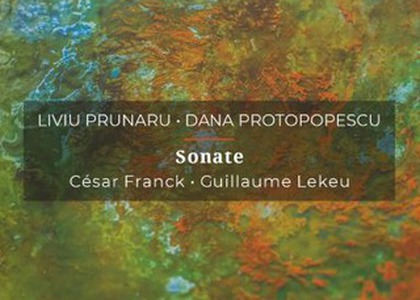
Violinist Liviu Prunaru and pianist Dana Protopopescu – Romania of Musical Values, December 1st, 2025
A disc recorded by violinist Liviu Prunaru and pianist Dana Protopopescu, emblematic musicians of Romanian performance art over recent decades, who form an exceptional duo with a remarkable international career. Their album, which includes special recordings made in 2013 at the Radio Hall, marks 135 years since the death of César Franck and 155 years since the birth of Guillaume Lekeu, offering listeners the opportunity to hear the Violin and Piano Sonatas by these essential composers of late Francophone Romanticism.
Liviu Prunaru has carried out an impressive career as concertmaster of the prestigious Royal Concertgebouw Orchestra of Amsterdam and has appeared as a soloist with renowned ensembles such as the London Symphony Orchestra, the Royal Philharmonic Orchestra in London, the Radio National Orchestra, and the Lausanne Chamber Orchestra. Over the years, he has enjoyed a close collaboration with Dana Protopopescu, a pianist who has distinguished herself both as a soloist and as a chamber music partner of top-level artists, and who has received the Musical Critics' Award in Bucharest twice.
The album released in November 2025 by Liviu Prunaru and Dana Protopopescu is the third disc by the two musicians to appear at Casa Radio Publishing House. On their previous albums, they presented recordings of the complete Violin and Piano Sonatas by Beethoven and Grieg, praised by critics and the general public alike for their interpretative refinement.
Violinist Liviu Prunaru offered us an interview, speaking about this disc:
How would you describe your collaboration with pianist Dana Protopopescu over the years, and especially for this album?
Extraordinary and fruitful, in two words! More broadly speaking, I can say that we have always felt extremely comfortable together on stage. Although we did not play together at the Queen Elisabeth Competition, that is where we nevertheless got to know each other: Dana performed with the first prize, and I played with another pianist. However, at a later meeting at the Romanian Cultural House in Brussels, we were paired together somewhat by chance, and after reading through the Third Sonata, we realized that we matched each other very, very well. From that moment on, we began giving many concerts together, both in Romania and especially in Belgium, as well as in other countries. We also played together in Luxembourg and Amsterdam. From this collaboration many masterpieces have emerged for us, recordings not necessarily official ones made by radio, but recordings I made on my phone and which I still listen to with great, great pleasure.
I remember the complete cycle of Beethoven sonatas. That was truly deep work, and something we still enjoy to this day. I listen to them with great pleasure. So I am eagerly looking forward to hearing the new disc as well, to see how it turned out.
The new album includes César Franck's Sonata in A major and Guillaume Lekeu's Sonata in G major. How would you characterize these works?
Rather than characterizing them, I will tell you what these sonatas mean to me personally. It feels more personal-my closeness to these works. First of all, they represent a legacy, as you mentioned, from the French sphere, which I would call Franco-Belgian, because both composers have also been considered Belgian. That is why this project was conceived under this sign: two Belgian sonatas, recorded by two Romanian-Belgians, since we both also hold Belgian nationality.
Why these sonatas? I would like to speak first about Lekeu's sonata, because it is the lesser known of the two. It represents another legacy, this time coming from the Menuhin Academy, which impressed me enormously from two points of view. First, when I heard it for the first time, performed by my idol Arthur Grumiaux - I was deeply impressed. Later I realized that it was again a legacy coming from the Menuhin Academy. Why? Because it was performed very often by my former teacher, Alberto Lisi, and also by Menuhin himself. I remember that when I played it for Mr. Lisi, he would say, "Look, this is how Menuhin did it here!" So it is a continuation, a spiritual legacy, coming directly from Menuhin. And whenever I played this sonata in Belgium, in addition to the fact that it resonated beautifully there, I evoked these images and memories coming from the Menuhin Academy, where I studied throughout my youth.
Franck's sonata, as is well known, is a very famous piece that appears frequently on concert stages all over the world. I always wanted to play it, and it was not from the very beginning that I managed to give it its final form. Several good years had to pass before I truly understood what he wanted to express with this sonata. My collaboration with Dana helped me discover many nuances.
Dana Protopopescu has enormous experience collaborating with violinists, because for many years she was the official accompanist of the Queen Elisabeth Competition in Brussels. You can imagine that she has played all these pieces many times, with many different musicians, and she was kind and generous enough to pass on some of this knowledge to me and help me understand the work a little better.
I hope that in the end we have managed to offer this final form, after many years of playing together, during which we often included these two sonatas in our programs. I believe the last time we performed Lekeu's sonata was at the Athenaeum, and Franck's, I think, was last performed in Belgium.


