



Disk of 2024
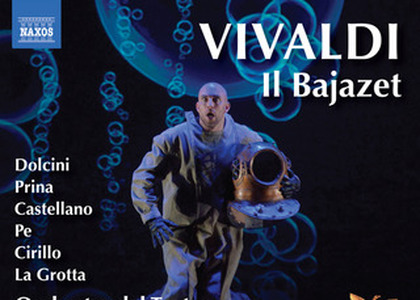
Antonio Vivaldi – Baiazid – Opera, a world, February 15th, 2026
Antonio Vivaldi - Baiazid, featuring Renato Dolcini, Sonia Prina, Loriana Castellano, Raffaele Pe, Lucia Cirillo, Valeria La Grotta; basso continuo: Alberto Busettini and Nicola Lamon (harpsichord), Francesco Ferrarini (cello); Orchestra of the Teatro La Fenice in Venice; conductor Federico Maria Sardelli. Performance recorded at the Teatro Malibran in Venice.
For this edition, I have chosen an opera written for a… carnival. In 1735, Antonio Vivaldi was commissioned to compose a work for the opening of the Verona Carnival. We are listening to it in a recording released by Naxos on January 16, an album included in the Discs of the Year 2026 project, which we present here in its premiere broadcast.
The title of the opera is Baiazid. Beautiful music (with the well-known Vivaldian effervescence), performed to a high standard. It is the disc release of a performance that took place on June 9th, 2024, at the Teatro Malibran in Venice, the second home of the famous Teatro La Fenice.
Baiazidis a mature opera by Vivaldi, written in three acts, with Sultan Bayezid I as its protagonist. The libretto was written by Agostino Piovene and is based on the tragedy Tamerlane, or the Death of Bayezid by Jacques Pradon. The score may be considered a pasticcio, as approximately 80% of it belongs entirely to Vivaldi. The pasticcio was fashionable and well appreciated; at that time, it was perfectly natural for a composer to quote himself or to use musical pieces written by other composers, adapting the text. For Baiazid, aware that other musicians were in vogue at the time, Vivaldi chose to follow the trend by including several arias by younger composers: Johann Adolph Hasse, Geminiano Giacomelli, and Riccardo Broschi. We also know that Vivaldi composed in their entirety the musical parts for three characters-Baiazid, Asteria, and Idaspe; you will recognize his style, as the arias of these characters are the most beautiful and best showcase the soloists' voices. Naturally, to ensure overall unity, Vivaldi composed the recitatives for all the characters.
A work of restoration was undertaken by the conductor of this production, Federico Maria Sardelli, who inserted several arias composed by Vivaldi that he considered suitable for the score (including from a stylistic point of view), as some of the original ones have not survived in manuscript form. Thus, he ensured the fluency of the musical discourse. Principal conductor of the Orchestra of the Accademia Barocca di Santa Cecilia in Rome, Sardelli is also known and appreciated for bringing previously unpublished works by Vivaldi back into the international repertoire and for making their premiere recordings; he is also a member of the Istituto Vivaldi and is responsible for updating and completing the catalogue of works by the Venetian composer. The score on which this recording is based, published in 2019, belongs to the critical edition prepared by Bernardo Ticci.
The solo cast is somewhat heterogeneous, but overall the voices are well chosen for this score.
In the title role of Sultan Bayezid I: Renato Dolcini, a bass-baritone with a dark timbre that lends dramatic intensity to his portrayal - a father who compellingly conveys either fury or despair, depending on the context.
Asteria, the Sultan's daughter, is portrayed by mezzo-soprano Loriana Castellano - a sumptuous, dark-hued voice with beautiful coloratura and a generously rich lower register. Her voice suits both incisive passages and moments of touching lyricism.
The contralto Sonia Prina sings Tamerlane, the Mongol-Tatar leader who defeated Bayezid I; her voice has a dry sonority that occasionally clashes, with an interpretative style that does not fully appeal to me.
The refined countertenor Raffaele Pe is Andronic, the lovestruck Greek prince, with a lyrical voice and a superb contralto range. The large leaps and coloraturas in the upper register do not always favor him. Admirably, however, he delivers the Act III aria with remarkable theatricality - truly spectacular!
The prince's advisor is Idaspe, a role sung by light-lyric soprano Valeria La Grotta - the sunniest voice in the cast, with coloraturas executed impeccably.
Irene- the Princess of Trebizond, who had been chosen as Tamerlane's bride, but upon going to meet him discovers that he has changed his choice and is now asking for Asteria's hand - is portrayed by mezzo-soprano Lucia Cirillo. In Act I, she faces a fiendishly written aria that takes us on a roller-coaster of wide leaps and expertly executed coloraturas, shaping an aggressive character. In Act II, you will be surprised by another facet of both this character and this voice - long, legato phrases without vibrato that convey Irene's inner anguish, revealing the sweetness in Lucia Cirillo's metallic timbre.
The orchestra is that of the Teatro La Fenice in Venice, an energetic and experienced ensemble that performed the opera in the spirit of the Baroque style, reflecting a strong historical understanding. One important detail: Federico Maria Sardelli carefully arranged the continuo section (two harpsichords and a cello) in accordance with the practices of Venice at the time and particularly with Vivaldi's own compositional style. Moreover, the conductor did not include oboes or bassoons in the orchestra, since these instruments are not specified in the score. Therefore, we have a recording with an instrumental ensemble that is historically accurate.


