


Disk of 2024
Antonio Draghi - Das verwunschene Glück (The Enchanted Happiness ) - Opera, a world, 8th of March 2026
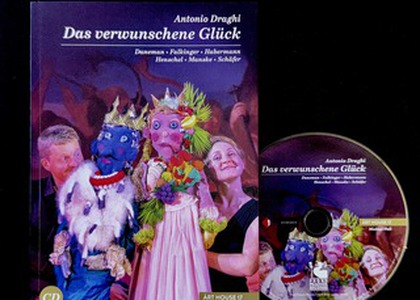
Antonio Draghi - Das verwunschene Glück (The Enchanted Happiness) with: Sophie Daneman, Johanna Falkinger, Julian Habermann, Dietrich Henschel, Anna Manske, Markus Schäfer; Instrumental orchestra "Ārt House 17" conducted by Michael Hell (Performance recorded on June 22nd, 2025 in Graz).
Premiere album released on December 6th, 2025
I present to you The Enchanted Happiness (Das verwunschene Glück, originally named Gl'incantesimi disciolti) by Antonio Draghi, a Baroque opera written in the honour of the wedding of Emperor Leopold I of the Holy Roman Empire with his bride, Claudia Felicitas of Austria. The album got released by Proud Peacock Records on December 6th, 2025 and got included in the 2026 Albums of the Year project; we are delighted to listen to this album for the first time on the radio. The album comes with a booklet the size of a book, which it provides all the information worth reading in great detail. It was printed in honour of the show that took place on June 22nd, 2025 at the splendid Baroque Eggenberg Palace in Graz, Austria (the place where the imperial wedding took place over three centuries ago).
An event of great historical importance took place in Graz in 1673, namely the wedding of Leopold I of Habsburg. The Habsburgs were on the verge of extinction, and it would've ended like if Leopold weren't to have any descendants: his first wife died while she was pregnant, while Austria had two major enemies, namely the Ottoman Empire and France. As a result, everyone went into an emergency for a new wife for the emperor to marry. As per the customs of those times, a wedding at Vienna's imperial court was impossible due the imposed mourning period for Leopold's late wife that was of exactly one year (and was not completed yet at that moment), so the wedding was lavishly celebrated in Graz. The entire court shed their mourning attires and travelled to the province in order to celebrate the union. The Italian composer Antonio Draghi was tasked with the creation of an opera for the wedding. The original title was Gl'incantesimi disciolti, and the libretto was written by Nicolò Minato. There is also an aria that was composed by the Emperor himself for the character Happiness, who is supposed to be a nod to the bride - of course, there is no coincidence that the name is inspired by the Empress' real name. The Emperor and Empress were very fond of this opera, as they shared a passion over music. Unfortunately, although they had a happy marriage, the union lasted only three years due to the Empress' untimely death of tuberculosis at 23 years old. The subject of the opera is subtle and it comes in an allegorical form, while the characters are equally subtle and they pay homage to figures from the imperial circle, as well as the intrigues that took place throughout the processes of finding a new empress and planning the wedding. We have heroes and villains alike, with the latter having Happiness bewitched, only for Reason to step in and break the spell. The orchestral score recently got reconstructed by Michael Hell, the musical director of the current version of the opera, which it finally got recorded for the first time. As a true opera-ballet, the masterpiece used to include dance recitals composed by Johann Heinrich Schmelzer, but the original pieces got lost to time. Thus, Michael Hell chose to patch up these missing links with other creations signed by Schmelzer in addition to pieces signed by composers who were performing at the palace within the same period, namely Antonio Bertali, Heinrich Ignaz Franz Biber, Philipp Jakob Rittler, and Giovanni Valentini. The decision to perform the opera in German was due to the desire for a better understanding of the text; the libretto was rewritten by Thomas Höft based off of an Italian translation dated from the year that the wedding took place. The spectacular production celebrated four centuries of existence for the Eggenberg Palace, which it happened last year.
The cast brought together young soloists, as well as artists who are at the twilight of their careers. The most diaphanous and brightest voice belongs to the Austrian soprano Johanna Rosa Falkinger playing Happiness. The British soprano Sophie Daneman manages to impress with her vocal rawness and elegant interpretation as The Lie - which is the only character with a score that also features arias in Italian. Envy and Reason are two versatile roles performed by the Austrian mezzo-soprano Anna Manske, who ends up being theatrical in the former, and expressive, as well as refined in the latter. The German tenor Julian Habermann embodies Affection with nobility. At the other end of the spectrum, Selfishness is embodied by the German tenor Markus Schäfer in a comical, deliberately ridiculous, and a particularly theatrical manner. The German baritone Dietrich Henschel makes the cast complete by playing the role of Good Advice. The singers were accompanied by the "Ārt House 17" instrumental ensemble, which put the score in the spotlight under the careful guidance of Michael Hell's baton as the conductor and artistic director of the ensemble, who also accompanied the recitatives by playing the harpsichord.


