



Disk of 2024
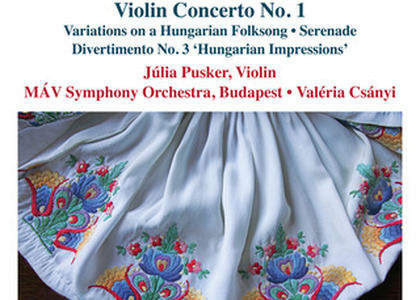
Budapest MÁV Symphony Orchestra, conductor Valéria Csányi, CD Review, March 12th, 2026
Leó Weiner, Violin Concerto No. 1, Op. 41 in D major (soloist Júlia Pusker) and Divertimento No. 3, Op. 25 "Hungarian Impressions"
In 2016 the Budapest MÁV Symphony Orchestra, conducted by Valéria Csányi, launched an extensive recording project with the Naxos label, aiming to record the complete orchestral works of Leó Weiner. In December last year, the fourth volume of this series was released, a disc featuring the Violin Concerto No. 1, the Variations Op. 30, the Divertimento "Hungarian Impressions," and Serenade Op. 3 by this prolific composer who lived between 1885 and 1960. He was one of the most important music teachers in Hungary, teaching at the Budapest Academy of Music, and among his students were violinist Tibor Varga and conductors Antal Doráti and Georg Solti. His compositions are distinguished by lyrical qualities, richly romantic orchestration, and the influence of Hungarian folk music.
This disc includes the Violin Concerto No. 1 in D major, written in 1958, the composer's last major work, in fact an orchestral arrangement of the Sonata for violin and piano Op. 9, composed in 1911.The soloist is Júlia Pusker,a 35-year-old violinist who gained international recognition after becoming a laureate of the Queen Elisabeth Competition in Brussels in 2019. The musician performs on a valuable Stradivarius instrument dating from 1714.
From the same album, recorded between 2019 and 2024, we also propose Divertimento No. 3 "Hungarian Impressions" for symphony orchestra. The composer Leó Weiner wrote about this score: "Its themes come from a collection of folk pieces preserved in the Ethnographic Museum in Budapest. The composition comprises five short movements, linked like the parts of a suite. The first movement includes three cheerful themes and is structured as a rondo. It is followed by a slow movement in parlando style, opening with a violin solo answered by the full orchestra. The third movement has a strophic structure and a humorous character, preceding a slow Ballad with theme and variations connected in the form of a chaconne. The final movement is based on a single theme that gradually intensifies from piano to fortissimo." The captivating tonal colors, vivid rhythms of the fast movements, and the stylistic diversity of the piece are rendered in an exemplary interpretation by the Budapest MÁV Symphony Orchestra under the baton of conductor Valéria Csányi.


