



Disk of 2024
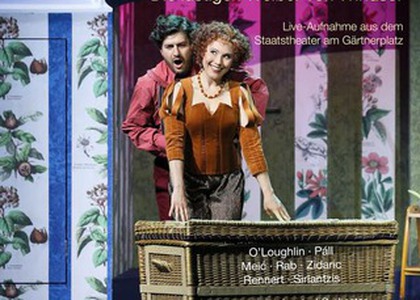
Otto Nicolai – The Merry Wives of Windsor – “Opera, a world,” April 5th, 2026
Otto Nicolai - The Merry Wives of Windsor - "Opera, a world," April 5th, 2026
Otto Nicolai - The Merry Wives of Windsor featuring: Timos Sirlantzis, Juan Carlos Falcón, Lukas Enoch Lemcke, Angelika Sedlmeier, Andreja Zidaric, Sophie Rennert, Gyula Rab, Matija Meić, Levente Páll, Jennifer O'Loughlin; The Choir (prepared by Pietro Numico), Children's Choir (prepared by Verena Sarré) and Orchestra of the Gärtnerplatz State Theater in Munich, conductor Rubén Dubrovsky. Performance recorded on April 26th, 2024 at the Gärtnerplatz State Theater.
Premiere album, released on January 16th, 2026
I invite you to a performance! The most recent recording of the opera The Merry Wives of Windsor was released by Gramola on January 16th. It is the premiere performance of a new production from the Gärtnerplatz State Theater in Munich, recorded on April 26th, 2024. The record label chose to keep the applause throughout the performance, so we can feel as if we are sitting in the theater. We will listen, for the first time, to this album included in the "Records of the Year 2026" project.
Prolific across all musical genres and also the author of musicological studies, the German composer Otto Nicolai distinguished himself as a conductor as well, being one of the founders of the Vienna Philharmonic. His most acclaimed work remains the comic-fantastical opera The Merry Wives of Windsor, completed in 1849-the year of his death. Nicolai died of a stroke just two months after the premiere, at only 38 years old. He did not have time to enjoy the success of his opera, which toured across Europe, nor two major appointments-music director of the Berlin Opera and member of the Royal Prussian Academy of Arts (the latter on the very day of his death).
Written as a singspiel-a form already out of fashion in the Romantic era-the opera blends Italian influence, evident in its charming and captivating melodic lines, with the rigor of the German school, reflected in its elegant orchestration. The libretto, by Salomon Hermann Mosenthal, is based on Shakespeare's comedy of the same name, which also inspired Verdi's famous opera Falstaff. Unlike the play and Verdi's work, Nicolai's opera is not widely regarded as equally humorous, which has led to the score being especially appreciated in German-speaking regions, where it is frequently staged. For this new production, the spoken texts were significantly reduced and modernized, with added gags to appeal to contemporary audiences. On the recording, we will not hear the dialogues-only the musical numbers (or perhaps just a few words remain?).
After a large, delightful overture that introduces musical motifs heard throughout the three acts, a strong solo cast takes the stage: American light lyric soprano Jennifer O'Loughlin as Frau Fluth (counterpart to Alice Ford) offers a charming interpretation; Austrian mezzo-soprano Sophie Rennert as Frau Reich (Meg Page's counterpart) provides a fine timbral contrast to her "neighbour", with beautiful low-register sonorities (her ballad opening the final act-excellently performed-seems to be inspired by Wagner's The Flying Dutchman); Hungarian bass Levente Páll, born in Romania, portrays Sir John Falstaff with an impressive vocal range, though perhaps a bit too elegant for the character; Croatian baritone Matija Meić as Herr Fluth (Ford's equivalent) impresses with a solid lower register and refined phrasing, especially in his duet with Falstaff; Greek bass-baritone Timos Sirlantzis as Herr Reich (Page's counterpart) balances the male roles with a necessary contrast to Meić; Hungarian lyric tenor Gyula Rab is an ideal choice for the young lover Fenton; Slovenian coloratura soprano Andreja Zidaric as Anna Reich (Anne Page's counterpart) is graceful and expressive; Spanish tenor Juan Carlos Falcón and German bass Lukas Enoch Lemcke form a delightful duo as Spärlich (Slender's counterpart) and Dr. Cajus; and Austrian actress Angelika Sedlmeier appears as Die Muhme.
The Choir (prepared by Pietro Numico) and Children's Chorus (prepared by Verena Sarré)-ensembles with an essential contribution to this score (notable contrasts in the final act, from the lyrical "O, sweet moon" to the frenetic dance)-belong, along with the energetic Orchestra (at times perhaps too loud, nearly covering the voices), to the Gärtnerplatz State Theater in Munich.
At the rostrum is Rubén Dubrovsky, the institution's chief conductor starting with the very season in which this performance took place. Under his baton, the opera unfolds at a lively, brisk tempo that keeps us engaged, while also offering delicately rendered passages that allow the soloists the freedom to shape the refinement required in lyrical moments.


