



Disk of 2026
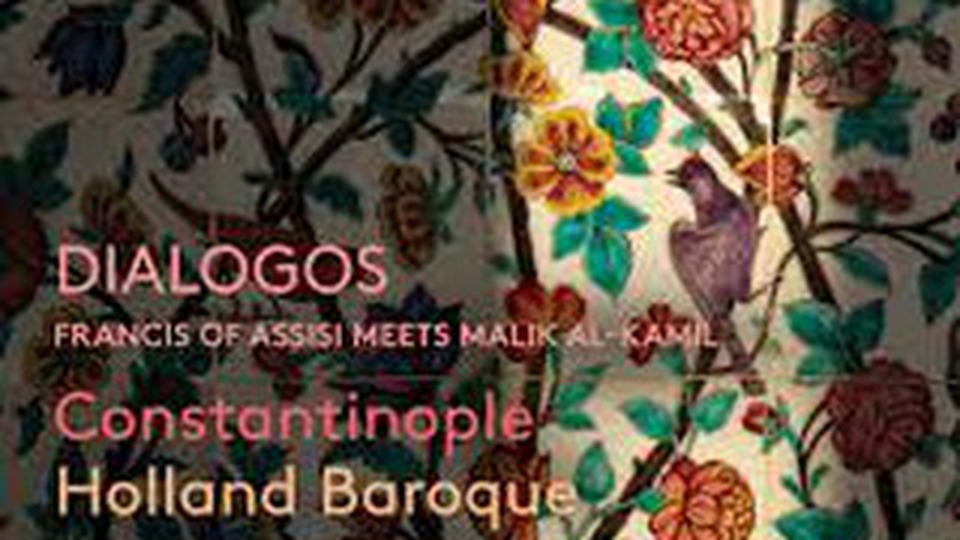
"Constantinopole & Holland Baroque" Ensembles - Dialogos (Francis of Assisi meets Malik al-Kamil) - CD Review, May 14th, 2026
The ensembles "Constantinopole & Holland Baroque" - Dialogos (Francis of Assisi meets Malik al-Kamil) - CD Review, May 14th, 2026
Works by Didem Bașar, Judith and Tineke Steenbrink, Dimitrie Cantemir, Ali Ufki, Kiya Tabassian.
Premiere album, released on March 31st, 2026
The entirely original album "Dialogos" created by the ensembles "Constantinopole" of Montreal and "Holland Baroque" - the latter known for experiments that cover apparently antagonistic styles - from Bach to gospel music, jazz and Gregorian chant. This time, the music proposed by the two ensembles is inspired by a historic meeting in 1219 in Egypt, between Saint Francis of Assisi and Sultan Malik al-Kamil, during the Fifth Crusade. Before discussing the music, I evoke this episode described not as a clash between institutions and religions, but as a meeting between two personalities open to dialogue. Saint Francis of Assisi then went to the Muslim camp to preach peace and Christian values, being received by the sultan with respect and engaging in dialogue for several days in a row. We don't know if this event brought peace between Christians and Muslims, but it has remained a symbol of dialogue between religions over the centuries.
Based on this historical event, the "Constantinopole" ensemble of Montreal and "Holland Baroque" envisioned a musical journey inspired by old manuscripts such as Laudario di Cortona, dating back to the second half of the 13th century - the oldest codex in the Italian language - and by the works of the Polish Wojciech Bobowski, known as Ali Ufkî, a dragoman (which means translator and musician in the Ottoman Empire). He translated the Bible into Turkish, composed a collection of Psalms for the Turkish modal system, and other antalogies of music. He is a character six decades younger than Dimitrie Cantemir, whose name appears in the summary of his album. These sources of the past are, however, reshaped into new compositions by Judith and Tineke Steenbrink, the two sisters who lead the ensemble "Holland Baroque". Therefore, we're dealing with other forms of dialogue between civilizations - the Persian, Turkish, and the one of the European Baroque, but also between the old music and the contemporary one in this album released on March 31st, under the Pentatone label.
This eclectic musical discourse that has the gift of surprising us is truly unique. We are carried through a labyrinth of sound that is now undulating according to a Middle Eastern profile, now returning to a composition with an obvious medieval and contemporary European influence. This is because, beyond the already mentioned sources of inspiration, the authors of the music and arrangements are the members of the two ensembles themselves. Constantinopole is well-known to the Canadian public, a group led by Kiya Tabassian - composer, vocalist and setar performer (a traditional Persian stringed instrument resembling a lute). He is joined by Didem Başar - a kanun performer (an instrument of Turkish origin similar to the hammered dulcimer), and Patrick Graham - percussion (whose sonic palette is extremely diverse). Meanwhile the ensemble "Holland Baroque" is based on a formidable string section, transverse flute, bassoon, lute, harpsichord, and organ, led by the two composer sisters - Tineke and Judith Steenbrink.
This intercultural dialogue between the Orient and The West is fascinating, with languages easily and casually mastered by all the musicians involved in this project. Starting from a historical encounter between two illustrious figures, Saint Francis of Assisi and Sultan Malik al-Kamil, the musicians build a universe of peaceful coexistence between two antagonistic civilizations. And returning to the two Dutch sisters, everything becomes possible musically speaking. "It's about the art of the rhetoric - how you convince your audience of the truth of what you state," says Judith Steenbrink in an interview, or according to Tineke Steenbrink, "it's a combination of being highly disciplined in performance and absolutely free in equal measure. These two aspects are so different - the complete control of the craft and the freedom. The resulting effect? You feel like you can fly and this makes you happy".
Translated by Bianca Maria Costescu,
University of Bucharest, Faculty of Foreign Languages and Literatures, MTTLC, year I
Corrected by Silvia Petrescu


