



Disk of 2026
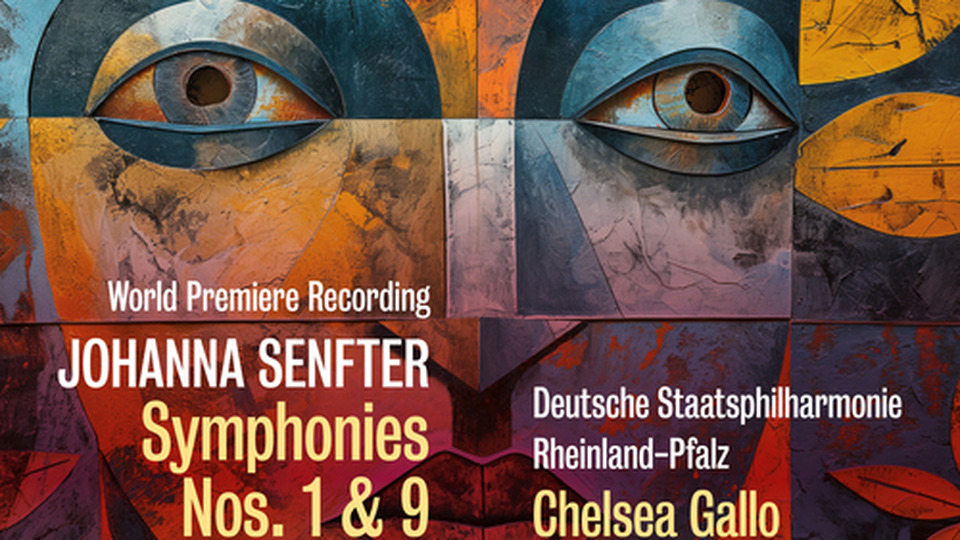
Johanna Senfter - Symphonies Nos. 1 and 9 - Music Box, May 18th 2026
Johanna Senfter - Symphonies Nos. 1 and 9 - Music Box, May 18th 2026
An album featuring two symphonies recorded for the first time in the world, both composed by the German composer Johanna Senfter, recorded by the Staatsphilharmonie Rheinland-Pfalz Orchestra, led by the American conductor Chelsea Gallo, a disc released by the Capriccio label on May 15th.
Recently, we have been discovering more and more works by female composers, as interest in their music continues to grow. Keeping an axiological scale of values, we can objectively acknowledge that many valuable works have been unjustly consigned to oblivion.
This is also the case for Symphonies Nos. 1 and 9 by Johanna Senfter.
But who was Johanna Senfter, a name practically unknown to us?
She was born in 1879 and passed away in 1961, she was, for instance, a contemporary of George Enescu. Between 1908 and 1910, she studied with Max Reger, who reportedly regarded her as a great talent and one of the finest musicians he had ever trained. Johanna Senfter, a shy and very reclusive composer, left behind a set of approximately 135 works, including 9 symphonies, which fell into complete obscurity after her death, even though the scores remained in the archives of the Cologne University of Music. Only recently have efforts been made to bring to light her music which is rooted in the realm of consonance, featuring expensive sonic architectures and a certain compositional inspiration.
Let's take Symphony No.1 as an example, composed in 1914. In this symphonic work, we can recognise echoes of Bruckner's and Max Reger's music, with a dense orchestral texture and an emphasis on harmonic development.
Between 1914 and 1949, the years in which Johanna Senfter composed her first and her last symphonies, we can trace the evolution of the German composer's musical language characterized by an intensification of expression and dramatic tension, all while remaining within the broad realm of tonality and consonance. Clearly, after two world wars, the vivacity and hope of the First Symphony give way to a more mature outlook, one that continues to raise questions about the meaning of life.
This is the impression left on me by Johanna Senfter's final symphony, Symphony No. 9.
Translated by Maria-Lorena Vasilescu,
University of Bucharest, Faculty of Foreign Languages and Literatures, MTTLC, year I
Corrected by Silvia Petrescu


