



Disk of 2026
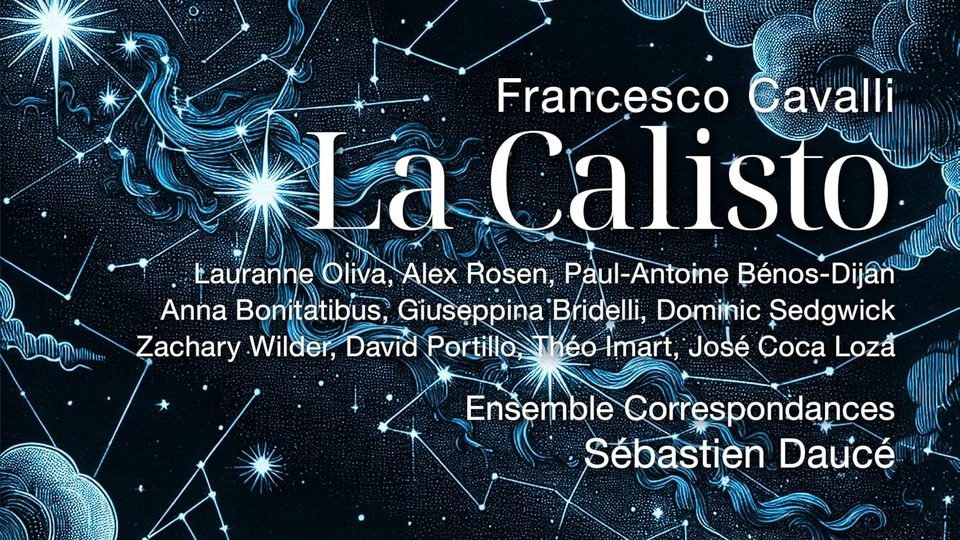
Francesco Cavalli - La Calisto - Opera, a World, September 20th 2026
Francesco Cavalli - La Calisto - Opera, a World, September 20th 2026
Francesco Cavalli - La Calisto, featuring: Lauranne Oliva, Alex Rosen, Paul-Antoine Bénos-Djian, Anna Bonitatibus, Giuseppina Bridelli, Dominic Sedgwick, Zachary Wilder, David Portillo, Théo Imart and José Coca Loza. The Correspondance Ensemble, conducted by harpsichordist and conductor Sébastien Daucé.
Premiere album, released on May 15th 2026. Performance recorded in July 2025 at the Aix-en-Provence Festival.
For this edition, we have chosen to listen to ''La Calisto'', Francesco Cavalli's best-known opera, as on May 15th Harmonia Mundi released an album bearing this title, featuring a recording of a performance given in July 2025 at the Aix-en-Provence Festival. We are listening to this album for the first time as part of the Albums of the Year 2026 project. I would like to point out that this is the opera's fourth commercial recording, the first dating back to 1971. In that remarkable cast, the title role was performed by the late soprano Ileana Cotrubaș.
But who was Francesco Cavalli? His name was Pier Francesco Caletti Bruni, and he was born in 1602 in Crema, a town in Lombardy under the rule of the Serenissima (the Republic of Venice). Federico de Cavalli, a Venetian nobleman, had once served as governor of the town. Having recognised the extraordinary talent of the young Francesco, he took him under his protection. The composer's name first appeared in 1617, when it was entered in the register of St Mark's Basilica as "Pietro Francesco Bruni Cremasco". His musical education was overseen by Claudio Monteverdi, who was, at the time, the maestro di cappella of the Venetian basilica. In 1640, a new entry appeared in the same register, identifying the young composer as "Francesco Caletti, detto Cavalli". He had adopted this surname as a gesture of gratitude towards the nobleman without whom he might never have achieved fame. From that year onwards, Cavalli also served as organist at the basilica. Until his death in 1676, he pursued a dual career in Venice, working both as an opera composer and as a church musician.
La Calisto is an opera comprising a prologue (a characteristic allegorical element of the Baroque era) and three acts. Cavalli composed it in 1651 to a libretto by Giovanni Faustini, based on Book II of Ovid's Metamorphoses. Premiered in Venice that same year, the opera did not enjoy the success necessary to secure its lasting place on the stage. However, it was restored to the international repertoire in the second half of the previous century.
This new recording (and I would once again like to emphasise how wonderful it is to be able to enjoy this magnificent music without being distracted by the staging) brings several musical innovations. Indeed, no two recordings are alike. This time, the work is conducted by Sébastien Daucé, artistic director and founder of the Correspondance Ensemble, established in France in 2009. Speaking about the score, Daucé describes it as a combination of fable, comedy and tragedy, a genuine Venetian jewel that takes us on an emotional roller coaster under the enchanting spell of its captivating arias. Sébastien Daucé has made several cuts in the work, pointing out that Cavalli himself had marked some passages for omission in the manuscript. He has also introduced subtle additions to the orchestration, including in the accompaniment of certain recitatives, and incorporated several sinfonias (some of which were mentioned in the libretto but absent from the score). These instrumental pieces, serving as interludes, have been drawn from the works of Cavalli and his contemporaries in northern Italy: Marini, Legrenzi, Rossi, Arrigoni, Merula and Valentini. The opera concludes with one such addition: a Passacaglia by Biagio Marini. As a result, the ending is entirely different. Gone is the apotheosis in which the transformation of the nymph Calisto into a constellation provided a radiant conclusion. Instead, we have a version much more deeply focused on psychological drama, emphasising the abuse inflicted upon her by the gods. This aspect is also reflected in the staging, where Calisto fatally stabs Jupiter as an act of revenge. Thus, the opera comes to an end on a funereal note.
Overall, the cast is good and consistent in quality, although there are also several absolutely splendid voices.
The French-Catalan soprano Lauranne Oliva gives a wonderful interpretation of the title role, Calisto. She captivates us with her crystalline, sweet voice, conveying the character's vulnerability with remarkable sensitivity.
In the roles of Jupiter and Jupiter disguised as Diana, we find American bass Alex Rosen. He is authoritative in his portrayal of the god and introduces ironic inflections in the scenes performed in disguise. He possesses a warm, pleasant voice, with an excellent upper register.
Italian mezzo-soprano Anna Bonitatibus portrays Eternity in the Prologue and Juno in the opera itself. In the latter role, we find her either cutting and incisive or deeply introspective. She portrays a wife consumed by jealousy, the element that lends the drama its intensity.
Italian mezzo-soprano Giuseppina Bridelli takes on the role of Diana. She is another artist who skilfully explores a variety of emotional states: languorous in the scenes with Endimione and aggressive in those with Calisto.
There are also two outstanding French countertenors. Exceptionally sensitive, with a dark-hued, lyrical voice, Paul-Antoine Bénos-Djian portrays Endimione. The magnificent sopranist Théo Imart delights us with his brilliant voice and luminous vocal production. He possesses an astonishing soprano register and can be heard as Destiny (in the Prologue) and subsequently as the Satyr.
American tenor Zachary Wilder performs the role of the nymph Linfea in travesti (she provides the comic element throughout the opera), and another American tenor, David Portillo, takes on three roles: Nature (in the Prologue), Pan and one of the Furies.
British baritone Dominic Sedgwick completes the cast harmoniously in the role of Mercury, the son of Jupiter, and Bolivian bass José Coca Loza performs the music for two roles: Silvano and another Fury.
Under the direction of Sébastien Daucé, the Correspondance Ensemble sustains the entire drama, imbuing the musical passages with tension, melancholy and funereal undertones, while also providing moments of jubilation.
Translated by Maria-Lorena Vasilescu,
University of Bucharest, Faculty of Foreign Languages and Literatures, MTTLC, year I
Corrected by Silvia Petrescu


