



> Interviews
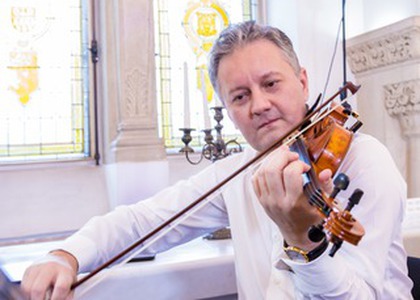
Interview with Dr. Remus Nica, member of the Doctors’ Orchestra
The Doctors' Orchestra "Dr. Ermil Nichifor" and its guests, together with the Romanian National Choir, will perform on Saturday, December 6th, 2025, the fifth edition of the concert "Harmonies of Hope" at the Romanian Athenaeum.
Since 2022, the concert "Harmonies of Hope" has been supporting oncology patients. What has been the journey of this charitable mission?
We started in the same year and at the same time as the law dedicated to cancer patients. We wanted to signal, through the appearance of this event, first of all that the state cares for oncology patients in Romania, and secondly, to draw attention to our duty, as healthy people, to care for oncology patients. As doctors-especially us-through the empathy, love, and ultimately the life we offer each patient we treat, because we give a part of our soul and our life to every one of them, beyond the everyday treatments, we wanted to also offer psychological support, to try to brighten their faces through music.
Another purpose of this event was to draw the population's attention to the fact that we must care more for our fellow human beings, for those who suffer. It is not enough to expect medical staff to care for patients; you must also get involved and offer support. Only in this way can we move forward, only in this way can we help these patients. This is the message the event wanted to convey, and that is why it appeared.
We thought that doctors should sing for their patients.
What is the message of this year's concert?
At the fifth edition, which will take place on December 6 at the Romanian Athenaeum, doctors from 5-6 university centers-Bucharest and five others-will be on the Athenaeum stage. The idea is that together with doctors from all over the country, we stand by our patients. The message is one of unity and love toward patients and toward our fellow human beings.
What other institutions or organizations are involved in this project?
The first and most substantial financial support, we hope, will come from the Government of Romania, with whom we have a partnership. I said "we hope" because we have not yet managed to receive financial assistance, but we are extremely optimistic that they will eventually help us. Other partners who have been with us throughout all these years and who participate in the treatment of oncology patients are the Romanian College of Physicians and Carol Davila University of Medicine and Pharmacy-institutions that oversee the education and coordination of physicians in Romania, particularly in Bucharest.
It seemed very natural and normal that these institutions would stand with us. They have always welcomed us with open arms and collaborated beautifully with us.
Also, the Romanian Athenaeum and the Bucharest National Opera, led by Maestro Daniel Jinga-who is also the conductor of the event together with Maestro Iosif Ion Prunner from the George Enescu Philharmonic-have been with us for all the previous editions.
Together with them, the Romanian National Choir was built and developed alongside us, with the most beautiful voices-yet another musical entity associated with our event.
A number of private entities are also with us and have supported us throughout the years, and we hope for fruitful collaboration in the future as well.
This year's edition of the Harmonies of Hope concert will feature renowned musicians such as soprano Cellia Costea, violinist Valentin Șerban, tenor Daniel Magdal, bass-baritone Florin Ganea, and pianist Alexandru Burcă. How did you decide on this artistic lineup?
I would add a surprise you will discover on the Athenaeum stage: Ștefan Cazacu.
How did we reach these decisions? First of all, Cellia Costea is an extraordinarily appreciated voice on stages around the world. She is Romanian by origin. I found it beautiful and important for her to join us, and this wonderful person accepted our proposal with open arms, which for us was essential from a human standpoint. Artistically, there is no way to thank her enough for choosing to be with us-she is such a major musical personality.
Tenor Daniel Magdal will also join her on stage. He is another fabulous voice, also Romanian, with modesty, elegance, and love for people such as only true values possess.
We also have the voice of Florin Ganea, one of the finest bass-baritone voices, and in my opinion, a unique voice in Romania-a person I hold in very high regard.
As for instrumentalists, the renowned violinist Valentin Șerban-celebrated both in Romania and abroad-deserves a place at our side in this event; he is an extraordinary performer and a person with a beautifully warm soul.
At the piano, Maestro Alexandru Burcă, who has been with us throughout all these years; he is also an incredible talent and a wonderful person.
And Ștefan Cazacu appears as a surprise. He has been with us in previous editions as well-he has a great soul… these will be the artists joining us, and we thank them wholeheartedly.
How was the musical program for this edition created?
After speaking individually with each artist, I tried to build it on the pattern of the previous concerts. "Harmonies of Hope," as an event, has a specific structure. In the first part, we try to suggest-or at least guide you to identify during the performance-the story of the cancer patient. Starting with the first musical piece, the moment of discovery, the shock the patient experiences when hearing the diagnosis, signaled this year through Verdi's composition, the Requiem "Dies irae." That is how we will open the program.
Then comes the silence that falls when the person is confused, not yet knowing what to do, left speechless. We will continue with "Coro a bocca chiusa" from Puccini's Madame Butterfly. And so, we pass through the emotional states of the cancer patient until, ultimately, we reach the sunny clearing where life and light prevail and our patient is healthy. This year we will end victoriously with the march "Pomp and Circumstance", a lively, beautiful, life-filled piece by Elgar.
In the second part of the program, we aim to bring our audience into a winter atmosphere, with waltzes, polkas, carols, and we will begin with The Skaters' Waltz by Waldteufel.
We try to create an atmosphere so that when people leave, their hearts will be singing, and they will be truly happy.
How do the doctors involved in this project perceive the role of music in the lives and recovery of patients?
The role of music in each of our lives is extremely important. I don't think there is a person on this Earth who doesn't realize that music nourishes our spirit, our body, and our soul. The fact that music has a healing role in everything we live and do is undeniable; it is scientifically proven. We encounter this often in the operating room or at the patient's bedside.
For physician-musicians, music is a way of life. What we do, we do with great passion. Let us not forget that this year, on the Athenaeum stage, there will be the Doctors' Orchestra from Cluj and doctors from Constanța, Galați, Brăila, Craiova… a very beautiful representation. In the future, we also hope to travel with our orchestra to these cities and perform for our patients throughout Romania.
Finally, what are the tools available for actually raising funds at the concert on December 6th?
Those who come with an open heart to support us have several options: there is an account where donations can be transferred; there are people available with information; and there is a website-Harmonies of Hope-managed by the association of the same name. There are many ways in which people can help people.
It is enough to go and say, "My dear, whenever you need something, call me and I will be there with everything I can," because money is not the only essential thing; thoughts-one of the strongest forces in this universe-help a patient tremendously. And unfortunately, nowadays, I don't think there is anyone who doesn't know at least one or two cancer patients. I truly don't think there is.
Therefore, we can help our fellow human beings in many ways!
Translated by Ioana Nicolescu,
University of Bucharest, Faculty of Foreign Languages and Literatures, MTTLC, year II
Corrected by Silvia Petrescu


