



> Interviews
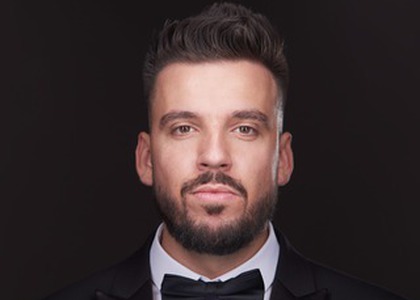
Bass Alexander Köpeczi on his appearances at the Metropolitan Opera in New York
Alexander Köpeczi, you are returning to the Metropolitan on December 6th in the role of Colline in Puccini's La Bohème. It's the role with which you actually made your debut last season on the Met's stage. How did you perceive the atmosphere at the Met then, and how do you perceive it now? Has anything changed? Maybe you're a bit more relaxed, more familiar with the place, with the stage?
Surprisingly, I was relaxed again. It was probably the most beautiful debut I've ever had in a major theatre. Everything unfolded as it should, exactly as I had imagined years before - I genuinely felt like I was floating. And the immediate feedback from the music staff was wonderful; I must admit it was an absolutely unforgettable moment, one I will keep with me forever.
You also had two other performances this season here, on November 30th and December 4th. And you're part of a remarkable cast, of course, since we're talking about the Metropolitan Opera. You're singing with Juliana Grigoryan, Mané Galoyan, Stephen Costello, David Bižić, and Iurii Samoilov. Did you already know any of them? Had you worked together before, outside of La Bohème?
I had worked and was colleagues only with Stephen Costello, in Munich, where I spent two years in the ensemble of the Bavarian State Opera. We sang together in Don Carlo, he was Don Carlo, I was the Monk. We always had a very good collaboration; Stephen is a wonderful colleague.
I also work very well with maestro Rustioni. I debuted in Aida - my first Aida - as Ramfis, in Munich, in a new production, and we've collaborated many times. This year he was appointed Principal Guest Conductor at the Met for a three-year term.
So yes, I know several people here. It's not exactly a debut - it's a whole new life for me.
Speaking of productions, this one revives Franco Zeffirelli's staging. And this La Bohème is the institution's most frequently performed production. It's a very beautiful, classic staging in which I assume most singers feel comfortable. How do you feel? What kind of approach do you prefer - more modern or more traditional?
You should know it's also the Met's oldest production still running. Usually, there are 4-5 performance periods of Zeffirelli's La Bohème throughout a season, meaning 4-5 casts. Sometimes casts get mixed, sometimes certain singers end up with 8-9 shows. It always depends on the artists' availability. But yes, it's probably the most frequently performed opera at the Met.
I'm very grateful and truly lucky to have been invited back. To perform both Zeffirelli's La Bohème and The Magic Flute, in English, in Julie Taymor's production - she's won many Tony Awards, especially for her hugely famous Lion King production on Broadway in '97, if I remember correctly.
With The Magic Flute - Mozart's Die Zauberflöte - the Met wanted, beginning in '96, to create a show for whole families, including children. To make it interactive, fun, something that brings a child into an opera house like the Met for the first time.
In The Magic Flute, you sing Sarastro. It's a very colorful, beautiful, visually striking production, as you said - even for the youngest spectators. Vocally, where do you feel more at ease: in Sarastro or in Colline? They're very different roles, with very different styles - Mozart vs. Puccini.
I completely agree. I feel a bit closer to Colline, both as a character and in terms of age. Also because I've performed Colline far more often. I feel good as Sarastro too, but the role of Sarastro - the priest - emerges from a certain life experience. You need a bit of background, both personally and professionally. Not that younger singers can't sing it, but you need a certain maturity in all aspects to interpret it fully. I'm not saying I don't have that - I'm just saying Colline is closer to me.
The cast is young - you're performing with Juliana Grigoryan, Mané Galoyan, David Bižić, and Iurii Samoilov. These are your constant stage partners in the few shows you perform in. How important is it that the singer matches, even in age, the character?
It's very important because it gives credibility to the role. If you're the right age, your voice, character, persona, phrasing - everything - comes together at the same artistic point, giving a sense of interpretive harmony to the audience. It all feels like a storybook - exactly as it should.
The Bohème boys are usually young, in their early twenties. Colline is the oldest, maybe around 23, if I remember correctly. So yes, we feel close to our characters. As young people, we feel more connected to these roles than to very complex, dramatic roles, because artists' souls are often more lively, younger, more childlike. That's the truth.
When you first approached Colline, do you remember your perception of the character's motivations - his psychology? After all, he's a young philosopher.
I know I first performed La Bohème in Cluj. Probably at the Hungarian Opera, if I remember right; I know I also did it at the Academy. And we did a student production at the Romanian National Opera Cluj-Napoca - an Academy production staged at the Opera. I remember both shows.
I was extremely emotional and even a bit worried, because Colline is difficult, and at that time I wasn't very well prepared. So the worry was greater. But I remember it fondly, and I want to thank all three institutions - the Music Academy, the Hungarian State Opera of Cluj-Napoca, and the Romanian National Opera Cluj-Napoca - for those opportunities. It's very important to perform such roles at a younger age so you can get a taste for working on a major stage - not just in the Academy studio - with a real audience. That's when you truly feel your first steps as a real artist.
I know you started studying music and you were originally a pianist.
Yes, I was a pianist - I studied for 12 years, including high school. And afterward, I studied four years of principal piano at the Conservatory, in Professor Csiky Boldizsar's class. I even have a bachelor's degree - I could teach.
Do you think you're more emotional now as an opera singer than you were as a pianist? Where do you feel more comfortable?
I'm at a point in my life where, looking back, I see things very clearly. When you're younger, you don't know yourself as well, and music develops you on many levels - your inner life, your soul, your thoughts, your emotions. Over time, these settle.
When I played piano, I always had huge nerves - I was very stressed and worried: "What if I press the wrong key?" Always a bit tense before going on stage, and even afterward - I often blamed myself. But with singing, I didn't do that. And I later realized why: we label ourselves, and I thought I was introverted.
Pianists are usually more introverted - maybe not truly introverted, but more so, partly because they spend eight hours a day between four white walls with a piano and maybe a painting.
And it took me a while to realize I'm actually an extrovert. I like expressing my thoughts, feelings, states - I like communicating outward, not holding everything inside, including my temperament. It took choral singing, then solo singing, for me to discover that I express myself better directly with my voice, my larynx, my vocality, than through an instrument - where everything goes first into the piano and only then reaches the audience. It took time to realize piano might not be my greatest passion.
But I'm sure your rich experience as a pianist helps a lot in approaching vocal repertoire. I imagine you sit at the piano, read a score, accompany yourself, perhaps?
Yes, I do, but not at the level I did 10 years ago. I no longer aim to be extraordinary at the piano because I'm focusing 100% on vocality - technique, interpretation, phrasing, breathing. And honestly, I no longer have the patience; to be very good at both piano and singing you need to study both separately, then put them together. Right now, I don't have the patience for that.
And probably not the time either…
No, I don't have time for everything.
Do you still work regularly with a teacher or coach?
I have several maestros in different parts of the world.
Depending on repertoire?
No, depending on -
On the place you're in?
Exactly - depending on where I am and when I have free time, I ask for guidance on where I should be heading interpretively and technically.
Recently I was lucky to have Iulia Suciu, the Vice-Rector of the Gheorghe Dima Academy, with me. Since I couldn't go to Cluj, I invited her to spend a week with me - we had to prepare a more complex repertoire for upcoming projects. So we spent a week in Paris working intensely on 4-5 roles that I'll sing in the not-too-distant future.
What does the "not-too-distant future" look like for your professional agenda? What debuts and collaborations are coming up? Where else can we hear you?
After I finish here at the Met, on January 2nd, I have a performance; on the 4th I'm back home in Munich, and my first project is on January 9thin Budapest, where Anna Netrebko will debut in Verdi's Requiem, and I'm very lucky to be there.
Then I go to Barcelona to sing Alvise in La Gioconda - six performances starting mid-February. Then in March I move to Naples, to Teatro San Carlo, for my debut as Raimondo in Lucia di Lammermoor - four shows. In April, I move to Covent Garden as Sparafucile in Rigoletto.
At the end of the month, I'm at the Bavarian State Opera in Il trovatore. Then in mid-May, I go to Copenhagen for my debut as Banco in Macbeth, under the baton of Sir Antonio Pappano - I'm very grateful. I end the season with Macbeth at the Hungarian State Opera in Budapest as Banco - three performances. And in the summer I'll be at the Santa Fe Festival (which is almost at the level of the Salzburg Festival), where I will be very lucky to sing Sarastro in Die Zauberflöte and Prince Gremin - my debut in Eugene Onegin by Tchaikovsky.
How beautiful and how diverse! A real tour de force!
It will probably be my richest season - the most important of my career so far. In one season I'm singing in Paris, the Met, Barcelona, Covent Garden, Bavarian State Opera, Santa Fe, Budapest, Copenhagen, Naples…
Some of the most important opera houses in the world.
A dream season! Simply a dream season.
Your agent, Maria Moț, surely plays a big role in all this. How did you meet?
We began collaborating in 2021 - we signed then and met for the first time at Covent Garden for an official audition. After the Vinas Competition audition, there was another official audition for Covent Garden, with several agents and the whole music staff present. That's where Maria heard me. Without Maria, I wouldn't be at this point in my career - ours is always teamwork. In our field nothing happens accidentally, but also nothing happens alone. It is always teamwork, and I want to say that I am very grateful to have Maria Moț as my agent and as a friend - she is an extraordinary agent, probably the best in the world.
I follow her as well and see how dedicated she is - always close to her artists, supporting them everywhere in the world. It's beautiful.
She's always present at every premiere or first performance of her artists - it's extraordinary. Her level of dedication is sky-high.
You're truly among the greatest right now, as many top opera artists today are represented by Maria Moț.
Yes. And recently we welcomed Mihai Damian into our family - winner of Operalia 2025, an incredible achievement. I hope the Romanian press will talk more about this. I'm not sure people realize how huge his achievement is. For me, his performance equals that of Nadia Comăneci, Gică Hagi, David Popovici - you can go on. It's like the Olympics of opera singers.
Translated by Adina Gabriela Văcărelu,
University of Bucharest, Faculty of Foreign Languages and Literatures, MTTLC, year II
Corrected by Silvia Petrescu


