



> Events
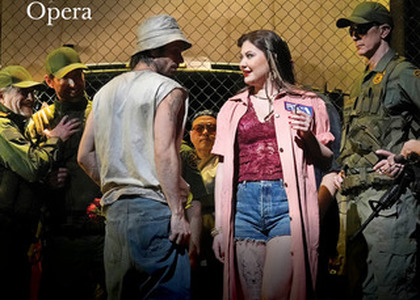
Live from the Metropolitan Opera in New York - Carmen by Bizet
The series of live broadcasts from the stage of the Metropolitan Opera in New York continues on Saturday, January 17th, 2026, on Radio România Muzical. This time, we bring you one of the most famous and beloved operatic creations of all time: Georges Bizet's Carmen.
A production by director Carrie Cracknell at the Metropolitan Opera
The performance we will follow is a revival of the production that premiered during the 2023-2024 season - a controversial staging, visually striking and powerful, signed by British director Carrie Cracknell, who made her Met debut on that occasion. Cracknell relocates the action to the present day, placing it within the context of a human trafficking gang and offering a new perspective on the opera's themes. Instead of the 19th-century cigarette factory in Seville, the women now work in a modern American weapons factory. Instead of a bullfight, the final act takes place at a rodeo, where Escamillo becomes a rodeo star and drives a bright red sports car. Don José kills Carmen with a single, swift, chilling blow from a baseball bat. The production generated mixed reactions from critics. Some praised it for foregrounding contemporary issues such as gender violence and abusive labor structures, while others were more skeptical. According to the program notes, Cracknell transplants Carmen into a "contemporary American industrial city," which, for some, denies the poetry of the music at every step. Still, even the harshest critics agreed that the cast ultimately saves the performance through sheer vocal brilliance.
So, who is singing in this version?
The cast of the January 17th performance
At the top of the bill is mezzo-soprano Aigul Akhmetshina, the most sought-after Carmen of our time. Turning 30 this year, the artist has already appeared in no fewer than eight (!) different productions of Bizet's opera. She has sung Carmen at the Royal Opera House in London, Deutsche Oper Berlin, the Bavarian State Opera in Munich, the Verona Arena, Teatro San Carlo in Naples, the Glyndebourne Festival, the Vienna State Opera, and of course, the Metropolitan Opera in New York. This Saturday, we too have the chance to hear her live from the Met. At just 27, Akhmetshina was already a true sensation on the international opera scene. The New Yorker praised the "fresh energy and ferocity" of her interpretation, noting that she was "the only truly impressive thing in this Carmen production - wearing turquoise cowboy boots." Born in the Republic of Bashkortostan in the former Soviet Union, Akhmetshina rose to fame at only 21, when she made her debut as Carmen at the Royal Opera House in London. Her journey to success is a Cinderella-like story in itself: born in a small village, she faced enormous obstacles - including health issues and adapting to a completely new world - and, through perseverance and discipline, forged her path to international stardom.
On January 17th, her partner on stage is American tenor Michael Fabiano, who returns to the role of Don José. Fabiano is a Met veteran and an internationally acclaimed artist. In 2014, he won both the Richard Tucker Award and the Beverly Sills Award, becoming the first singer ever to receive both prizes in the same year. Two other major voices of today will also be heard: soprano Janai Brugger as Micaëla, and bass-baritone Christian Van Horn, another familiar presence at the Met, as Escamillo. The performance is conducted by Pier Giorgio Morandi, one of today's leading conductors, who previously served for ten years as principal oboist of the Orchestra of Teatro alla Scala in Milan.
During the broadcast intermission - a conversation with Aigul Akhmetshina
A special moment of Saturday's live broadcast will be the airing of excerpts from an extensive interview (we spoke on the phone for a full hour!) that I recorded with mezzo-soprano Aigul Akhmetshina. This will be a rare opportunity to hear directly from the artist about her vision of this legendary role, as well as stories about the challenges and joys of performing Carmen in this modern production. Akhmetshina has previously spoken about her nuanced understanding of the character - how she manages to make Carmen both dangerous and irresistible, while also bringing something deeply personal to the role. For her, Carmen is "everything a woman can be" - a statement that perfectly captures the complexity and depth of this demanding character.
The opera that changed the rules of the game
Georges Bizet composed Carmen between 1873 and 1875. He was 36 at the time of the opera's premiere and did not anticipate the scandal that would follow. The performance on March 3rd, 1875, at the Opéra-Comique in Paris shocked and scandalized audiences with its break from convention. Imagine the Parisian opera stage - accustomed to offering the bourgeois public relatively harmless entertainment - presenting an opera populated by people from the lower classes, where women smoke and fight, where smugglers appear, where passions are raw, untamed, and unpolished, and where the ending is violent and tragic. In 1875, such characters were simply not seen on the opera stage. Queen Victoria was still on the throne, and the moralists of her generation were in full force. Yet change was already in the air through the Realist movement, which had entered French art and literature through painters like Degas and Courbet and writers such as Balzac and Flaubert, all devoted to depicting everyday life and people from all social classes.
Bizet based Carmen on Prosper Mérimée's novella of the same name (1845), with a libretto by Henri Meilhac and Ludovic Halévy. The composer himself was convinced of the quality of his music, declaring: "They say I am obscure, complicated, boring… Well, this time I have written a work full of vivacity, color, and melody." And yet, the initial reaction was one of shock. The audience remained rigid during Act IV, and after the premiere only a few devoted friends came backstage. Bizet died suddenly after the 33rd performance, unaware that his opera would achieve international recognition within the next ten years. It was the anniversary of his wedding. He was only 36 and believed he had written the greatest failure in opera history. But Pyotr Ilyich Tchaikovsky had been right when he predicted: "In ten years, Carmen will be the most famous opera in the world." The first major success came in Vienna on October 23rd, 1875. Over the next three years, Carmen was staged in nearly all the great European opera houses, and today it remains one of the most frequently performed operas, with the "Habanera" and the "Toreador Song" among the most famous arias in the entire operatic repertoire.
So, this Saturday, January 17th, on Radio România Muzical, whether you are an experienced opera lover or a curious newcomer, let yourself be carried away by the fiery story of Carmen and Don José. Let Bizet's music envelop you, be seduced by the magnetic voice of Aigul Akhmetshina and the passionate interpretation of Michael Fabiano. Because, in the end, Carmen teaches us that love truly is a "rebellious bird" - impossible to capture, impossible to tame, and therefore all the more precious. Though we are thousands of kilometers away from New York, through radio and the European Broadcasting Union we will once again be attentive listeners to a production unfolding on the stage of the Metropolitan Opera.
My guest in the studio this time is music critic Costin Popa.
We warmly invite you to join us on Saturday, January 17th, from 8:00 PM, for a memorable evening of opera!
Translated by Adina Gabriela Văcărelu,
University of Bucharest, Faculty of Foreign Languages and Literatures, MTTLC, year II
Corrected by Silvia Petrescu


