



> Events
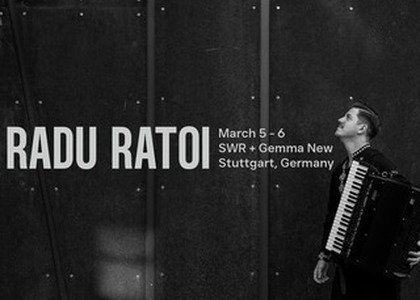
Radu Rățoi and 20th-Century Music Live from Stuttgart – Friday, March 6th, 9:00 PM
Diversity is the defining feature of 20th-century music. In both musical language and sources of inspiration, modern composers embraced freedoms that few could have imagined in earlier eras, leading to an increasingly pronounced individualization of musical styles. While this is almost self-evident, it is also worth noting that certain common traits can still be observed. These become particularly clear when several works from the modern period are brought together under the umbrella of a single program, as the organizers of the concert taking place on Friday, March 6th, at the Liederhalle in Stuttgart have chosen to do.
Conductor Gemma New will lead the Stuttgart Radio Symphony Orchestra, and the program will open with Adagio Op. 11 by Samuel Barber. An eminently eclectic composer, Barber succeeded in blending the aesthetic traditions of the nineteenth century with the stylistic tendencies of his own time, creating music that can be described as lyrical and expressive, despite its occasional dissonances and tonal ambiguity. The famous score he wrote at the age of just 26, Adagio, Op. 11, is widely regarded as emblematic of his work.
More than thirty years after his death, Astor Piazzolla is now considered one of the great names of Argentine music. During his lifetime, however, his work was often the subject of controversy. The reactions of Argentina's more conservative music lovers were frequently hostile, yet the composer's innovations ultimately took root, giving rise to a new style known as nuevo tango. Piazzolla's formal musical education undoubtedly had a lasting impact on his career; without the period he spent in Paris under the guidance of Nadia Boulanger, audiences might never have had the opportunity to enjoy the Aconcagua Concerto for bandoneon and orchestra, the work that will feature the young performer Radu Rățoi as soloist.
Sergei Prokofiev's music possesses a rare quality, particularly in the context of twentieth-century composition, of being both accessible and compositionally compelling. These are only some of the traits that have secured his works a constant place in the repertoire of symphonic ensembles. Striking not only for its sonority but also for its melodic richness, Prokofiev's music skillfully combines the classical-romantic tradition with some of the most significant experiments of his contemporaries, and the results speak for themselves. The audience will hear two representative works from his catalogue: the Violin Concerto No. 2 in G minor, Op. 63, with Hana Chang as soloist, as well as the Symphony No. 1 in D major, Op. 25, Classical.
The result is a thoroughly modern program featuring works by representative composers of the twentieth century, performed by young musicians, all this on Friday, March 6th, starting at 9:00 PM, on our station's frequencies, as part of the program European Stage.
Translated by Carmen Badea,
University of Bucharest, Faculty of Foreign Languages and Literatures, MTTLC, year II
Corrected by Silvia Petrescu


