



> Events
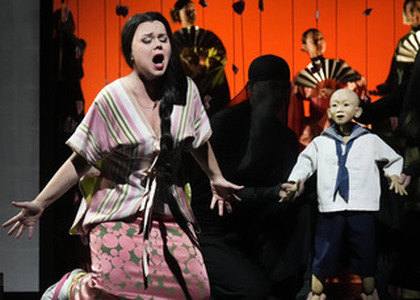
LIVE - Madama Butterfly from the Metropolitan Opera House in New York
Saturday, 14th of March 2026 at 7:00 P.M. on Opera Prima
Over the years, lots of legendary performers have brought the role of Cio-Cio-San to life, among which were Maria Callas, Renata Tebaldi, Anna Moffo, Renata Scotto, and lately Angela Gheorghiu (on a studio album) and Ermonela Jaho as well.
This Saturday, 14th of March 2026we will have the opportunity to hear a live broadcast of the soprano Aleksandra Kurzak interpreting this deeply moving and challenging score from the Metropolitan Opera House's stage in New York.
The idea of writing a "Japanese" opera came into Puccini's mindduring the premiere of his Tosca at Covent Garden, London of the summer of 1900. Puccini had attended a play signed by David Belasco named Madama Butterfly. Belasco took inspiration from a short story published in 1898 by John Luther Long, an American lawyer. In fact, the main plot of an abandoned geisha had been done in a novel by Pierre Lori first published in 1882, Madame Chrysanthème; André Messager used it as the inspiration for a light opera (turned failure) presented at the Opéra Comique of Paris in 1893. Puccini got instantly captivated by the tragic fate of Cio-Cio-San ("butterfly" in Japanese), which was similar to that of Mimi from La Bohème. The negotiations with Belasco dragged on for a long time, and the agreement happened at last in April 1901. Afterwards, the composer turned to the people he had worked with on Tosca for help, Luigi Illica and Giuseppe Giacosa.
The autumn of 1902 came with Puccini getting introduced to East Asian music through the wife of the Japanese ambassador - she was the one who gave the composer a collection of folk songs Japan and advised Puccini on the appropriate names for his characters. In November 1902, Puccini decided to cut out the second act from the opera, which was supposed to take place at the USA Embassy in Japan; this change led to the opera having two oddly-length acts. Although the librettists and Puccini's publisher (Ricordi) alike were upset about the change, the composer managed to have the last word on it. On 25th of February 25 1903, Puccini became the victim of a terrible car accident which he struggled to recover from over the course of several months. The doctors discovered he had diabetes during one of his checkups, from which he would never make full recovery - Puccini was already 45 at the time. Puccini was finally able to play the piano again in the summer of 1903, and he resumed composing operas. He wrote the conductor Lugi Mancinelli: "Butterfly means a great deal to me. This is a major female lead role, with little singing for the tenor and baritone, there will be two acts. The first act serves as exposition: it is colorful, full of action, and funny moments, while the second act is deeply moving, tender, and gentle."
However, the creation of the opera is slowly progressing due to the composer's convalescent period, as well as his unstable love life. The first act is done on 15th of September 1903, and the entire opera was completed by the end of that year, on 27th of December. The premiere of Madame Butterfly was scheduled for La Scala in Milan on 17th of February 1904. The director of the opera house selected the finest voices of the time and Cleofonte Campanini, a renowned conductor. Unfortunately, the premiere was a failure, prompting Puccini to cancel the second show and alter the score with the help of his librettists. The most significant change was the return of three acts structure, and the addition to Pinkerton's score of a beautiful romance - Addio, fiorito asil. The revised opera was a success at Brescia's Teatro Grande on 28th of May 28 1904, under the baton of Arturo Toscanini.
The opera is set in the early 20th century in Nagasaki, Japan. Cio-Cio-San (also known as Butterfly), is a young Japanese woman married to the American lieutenant B.F. Pinkerton; Pinkerton views their marriage as temporary, but the union is sacred to Cio-Cio-San. Shortly after the wedding, Pinkerton abandons Butterfly and returns to America, only for him to return to Japan a few years later with his new American wife upon learning that Butterfly had given birth to his son. Upon discovering that Pinkerton has a new wife and will not return to Japan to live with Butterfly, she agrees to give up on her son and commit suicide, as she got stripped of all hope.
The soprano Aleksandra Kurzak will step on New York's stage with the mezzo-soprano Jennifer Johnson Cano as Suzuki, the tenor Adam Smith as Pinkerton, the baritone Quinn Kelsey as Sharpless, the tenor Tony Stevenson as Goro, the baritone Jeongcheol Cha as Prince Yamadori, the bass Peixin Chen as Bonzo, and the mezzo-soprano Hannah Jones as Kate Pinkerton. The production is directed by Anthony Minghella, and will feature the Metropolitan Opera House's ensembles, namely the New York Metropolitan Opera Orchestra and the Chorus (prepared by Tilman Michael). Carlo Rizzi will be at the rostrum.
My guest in the studio is the soprano Madeleine Pascu, soloist at the the Bucharest National Opera. Her repertoire includes the main role in Giacomo Puccini's opera; therefore, she has much to share on this subject.
We are looking forward to having you join us on Saturday, 14th of March at 7:00 P.M. at Radio România Muzical.
Translated by Andrada-Teodora Ivanov,
University of Bucharest, Faculty of Foreign Languages and Literatures, MTTLC, year I
Corrected by Silvia Petrescu


