



> Events
The Heritage of the “George Enescu” Museum verified by a commission of experts
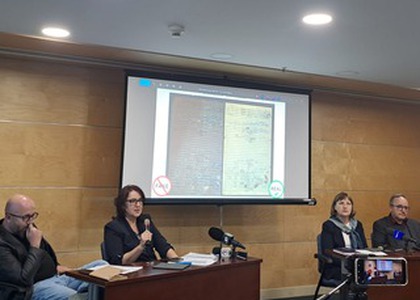
The situation of the heritage administered by the National "George Enescu" Museum was presented today, March 13th, 2026, starting at 2:00 P.M, during a press conference held at the headquarters of the Ministry of Culture.
The commission appointed by the Minister of Culture to assess the state of conservation and storage conditions of the cultural assets consisted of Dr. Emanuel Petac - President, Head of the Numismatic Cabinet of the Romanian Academy Library, President of the National Commission for Museums and Collections, and President of the Romanian Numismatic Society; Dr. Andrea Bernath - specialist in the conservation and restoration of cultural assets, Director of the Collections and Library Services Directorate at the National Library of Romania, PhD in Bibliology and Information Science; Dr. Laura Troșan - accredited expert conservator-restorer; and Dr. Anca Ioana Andreescu - Head of the Special Collections Service at the National Library of Romania.
The members of the commission were tasked with verifying the condition of the heritage and the storage conditions of the cultural assets during the restoration works of the Cantacuzino Palace, the historical headquarters of the museum. According to the report presented, the museum's cultural assets have been stored since 2021 in six containers placed in the institution's courtyard. This decision was made when restoration works on the palace began, after nearly a decade of delays. The contract for the building's restoration had been signed in July 2021 and estimated a duration of two years. Under these circumstances, the museum's management quickly vacated the premises, and the Board of Directors decided on the temporary storage of the heritage in containers, a solution intended both to protect the objects and to allow the continuation of inventory activities and the preparation of exhibitions. It was also emphasized that storage in containers was conceived from the outset as a strictly temporary solution. However, the situation became more complicated in 2023, when the restoration contract was terminated. Since then, the heritage has remained stored in the same containers, and what was initially intended as a short-term solution has turned into a long-term one. According to statements made by Dr. Petac during the press conference, the management of the Enescu Museum did not inform either the Ministry of Culture or the National Commission for Museums and Collections about the risks associated with the long-term conservation of heritage in containers. It was also noted that container storage was not, from the beginning, a fully compliant solution for heritage conservation.
In December 2025, a new tender procedure was launched for the design and execution of the restoration works, but only one bid was submitted, which is currently under evaluation. Under these circumstances, the completion of the works cannot realistically be expected earlier than three years from now, i.e., by 2029.
At present, the containers are equipped with devices for monitoring temperature and humidity - thermohygrographs and air conditioning units - as well as security systems, including motion sensors, door alarms, and external video surveillance.
At the time of the commission's visit, the microclimatic parameters were within acceptable limits. However, specialists warn that maintaining heritage in such a space over the long term involves structural limitations and risks. The experts visually examined a number of representative pieces from the collection, including manuscripts belonging to the composer George Enescu. Among these were pages from the Third Symphony, classified in the "Treasury" category of the national movable cultural heritage.
Following the preliminary inspection, no obvious deterioration occurring after 2021 was observed, the examination being visual and limited to a small number of documents. However, the experts emphasized that this finding cannot replace a systematic and comprehensive assessment of the entire heritage collection, a process that will take place subsequently, in correlation with available resources. From the standpoint of organization and packaging, the commission considers that appropriate preventive conservation measures have been adopted. Nevertheless, specialists believe that these measures cannot compensate for the structural limitations of storage in a container-type space.
The report also highlights the lack of a dedicated space for consulting documents, as well as the absence of clear procedures regarding access to the containers and the logging of such access. Experts stress that maintaining the current storage solution cannot represent a sustainable option in the medium and long term.
In this context, several options are being analyzed for the relocation of the heritage, which consists of 3,073 artifacts. At the same time, the commission draws attention to the importance of preserving the museum's institutional identity, as the collection represents a donation intrinsically linked to the existence of a museum dedicated to the memory of George Enescu.
The report presented today is preliminary. The full examination of the heritage collection will take place within the museum's internal procedures, through the individual verification of each item, during the handover process to a future custodian, under the supervision of a conservator.
Translated by Ioana Nicolescu,
University of Bucharest, Faculty of Foreign Languages and Literatures, MTTLC, year II
Corrected by Silvia Petrescu


