


> Events
The Bach Marathon – 12 hours of listening to Bach’s works
The Bach Marathon is a unique project held at the Pietati Lutheran Church in Cluj-Napoca, and it is now at its fifth edition. We gladly accepted the invitation from the organist Zoltán Horváth (the initiator of this project), and so we've spent 12 hours listening to Johann Sebastian Bach's music. The 21st of March is the day on which Bach was born in 1685, a date that became the European Early Music Day in 2013, a day on which thematic concerts are being held.
The Bach Marathon programme is captivating, designed in such manner so that the audience can enjoy a wide and diverse musical range, thus being provided with the dynamics necessary for such a long day.
At 10.00 A.M., the church's pastor held an opening speech, while the first musicians to perform were the talented students belonging to the "Gheorghe Dima" National Academy of Music.
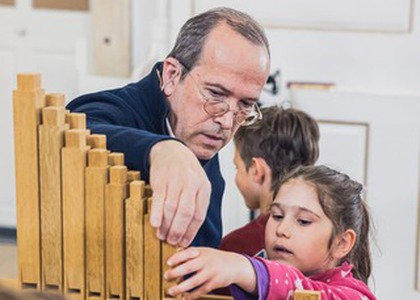
An important element was the learning programme - an organ-building workshop was held for the first time this year. Two groups of children aged between 7 and 10 took turns in building a miniature organ while being under the guidance of the organist Gesztesi Tóth László from Budapest, who also tested the organ by playing a short piece by Bach. The children were delighted.
Have you ever seen an organ before?
"No, I've never seen an organ in my life."
But what about a big organ?
"Yes, I have."
Have you ever heard what a big organ sounds like?
"Yes."
And what was it like to build it from scratch, little by little?
"The best day ever!"
"I really enjoyed it!"
Would you like to learn to play an instrument like that?
"Yes! I play the piano, and I have to go to music school as well."
"I play the piano, too!"
And would you ever want to swap the piano for the organ, or learn to play the organ alongside the piano?
"I'll give it a try!"
Will you be staying and listening to more concerts?
"Yes!"
Not only the children who participated in the workshops were among the spectators of the recitals in the marathon programme. Throughout the day, the church, beautifully lit by the bright sun, was full - lots of people were coming and going depending on their schedules or preference for certain artists. As I mentioned already, classical music concerts are a family event in Cluj, so I could see babies and elderly people alike.
The church also has a soundproofed play area for children, enclosed with glass walls, so that everything is transparent - therefore, the children listen to the sermons or in this case the music but they cannot disturb, so the little spectators also took a break to play. The arrival and departure of the audience was done in a quiet manner out of respect for the holy place and the artists alike; even the applause was respectful and never during breaks between the sections of the works.
The audience could enjoy a string of recitals from midday onwards, which you can listen to on the Bach Marathon's YouTube channel. I'll present just the most beautiful and meaningful moments of the entire programme. First, the church has two organs: a Baroque organ bought recently from Chirpăr and restored, and a large organ made by Oscar Walcker - one of the only four instruments from the same manufacturer in Romania (the other three being in Târgu Mureș and Bucharest, at the Lutheran Church and the Romanian Athenaeum respectively); and this one has also been restored after more than a century since it was built, and a third manual added. Both instruments were showcased by Amalia Goje Erdős, who erformed a piece essential for the Lutheran faith, namely the Mass for Organ Clavier-Übung III. J. S. Bach had composed a lot for the Lutheran church, so the marathon featured holy pieces as well.
There are two instruments which I find ideal to spend the day by enjoying the beauty of music, and both got featured in the marathon's programme by amazing performers. First, it's the harp, played by Kati Kinga Szabo, a harpist of the "Transilvania" Philharmonic, who presented a suite that was originally written for the lute and six chorales. Then it's the flute, played by János Bálint - I believe it is a privilege for the students from the Academy of Music to have had him as their teacher for the past three years; Bálint was the main flutist and soloist for the Hungarian Radio Orchestra and the Budapest Philharmonic. Now nearly 65 years old, János Bálint has chosen pieces that impressed with the beauty and clarity of their sound, as well as the elegant, expressive phrasing. A flute virtuoso, János Bálint plays a modern instrument made of wood, which got made in collaboration with a Japanese flute maker. For the two sonatas presented, he was accompanied on the harpsichord by Erich Türk, who is a well-known and admired musician from Cluj.
There were also performers who play Baroque instruments among those present; they are passionate about a well-researched approach towards Baroque music. Therefore, the act of merely owning such instrument is not enough, since theory makes all the difference. Among them could be found two of the marathon's guests, namely the Hungarian musicians Katalin Kovács for the harpsichord and Sándor Szászvárosi for the viola da gamba. We owe it to Szászvárosi for the inclusion of the viola da gamba as an instrument within three music schools in Hungary, some of them being at pre-university level.
The final concert got performed by the Cluj Baroque Orchestra, an ensemble founded during the pandemic by Csilla Szoverdi, a main first fiddle player within the 'Transilvania' Philharmonic Orchestra along with her husband, Előd Kostyák, who is the main cellist within the orchestra of the Hungarian Opera in Cluj-Napoca. In fact, most of the ensemble's members come from these two institutions. The Bach Marathon is the main project in which the orchestra takes part:
"We were founded before the first marathon, in December. So, the first marathon was in March, and we had our first concert in December."
"The Bach Marathon is one of our ongoing projects. We have played the final concert for every edition of the festival so far. We've been recently invited to the Early Music Festival in Miercurea Ciuc. Everyone has their own job and we only meet up whenever we can, although we're in our fifth year as a band. The Bach Marathon is one of our greatest opportunities to shine, and we're delighted to collaborate with exceptional artists during the event, who also push us to do better, and to get us into the European current of Baroque music of performing it as close as possible to the sonority of a few centuries ago."
The orchestra's programme included Cantata BWV 202 that featured the soprano Melinda Sámson and oboist Hédi Bátki for it, excerpts from The Art of Fugue, as well as two concertos (BWV 1043 included, crowd pleaser). The star of this edition was violinist Kati Debreczeni (accompanied by Csilla Szoverdi), who also conducted the ensemble. Kati Debreczeni has returned to Cluj after four decades of absence - she left the country in 1986, when she was still a schoolgirl. It was the first time that she offered a short interview in Romanian since then, and she answered my questions with enthusiasm, the same kind that followed her throughout the concert, and which it delighted the audience. Kati Debreczeni was concertmaster for the prestigious English Baroque Soloists for 25 years. She is also one of the concertmasters for the Age of Enlightenment Orchestra, and also leads the Constellation Choir and Orchestra since 2024 - all of the ensembles being founded by Sir John Eliot Gardiner. Violinist Kati Debreczeni has been to Romania before this event, but only in Bucharest for the "George Enescu" International Festival.
You performed in Cluj this evening. When was the last time you were home?
"I don't think I ever held a concert as a professional in Cluj. I held concerts at the music school and left in 1986."
When you were still in high school!
"I was in high school. I was in the same class with cellist Előd Kostyák."
And you've been in Romania beforehand for the Enescu Festival with at least one of the two ensembles you've been part of and still are.
"I've attended the Enescu Festival with Adam Fischer and The Age of Enlightenment Orchestra. The orchestra has attended last year as well, but I couldn't make it because I was with another orchestra, with Mr. Gardiner, but the orchestra will return and I hope we'll get together once more."
How did it feel to perform again in the city in which you've been a student once, emotionally speaking?
"It was a wonderful evening for me. It was a delight to collaborate with colleagues I've left behind when we were young. And now, we met up again and made music together. The colleagues have gathered together from the Cluj Philharmonic and the Hungarian State Opera alike, and they are very enthusiastic over performing in the Baroque style and playing period-accurate instruments. Historically-accurate performance practice is something that is being done all over the world, but it's a novel idea in Cluj. It was a real pleasure to be able to collaborate with them, and I think we've created a very special concert."
The Bach Marathon. What do you think of this idea?
"It's a fantastic idea, because it celebrates Bach's genius. He wrote for the organ, he wrote chamber music, vocal music, and instrumental music. If someone were to end up on a deserted island, Bach's music could provide everything that we need. There is an aria, or a sonata, or a chorale, or a piece for two voices, or a fugue by Bach for everyone."
Finally, I spoke with the violinist Ana Török as well, who is the concertmaster for the 'Transilvania' Philharmonic and main violinist for the Arcadia Quartet. She was glad to share her impression as part of the audience.
"I am delighted about Mr Zoltán Horváth's initiative. I think it's phenomenal that we can listen to such a varied range of music made by this great composer."
She also told me how did her family had found the organ-building workshop. Ana Török has been present at the event with her husband (the cellist Zsolt Török) and their two sons since early that morning:
"They didn't know what they were going to attend at first. They couldn't imagine what was actually going to happen, and when they learnt that they would actually be involved in the building a miniature organ and not just watch, they were absolutely delighted. I've noticed that all of the children were skilled. They were building the organ as if it were a Lego puzzle, and they all enjoyed it very much. It was something that I've never seen before, to be able to build an instrument in less than an hour."
At the end of this marathon, his Excellency, Zoltán Dezső Adorjáni (Bishop of the Evangelical Lutheran Church in Romania) has addressed himself to the entire audience at the end of the marathon, and the evening got concluded with a prayer.
Besides being perfectly organised, the project benefited from the help of the church led by His Excellency. I asked him what this project means for Pietati, the only Lutheran church in Cluj-Napoca.
"Bach is at home within the Lutheran church. He composed many choral works, oratorios, and so on for Lutheran service and liturgy. So, we have a moral obligation as a church to perform Bach's music as a result. Secondly, I believe that it is very important for Bach to be celebrated within the church from a musical and cultural perspective, both in Cluj and Romania alike; this environment is where most of the works he wrote were born, in fact. We are delighted to have reached the fifth edition, and we hope that there will be more editions to come, as well as to feature performers from abroad and Romania alike. We are delighted over such a special cultural event."
It is an event that I highly recommend, as the Bach Marathon is an opportunity to spend a whole day filled by wonderful and diverse music, which is performed by valuable artists. This is a good way that you can escape the hustle and bustle of modern life by giving yourself all the peace and quiet you may need. The edition from 2027 shall also take place on Johann Sebastian Bach's birthday.
Translated by Andrada-Teodora Ivanov,
University of Bucharest, Faculty of Foreign Languages and Literatures, MTTLC, year I
Corrected by Silvia Petrescu


