



> Events
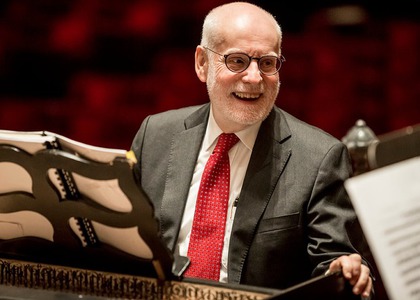
The conductor, organist, and harpsichordist Ton Koopman, guest in the series “Success Stories of Music”
Is it realistic to expect a musician to perform equally well late Romantic repertoire and Carl Philipp Emanuel Bach? Ton Koopman is convinced that it is possible, just as an actor must be able to perform both Shakespeare and avant-garde plays.
He himself carries forward a story that began over six decades ago, in which his true love, Baroque music has also gone through periods of exploring its relationship with other stylistic spaces, admittedly more like brief adventures. Koopman, a major name when it comes to Bach or Buxtehude (he completed a reference complete recording of Bach's 200 cantatas, on 36 CDs), has also conducted Haydn, Mozart, Schubert, and even,on rare occasions, Francis Poulenc.
Another defining aspect is his dual nature as both performer and researcher, which has allowed him, starting in the 1970s, to reexamine the foundations of how we relate to Baroque music and more broadly, to music written before the mid-19th century.
We invite you to a conversation in which we get to know a bit better the organist, harpsichordist, conductor, and musicologist Ton Koopman, a pioneer and one of the most respected figures associated with the historically informed performance movement, which remains closely tied to the rediscovery and revival of so-called early music. Initially timid in the decades following the mid-20th century, it gradually became an appreciated niche movement. What did it bring into focus? A reconsideration of the entire set of instruments appropriate for approaching a given repertoire, with the main thesis being that this perspective must respect the realities of the time. And if today, in the first decades of the 21st century, historically informed performance can no longer be ignored, having moved beyond its niche status reserved only for enthusiasts, much of this elevation is owed to figures such as this Dutch artist and intellectual.
Ton Koopman has lived through this true epic by creating his own ideal instrument: the Amsterdam Baroque Orchestra, founded in 1979. In 1992, the choir joined the orchestra, forming what is now known as the Amsterdam Baroque Orchestra and Choir.
Koopman, who turns 82 on October 2nd, was the special guest of the two concerts held on January 29 and 30, 2026, at the Romanian Athenaeum. The program he conducted marked the 270th anniversary of Mozart's birth (January 27th) and included works by the Austrian classical composer: Violin Concerto No. 5, with Sergej Krylov as soloist, the Serenade Nocturna KV 239, and Symphony No. 39. The opening piece, however, was Orchestral Suite No. 1 by Johann Sebastian Bach, the composer to whom the Dutch artist remains most closely connected.
On that occasion, we recorded the interview we now present to you in the next three editions of "Success Stories of Music," starting Sunday, April 26th, at 1:00 PM.
Translated by Elena Dumitrache,
University of Bucharest, Faculty of Foreign Languages and Literatures, MTTLC, year I
Corrected by Silvia Petrescu


