



> Events
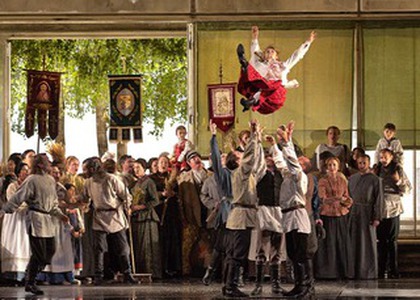
LIVE from the Metropolitan Opera in New York - Eugene Onegin by Tchaikovsky
This Saturday, May 2nd, 2026, at 8 P.M., I invite you to a new edition of Opera Prima. We're listening, live from the Metropolitan Opera stage in New York, the opera Eugene Onegin by Pyotr Ilyich Tchaikovsky. Of course with a wonderful distribution, worthy of this institution's renown!
My guest, in the Radio Romania Musical studio, is the soprano Marta Sandu, soloist at the Bucharest National Opera; an artist who debuted recently in the role of Tatiana from Tchaikovsky's opera.
Who are we listening to?
The soprano Asmik Grigorian is performing for the first time on Met the role of Tatiana, after her debut in this lyrical theatre which took place in 2024 with Madame Butterfly, in the context of a representation that stirred a lot of interest in the lyrical world. Nowadays, Grigorian is one of the most followed names in the international music scene, and I remember with great happiness and pleasure the moment when I heard her in Bucharest; back then she also sang in the concert the famous scene of the letter from Tchaikovsky's opera, and to me that performance was extraordinary! Her Tatiana is not a heroine that fits the conventional romance stereotypes, but a young woman with a dense interior life and in constant negotiations with herself. Baritone Yuri Samoilov, who takes over the title role after Igor Golovatenko's retirement, has sung the score in the past, offering a rather reserved and calculated Onegin. This is his second appearance at the Met this season, after he played Schaunard in Puccini's La Bohème a few months ago. In Lenski we will hear the tenor Stanislas de Barbeyrac, here in the role with the most dramatic and focused trajectory in the opera - the murdered poet (the mirroring of fiction in reality is obvious here, if we consider that Pushkin, the author of the verse novel that inspired Tchaikovsky's work, would die himself during a duel). Mezzo soprano Maria Barakova plays, in this interpretation, Olga, Tatiana's sister and the lover of Lenski, and in the role of the prince Gremin, symbolising mature and assumed love, is performing the bass baritone Alexander Tsymbalyuk, mezzo soprano Larissa Diadkova ( an extremely respected presence of the Russian scene) makes a comeback in the role of nanny Filippievna.
What will the staging be like?
The production, directed by British director Deborah Warner-a Tony Award-winning director and one of the most distinctive voices in contemporary theater-entered the Met's repertoire in 2013 and continues to be revived regularly, a sign that her proposal has stood the test of time. Warner constructs a scenic space in which the naturalism of the Russian provincial home in the first act-with its warm, almost tactile interiors conceived by set designer Tom Pye-gradually gives way to colder, more stylized geometries as the story advances toward the salons of St. Petersburg and the impossibility of recovering the past. The costumes signed by Chloe Obolensky and the lightning by Jean Kalman contribute to this subtle transition between the two worlds: of the lost youth and of the unfulfilled maturity. The choreography belongs to Kim Brandstrup.
The conductor of this performance is Timur Zangiev, who is debuting at the Met with this production. The young Russian conductor studied at the Moscow Conservatory and has made a name for himself on European stages in recent years. He was also well received at the Met, with those who attended the first performances of this series of Onegin writing about a certain sobriety in Zangiev's approach, which they find closer to the composer's wishes.
The opera's genesis and the connection with Pușkin's text
Eugene Onegin was created from a personal impulse, not a calculated career move. In 1877, Tchaikovsky received from the songstress Elizaveta Larovskaia the suggestion to transform Pușkin's novel of verses into an opera. Initially the idea seemed absurd, but on that same night he reread the novel and wrote the first framework of the libretto, and collaborated with Konstantin Șilovski to create it. Tchaikovsky called the piece, with disarming modesty, "lyrical scenes" - not an opera, not a musical drama, but something more intimate, less pretentious than a conventional opera show. The rapport with the literary source is one of selective fidelity: Tchaikovsky choosing to extract the pure emotional core: Tiana's death, Lenski's death, the too late understanding of Onegin, putting in the secondary plane the social portrait of the epoch.
We welcome you!
Translated by Elisabeta Cristina Ungureanu,
University of Bucharest, Faculty of Foreign Languages and Literatures, MTTLC, year II
Corrected by Silvia Petrescu


