



> Events
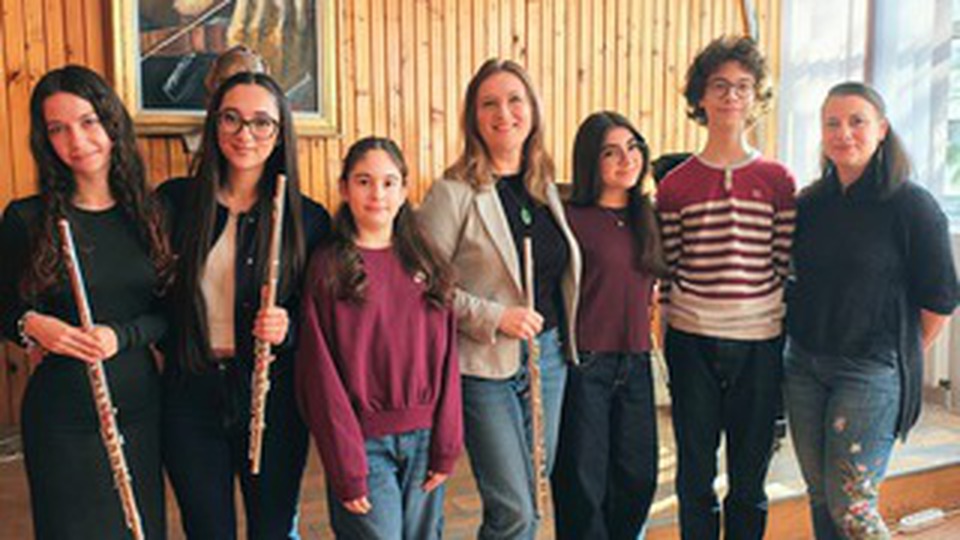
Ideas in the laboratory – meeting with the young flutists of the “George Enescu” National College of Music
What does the world of young musicians look like today? What does it mean to grow up in the universe of classical music and turn sound into emotion every day? To find out the answers to these questions, today we have with us teacher Linda Beatrice Boca and her students from the "George Enescu" National University of Music in Bucharest: Mariuca Iliuță (fifth grade), Eric Burcea (sixth grade), Anastasia Orlescu (seventh grade), Mihaela Albiță and Denisa Zărnoianu (twelfth grade).
To start, I wanted the teacher to tell me from what age can children start studying the flute and what benefits does this instrument have in their development?
Linda Beatrice Boca: "In theory, they can even start from first grade, because now there are instruments made for children. According to the curriculum, officially only from fifth grade, maybe from third grade with a doctor's permission. There are physical benefits - there are doctors abroad who, for certain afflictions, recommend swimming and playing the flute because we employ deep breaths that oxygenate our blood and organs and it's great from this point of view, and there are also the benefits you get when you study any instrument, namely that it develops the cognitive part, we use both hemispheres… So, it's good development for any child. It's not a coincidence that many Nobel Prize winners studied an instrument. What's interesting is that the flute is one of the oldest known instruments. At first, it was made out of animal bones, then rare wood, and today it's coated in gold, silver or even platinum. The upside of this instrument is that it's small, fits in any backpack, you don't have to pay a special fee in the plane when you travel. So, it's a versatile instrument that you can find in classical music, rock music, pop, jazz."
Every story starts with a moment of discovery, a meeting that can sometimes change everything. I invited the students to tell us how the flute story started for them:
"At first I started studying the piano, but it didn't fit me and I wanted to try another instrument."
"I tried the piano first and it wasn't really a match. I wanted to try another instrument and the first instrument I thought of was the flute."
"Ever since I was little, I dreamt of playing the flute and I imagined I'd study this instrument in-depth and now I'll continue studying it in college."
"At first I started with the piano and singing light music, and then I went to a show where I heard a flute for the first time and I liked that it had a beautiful sound and I decided to try this type of wind instrument."
"I went somewhere in the mountains with my parents and there was a large piano there and I tried playing it and I loved it. I studied piano until fifth grade, and then I was curious and wanted to try something new and I discovered the flute."
For those who haven't tried a wind instrument yet, the road can seem quite difficult, so I wanted to find out what advice my dialogue partners would offer to children who want to take this first step.
'The flute is a very interesting instrument, with a light and silky sound, but it can be very daunting in the beginning, especially when you want to play it but it won't respond as easily as the piano, but anything can be learned with proper guidance."
"For those who haven't tried the flute but wish to do so, I'd suggest they enjoy the process and I'd tell them the flute is an expressive and relaxing instrument once you've gotten to understand it, and it's also a good medium to express their feelings."
"I heartily encourage kids to start studying the flute, to explore, to see whether it fits them, because it's an instrument with a lot of potential that develops patience and intelligence. You can play it in an orchestra, where you have wonderful solos you could stand out with, and, if you like it, you'll realize with time that your entire life revolves around this instrument and it's part of you."
"First, they should experiment with the flute a bit, see what it can do by just blowing on it, and then taking flute lessons later."
"The flute, after you learn to play it, becomes a part of you."
The flute is not just a solo instrument, it's also an important voice in an ensemble. But how do the students see this instrument's role in an orchestra?
"The flute's role in an ensemble is one of coloratura. It brings a lot of light, effects, drama, and if needed, emotions."
"The flute's role in an ensemble is very important. It brings color and expressiveness through its ornaments and special sound."
"In an orchestra, the flute is a coloratura instrument. What does that mean? It means it brings light, warmth, cascades of sound, birdsong, it brings deep emotion, together with the other instruments. If you look at the orchestra, you'll find it in the first row of the woodwind section, on the left. It's worth keeping an eye on."
"The flute's role in an orchestra would be to give the music color and highlight it."
How important is classical music to them and, more importantly, how would they explain to people their age why it's worth listening to?
"I'd say classical music makes your body vibrate, makes you emotional and can take you through a lot of moods."
"Classical music made history and it's still performed today."
"I'd explain that classical music is an art that's hard to understand, but one that takes you to another world. It's different from other styles, because its beauty lies in the fact that it rouses certain feelings and inexplicable states in you."
"To whoever hasn't done it yet, I'd recommend listening to classical music to relax and reduce the stress they accumulated during the day."
"Even if for some people classical music might not make sense, or they might not feel anything from it, in my opinion that's because they've never truly tried to listen and feel something from classical music. I think it would help more if they attended a live concert. That way, more experiences and emotions are conveyed than through a recording."
And, thinking about the future, I finally asked them what dreams they have regarding the flute and music in general.
"My dream regarding playing the flute and music in general is to one day be able to earn a living from it and live a good life doing what I like."
"I want to become so skilled that I have the courage and determination to try my chances anywhere on this planet, to meet people, learn new styles and grow as much as possible. I want to perform on various stages and to experience as many things as I can. I like to play the flute and vocal and I hope that, in the future, I'll find opportunities to explore both."
"I haven't discovered my dream yet, but I'm sure that I'll stick to music in the future."
"I still haven't decided on a future about the flute and music in general, but I'll want to continue to go on stage and at competitions."
"My biggest dream is to be able to grow and learn enough that I'll be worthy of performing in the biggest orchestras in the world, to enjoy the spotlights, the stages, and make people happy with my music."
Today we discovered what the world of the flute looks like through the eyes of teacher Linda Beatrice Boca of the "George Enescu" National College of Music in Bucharest. I'm Ioana Țintea and we'll be meeting again soon with other stories from our idea laboratory.
Translated by Alexandra Teodora Ciolacu,
University of Bucharest, Faculty of Foreign Languages and Literatures, MTTLC, year II
Corrected by Silvia Petrescu


