


> Events
King’s Singers in Bucharest
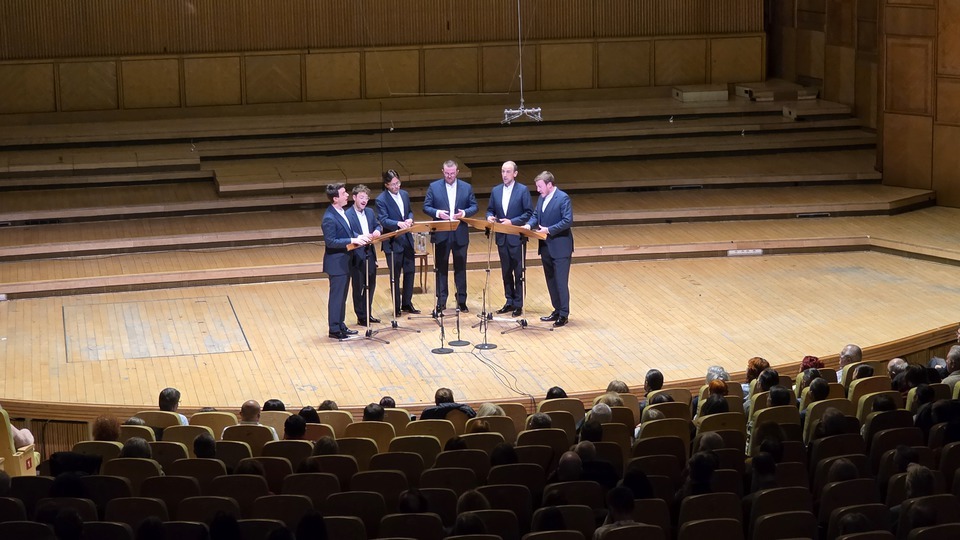
Six people, singing,
… and a hall filled with nearly a thousand souls listening, breathless, falling silent.
"Incredible" was the word on everyone's lips at the end.
And rightfully so: King's Singers delivered an extraordinary evening at the Radio Hall on November 23rd 2025, as part of the Bucharest Early Music Festival. A legendary ensemble performing for the first time in Bucharest, it's history dating back to 1968: six voices united in an outstanding vocal ensemble. The lineup featured countertenors Patrick Dunachie and Edward Button, tenor Julian Gregory, baritones Christopher Bruerton and Nick Ashby, and bass Piers Connor Kennedy.
It was an exceptional night in more ways than one.
First and foremost, the quality of the performance: vocal production, intonation, dynamics, ensemble cohesion, and pronunciation - everything was superlative. But, more importantly, there was what emerged beyond the flawless execution of the score: emotion, impeccable taste, the ability to convey the music's message, and the creation of a genuine sense of catharsis - the kind that only an artistic act of the highest spiritual calibre can evoke. I must admit that I am not easily moved, yet while listening to this live concert by The King's Singers, I could not hold back my tears for more than half the performance.
Since I resonated so deeply with the theme of the concert and the questions it raised for the contemporary individual. "Renaissance" isn't just about that time period, but more so about a spiritual rebirth that is expressed in all of the 15 religious pieces performed by The King's Singers. These are works they grew up with and sang themselves as young choristers in the church (I learned this incidentally from the introduction given by the six singers - delivered in an admirable Romanian!). These pieces are by mostly English composers that lived between the 15th and 16th centuries, the most well-known to us being William Byrd and Thomas Tallis. With the exception of a piece created by the first female composer known to history, that being the nun Hildegard von Bingen who lived between the late 11th and early 12th centuries. For me, at least, this choice served as the emotional climax of the concert: just two countertenors alone on stage, singing in semi-darkness; two voices evoking angels and inner peace.
The King's Singers possess not only the craft of singing, both solo and choral, but also a breadth of general and musical culture that resonates in every note. They also demonstrate an artistic intelligence that enables them to construct a program like the one presented in Bucharest on November 23rd: organizing 15 chants into three sections, each corresponding to the liturgical moments of a single day: the morning liturgy, the evening liturgy (sung before sunset), and chants associated with the night. It is unity within diversity, a flow that varies in dynamics, tempo, and expressed ethos, yet remains consistent in its core message: a shared trust in the Christian God, coupled with a sense of purity and spiritual elevation conveyed to the listener, whether in a church or a concert hall.
Yes, just six people, on a stage, without any visual effects, décor, lights, videos, or speakers. Just six people and early 500-year-old partitures, that speak to what it means to be human, about fragility, trust, hope and, ultimately, love. Things that evoke more emotion than a production hundreds of times more grandiose.
Six people that can then easily pivot to the Beatles repertoire or an American song, as an encore, in tasteful arrangements infused with top-tier humour. They also incorporate mime and stage acting, entirely free of any trace of vulgarity or heavy-handedness.
Recently, I have come across many discussions regarding the impact of artificial intelligence on human society, particularly within the arts. I have realized that there are others, like myself, who can identify images, videos, and compositions created by artificial intelligence - because there is an artificial quality to them that one can detect immediately, much in the same way one can discern what is kitsch (provided, of course, that one possesses a certain breadth of general knowledge). If there is one thing that artificial intelligence will likely never manage to do, it is to replace high-level artistic expression, like the kind exemplified by The King's Singers. Yet, this form of art speaks only to human beings: those who think for themselves, who feel and accept the world as it is, with flaws and all, and who seek the meaning of existence beyond the mere satisfaction of their last hearty meal. In short, it speaks to those who choose to preserve their own human intelligence, remaining uninfluenced by algorithms or subliminal messages.
And they know how to remain humble and human: the six King's Singers announced on stage that they want to meet with the public in the foyer and they did. They talked with them, signed autographs and took pictures with everyone who wished to be alongside them, without showing any sort of attitude, yet true stars nonetheless
An exceptional night.
That you too can discover at Radio România Muzical, since this concert was recorded and can be listened to at Radio România Muzical right on Christmas Day, December 25th, from 1PM, to be rebroadcasted at 10:40 PM. A gift that I must thank the Early Music Festival for.
Translated by Narcisa Bleau,
University of Bucharest, Faculty of Foreign Languages and Literatures, MTTLC, year I
Corrected by Silvia Petrescu


