



> Events
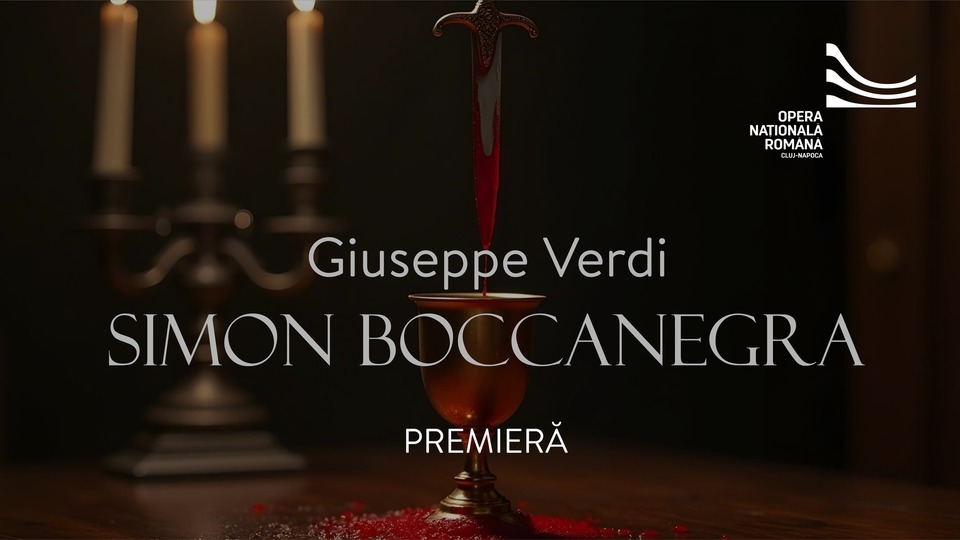
Verdi’s Simon Boccanegra at the Romanian National Opera in Cluj-Napoca
The Romanian National Opera in Cluj-Napoca has commenced the new season with the premiere of Giuseppe Verdi's opera Simon Boccanegra.
The Romanian National Opera in Cluj-Napoca has commenced the 2025-2026 season with the premiere of Giuseppe Verdi's opera, Simon Boccanegra on Saturday, the 4th of October 2025. I had the honour of watching the first performance, all thanks to the invitation extended by the institution's general director. The audience had the opportunity to watch the opera with a different cast interpreting the leading roles the following evening.
Simon Boccanegra is an opera that has only just been performed for the first time within the institution, as it rarely gets performed in Romania. It has previously been part of the Bucharest Opera's repertoire, it is currently part of the Craiova Opera's repertoire, and it previously got performed in concert at Timişoara. The opera consists of a prologue and three acts, being based on an original libretto signed by Francesco Maria Piave (with alterations made by Giuseppe Montanelli) that got revised after the opera turned out to be a failure at its premiere in Venice . back in 1857. The aforementioned revision included the music and the libretto alike, which got made by Arrigo Boito. The new version of the opera got presented at La Scala in 1881, which it was a great success. The opera is based on the play of the same name written by Antonio García Gutiérrez. Simon Boccanegra was a real historical figure, namely the first Doge of the Republic of Genoa; He got removed from office but got reinstated later on, and he ends up dying after being poisoned by his enemies. Boccanegra pursued a no-violence policy towards Venice during his time as a Doge. Venice was Genoa's main rival in the merchant navy, and he maintained good ties with Venice for a joint defence against the Ottomans.
The production features the genius of the renowned Italian bass Roberto Scandiuzzi, who just had his debut as a director. The Italian artist had performed Fiesco's role for more than 500 times, which also happened to mark his international debut at Covent Garden in 1991. Scandiuzzi is very familiar with the opera as a result. By being featured in a classical style and set within the original historical era, the production ended up being loyal to the score and libretto, thus the execution was made in very good taste. I did not perceive anything unique or novel in terms of directorial ideas, but I did appreciate that it did not stray away from the score, as it often happens these days, sadly. The Cluj audience leans towards traditional approaches, thus rejecting any sort of challenges or experiments that would alter the music or scenery in such way that it would be at odds with the libretto. As a result, the production is a masterpiece that brings forth the voices of the performers, keeping the singers within the spotlight. The character development and the dynamics instilled in the soloists by Scandiuzzi were equally excellent, with the singers putting on excellent acts due to bearing a profound understanding of their roles. The stage stylist Anca Pintilie created intricate sets and costumes that are accurate to the Genoa of the14th-century, while still respecting the stage directions written in the score: the small square within the prologue that bears the church wall and a lantern, then the arches of a palace terrace in Act I, a simple council room, one of the Doge's chambers in Act II, and a room inside the palace for the finale. The the image of a ship was a recurring creative element throughout the drama by appearing in various forms, and it ultimately becomes a ship on which Simon sails to the afterlife, a symbolic way of being swallowed up by the depths of the sea that he once ruled. Lorenzo Caproli created lighting design that evoked the atmosphere of Renaissance paintings without ruining the day/night transitions indicated within the score. Luca Attili was the genius behind the video design that consisted of fascinatingly realistic images, such as the sea visible through the arches of the palace terrace.
There is a prologue just like in Il Trovatore, and the plot is quite complex. However, there is a major difference in Boccanegra compared to Il Trovatore, where we can follow the action as it unfolds. The plot from Act I takes place 25 years after the events of the prologue: Simon is the Doge, but his rival Fiesco goes by Andrea Grimaldi now, and Simon's missing daughter (and Fiesco's granddaughter) is now Amelia Grimaldi, Andrea's adopted daughter. A narrator, played by Mihai Nițu was introduced to help the audience have a better understanding and to keep clarity upon the relationships between the characters. The narration takes place in front of the orchestra pit during the first intermission for the change of the set between the prologue and Act I.
Save for an exception, almost the entire solo cast and the ensembles made their debut in this production. Just like any debut of this magnitude, emotions played a massive role, given that the time for the preparations was likely not enough, but any flaws coming from the orchestra pit or the chorus and soloists had grown rare the performance went on, while the most noticeable ones occurred mainly within the prologue.
I saw the play featuring the first cast, the one with baritone Florin Estefan in the main role. A new paternal role for him made by Verdi, as he himself described within an interview I've conducted with him, but a very nuanced character, either way. He grew in intensity within his role as the show went on, as the artist built a character that emanated the necessary nobility for his position, revealing the Doge's authoritarian yet politically sound nature on one hand, and an emotional father who is overwhelmed by his longing for his daughter, on the other. This is a baritone role that brims with lyrically charged phrases, thus demanding great care to nuance, and the performer paid close attention to both of these aspects.
The Georgian bass Sulkhan Jaiani made his debut as Fiesco. The singer possesses an impressively deep bass voice, with a sensational low register. Il lacerato spirito, Fiesco's aria from the prologue is the best-known piece from the entire opera, as it is a showpiece for basses for which the audience always has high expectations from. I would have liked a more nuanced and expressive interpretation that could have matched the quality of his voice. It was only during the final act when I've noticed the artist's genuine engagement with his role, while holding a duet with Simon.
The soprano Paula Iancic made yet another debut following her success in Aida in May, which it also got held in Cluj. She took on the roles of Maria Boccanegra and Amelia Grimaldi this time. The young artist is a graduate of the Cluj Academy of Music, and she is slowly is mastering very complex roles. I've known her ever since she was a student, but I'm still amazed by her vocal maturity that she has for her age. It's a beautiful voice with a rich, full-bodied tone and a well-mastered singing technique that allows her to execute both melodic phrases and passages that require skill with the utmost grace. What more could I wish for? Only for her exceptionally resonant voice that holds up well across all registers to create more nuances, and to breathe even more life into the musical discourse. But an artist needs to perform in front of an audience as often as possible for that to happen, as private, individual study alone isn't enough. I hope her new status as a soloist for the Bucharest Opera will do her well. Teodor Ilincăi, who is her on-stage lover, is also her husband in real life. The tenor made his debut as Gabriele Adorno. I'm very familiar with him and his most recent success in Il Trovatore at Marseille, even if it's been a few years since I last heard Teodor during a live performance, and I was impressed by his performance in this new role. I know that he is impetuous, bounding with energy, and having performances that always feature resounding high notes (just as this specific score demanded), but he surprised me this time by having a certain sweetness in his voice, passages rendered with refinement, and a mature approach to this score, during which heroic moments were present, naturally. Although this was a debut, Teodor was already familiar with the score from the time played the role of the Captain for Bucharest Opera production. In fact, the role of Gabriele Adorno was a dream that came true for him after nearly two decades.
Another young graduate of the Cluj Music Academy is the baritone Mihai Damian. He was the only one experienced with this score after having played Paolo a few years prior. As such, he was the most relaxed of the bunch, leading to a faithful portrayal of the Machiavellian character. The dramatic curse scene at the end of the first act excellently showcased his acting skills, thus flawless. His voice already shows a vocal maturity that would allow him to take up major baritone roles in the future, on top of being based on an excellent technique. We are looking forward to hear him compete in the Operalia at the end of this month, on top of following the ascension of his career.
The cast was completed by other soloists, who also delivered excellent performances for their debuts, namely the bass Zoltan Molnar as Pietro, the tenor Iosia Balteş as the Captain, and the soprano Ștefania Barz as a Maid.
The chorus that got trained by Corneliu Felecan and the theater's orchestra also heavily contributed to the performance, and praises are due for the latter's solo moments. The conductor was a musician perfectly suited for Italian opera, namely David Crescenzi, who also happens to be the artistic director of the Cluj Opera.
Translated by Andrada-Teodora Ivanov,
University of Bucharest, Faculty of Foreign Languages and Literatures, MTTLC, year II
Corrected by Silvia Petrescu


