



> Events
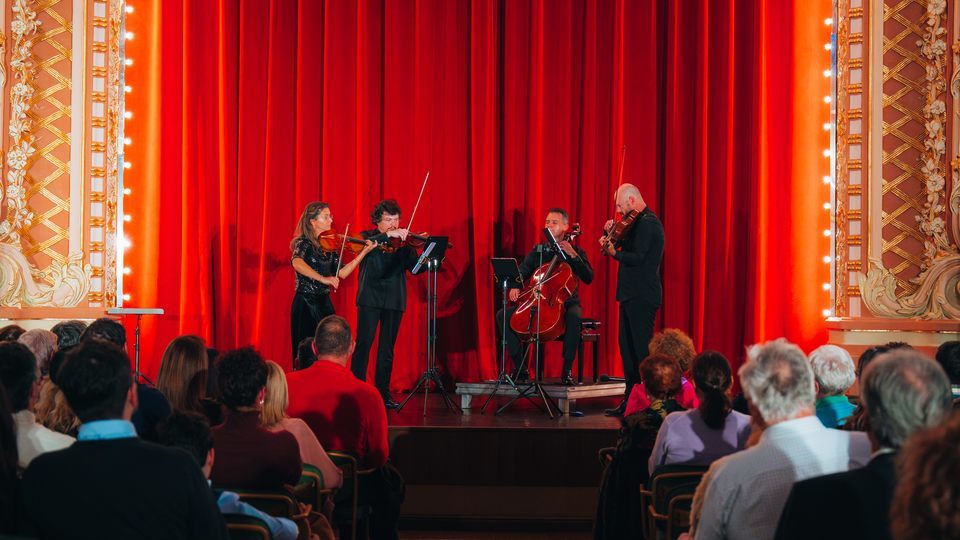
The Arcadia Quartet in Constanța
"Just write that they were exceptional, and that's it!" a friend tells me, noticing that I am jotting down a few thoughts during the intermission of the chamber concert given by the Arcadia Quartet. We are at the Constanța Casino, and her suggestion, though clearly a joke, is spot on and entirely in line with my own impressions. The four instrumentalists - violinists Ana Törok and Răsvan Dumitru, violist Traian Boală, and cellist Zsolt Török - make up one of the finest chamber ensembles of our time, not only locally, in their native Romania, but also on the international stage.
The Arcadia Quartet was formed in 2006, making 2026 an anniversary year for the ensemble - marking two decades of existence. Ana Török, Răsvan Dumitru, and Zsolt Török, all born in 1984, were students at the "Gheorghe Dima" Music Academy in Cluj-Napoca when they founded the quartet. In the early years, they collaborated with violists Marcel Cameniță and subsequently Cristian Suărășan, before Traian Boală joined the group; the lineup has remained unchanged since 2009. The Arcadia Quartet has performed on some of the world's most prestigious stages, including Wigmore Hall in London, the Concertgebouw in Amsterdam, the Musikverein in Vienna, the Konzerthaus in Berlin, Salle Gaveau in Paris, and Suntory Hall in Tokyo. They have also appeared at the "George Enescu" International Festival, as well as in Aldeburgh, Tel Aviv, and Beijing. In March 2015, they made their debut on BBC Radio 3 in a live concert broadcast from Wigmore Hall, and the following month, they became the quartet-in-residence at the "Tinerimea Română" (Romanian Youth) National Art Centre in Bucharest, with six concerts per year broadcast by Radio Romania. Their collaborators include Sarah Chang, Robert Levin, Amit Peled, Remus Azoiței, and the Belcea Quartet. Their debut album, featuring works by Mendelssohn and Brahms, was released in 2009 by Fontenay Classics, while an album dedicated to Janáček's quartets followed in 2013 on the Orchid Classics label. Since 2017, the Arcadia Quartet has been recording for the Chandos label. Their complete cycle of Bartók quartets (2018) was named "Disc of the Week" on BBC Radio 3 and received five-star ratings from Diapason and Classica magazines. Their cycle of the 17 quartets by Weinberg garnered five-star reviews, the German Record Critics' Award, and ICMA nominations, with the third volume receiving a Diapason d'Or. Since 2021, the quartet has organized the "Arcadia Chamber Music Classes" -masterclasses designed for young string ensembles. The Arcadia Quartet is nominated for the 2027 ICMA Awards in the Chamber Music category for the final volume of their Weinberg series. Each of the four members of the chamber ensemble is a musician with the Transylvania State Philharmonic Orchestra in Cluj-Napoca: Ana Törok serves as concertmaster, Răsvan Dumitru is the principal second violin, Traian Boală leads the viola section, and Zsolt Török leads the cello section.
For me, reuniting with them in the concert hall was a source of double delight, as the evening took place at the Constanța Casino, a splendid venue that I had not yet had the chance to visit following its renovation. I would therefore like to take this opportunity to thank the organizers of the Cazino Music Festival for the invitation to attend this concert in such a remarkably beautiful space! The extensive festival, which runs every weekend (Saturdays and Sundays) from September 12th to November 22nd, 2026, is under the artistic direction of Ioan Holender, a figure with a distinguished career and significant influence in the world of classical music. He set out (and succeeded!) to bring renowned artists and musical ensembles from across Europe to the public in Constanța over the course of eleven consecutive weekends. This inaugural edition of the Cazino Music Festival is now drawing to a close; the final two events will feature soprano Adela Zaharia (performing on November 14 and 15) and baritone Ionuț Pascu (in recital on November 21 and 22). Both opera singers will also engage in conversation with Ioan Holender as part of their stage appearances. To date, the refined and elegant setting of the Casino has hosted, among others, the Janoska Ensemble and I Solisti Veneti, opera singers Liviu Holender and Adriana Gonzalez, and instrumentalists Ania and Sophie Druml (full details can be found on the festival website: https://cazinoul.com/cazino-music-festival/ ).
A glance at the festival program reveals an intention to attract a broader, not necessarily specialized, audience through more accessible - yet high-quality and valuable - concerts. Consequently, the Arcadia Quartet's concert also featured a program composed of selections and excerpts rather than complete works (a case in point being Bartók's Six Romanian Folk Dances, performed in an arrangement for string quartet by Dan Variu), with a repertoire ranging from Johann Sebastian Bach to ABBA. In fact, this was the very title of the evening: "From Bach to ABBA."
In a sense, we witnessed a brief lesson in music history, journeying through works by J.S. Bach, Haydn, Mozart, Beethoven, Mendelssohn, Brahms, and Johann Strauss II in the first half, followed by Dvořák, Rachmaninoff, Chopin, Kreisler, Piazzolla, McLean, Bartók, and Metea - concluding with "Money, Money, Money," the famous hit by the Swedish group ABBA. The encore, offered in response to the audience's enthusiastic applause, was a piece of film music: the main theme from The Pink Panther by Henry Mancini. The first part of the program consisted primarily of selections from string quartets: the Fugue from Haydn's Quartet Op. 20, No. 5; the Adagio affettuoso ed appassionato from Beethoven's String Quartet Op. 18, No. 1; the Adagio - Allegro vivace from Mendelssohn's String Quartet Op. 13, No. 2; as well as the finale of Brahms's Quartet Op. 51, No. 1. After a short intermission, we heard string quartet arrangements of Dvořák's Humoresque, Rachmaninoff's Vocalise, Chopin's Grand Valse Brillante, the Tik-Tak Polka by Johann Strauss II, Kreisler's Liebesleid, and Piazzolla's Oblivion. In addition to these, the program also featured Csárdás (attributed to Monti/McLean), Bagatelle No. 4 by Răzvan Metea, the Aria from J.S. Bach's Orchestral Suite No. 3, and Roses from the South by Johann Strauss II.
This is why I wrote that I had also witnessed a brief lesson in music history - and, by extension, a lesson on the history and evolution of the string quartet - presented in the most natural and engaging way possible by this extraordinary chamber ensemble. The evening felt like a sonic exploration through an impressively diverse catalog of styles, articulations, phrasings, and timbral combinations; we had the opportunity to observe the full range of resources and qualities of a string quartet, demonstrated at the highest level. Seated near me in the hall was a very young composer, a student at the Bucharest Conservatory, who had a great deal to learn from this concert (as, indeed, did we all). Afterward, he even spoke specifically with the Quartet's violist about certain sound effects he had heard, inquiring how they might be notated in a score. The fact that the musicians were so open and receptive is, once again, truly wonderful!
I enjoyed everything, but the first part of the evening left a particularly strong impression on me. I was mesmerized by the delicacy of the Bach aria that opened the evening; I admired the fluid, coherent execution of the contrapuntal interplay in Haydn's fugue; I was moved to the verge of tears by the emotional intensity of the Beethovenian passage; and I rediscovered the balance in Mendelssohn's music, as well as the tumult and passion in the finale of the Brahms quartet. The first half concluded with Roses from the South by Johann Strauss II - a waltz that set the stage for the second part of the evening, which brought us into the music of the 19th, 20th, and 21st centuries. I was also pleased to see Piazzolla's Oblivion (arranged by Uwe Müller) on the program; personally, I might have preferred a more deliberately "unrefined" approach - a bit grittier, while still maintaining the lyricism demanded by the score, and perhaps with more freedom, more rubato. Of course, this is a matter of personal taste and in no way diminishes the highly balanced, well-structured interpretation presented by the Arcadia Quartet.
I often reflect on how an event with positive connotations tends to attract other equally good developments. In this instance, it seems that the renovation of this extraordinary symbol of Constanța, the splendid Art Nouveau-style Casino, is also ushering in a cultural revival in a city where, until recently, the cultural landscape had been rather barren. In this regard, it seemed to me that Traian Boală, the violist of the Arcadia Quartet, who hails from Constanța, felt the same way. He mentioned being more moved than usual, as he was performing at home - something that does not happen very often.
Review produced with the support of the "Friends of Radio România Muzical" Association
Translated by Alia-Iarina Popa,
University of Bucharest, Faculty of Foreign Languages and Literatures, MTTLC, year I
Corrected by Silvia Petrescu


