



> Events
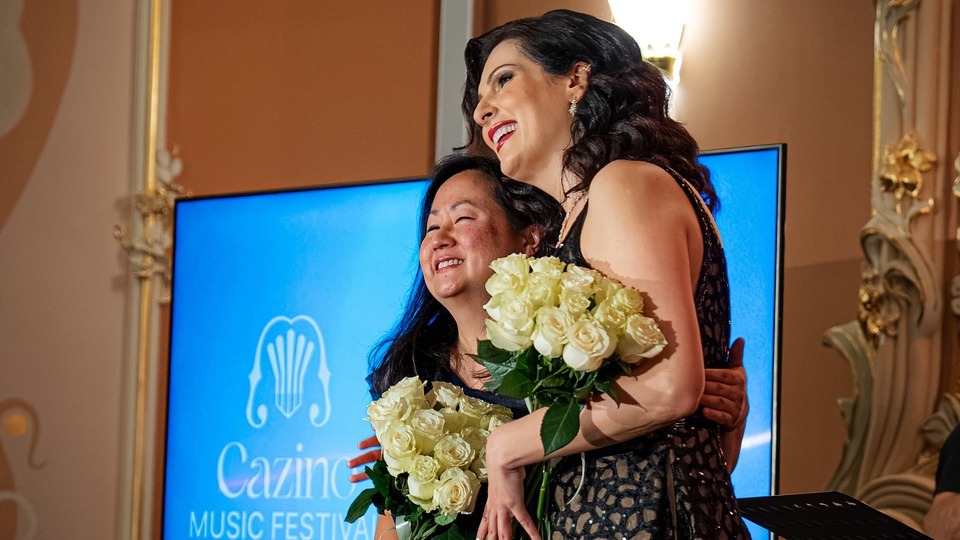
An Evening of Excellence with Soprano Adela Zaharia at the “Cazino Music Festival”
The inaugural edition of the "Cazino Music Festival" is drawing to a close, with the final two weekends dedicated to opera, hosted within the iconic, recently renovated building in Constanța.
On the 14th - 15th of November, the festival featured soprano Adela Zaharia, a prominent figure in today's opera world. She is currently the only Romanian soprano whose career spans the globe's most prestigious stages, including the Royal Opera House (Covent Garden) in London, the Metropolitan Opera in New York, the Vienna State Opera, the Paris National Opera, and La Scala in Milan (where she is set to make her long-awaited debut in February 2027). A true globe-trotter, Adela performs on stages across four continents, yet she returns to Romania about twice a year - typically in either Cluj-Napoca, where she studied and first performed, or Bucharest. It is also worth noting that she is a winner of the prestigious Operalia competition (2017) and has been a member of the Deutsche Oper am Rhein (German Opera on the Rhine) since 2015. It is within this institution that Adela has flourished as a professional, working alongside many other accomplished Romanian soloists, nearly all of whom are graduates of the academy in Cluj.
Given her extensive body of work, her appearance at the festival in Constanța, held under the artistic direction of Ioan Holender, came as a wonderful surprise, especially since Adela had been forced to cancel a subsequent engagement due to health issues following her resounding debut as Ophelia (in Ambroise Thomas's Hamlet) in Paris. Thus, her return to the public stage after a month-long hiatus took place in Romania, in an intimate setting: a recital designed to highlight pivotal moments in her professional life, with the artist sharing details about these milestones in conversation with the festival's artistic director.
Responding to the organizers' invitation, I was among the audience on the first evening, as part of a delegation from Radio România Muzical that included station manager Cristina Comandaşu and my colleague Irina Cristina Vasilescu (who will be sharing an interview she conducted with the artist). Despite a rainy, exceptionally blustery day - though the sun would emerge by Sunday- the venue, which seats over 200 people, was filled not only with music lovers from Constanța, but also with visitors from neighboring towns and even Bucharest, who had traveled specifically for this event.
Sporting a glamorous outfit for each of the two halves of the recital, featuring gold tones in the first and black in the second, Adela Zaharia opened the program with a piece frequently heard as an encore: Lauretta's aria from Giacomo Puccini's Gianni Schicchi (a surprise, as it was not listed in the program). Her opulent voice, characterized by remarkable consistency across registers and immense volume, immediately filled the hall, delighting the audience from the very first notes.
Throughout the evening, the "one-woman orchestra" - the discreet and attentive musician accompanying Adela - was Laura Poe (whose name did not appear anywhere in the program!). An American pianist and conductor of Korean descent, Laura Poe has been a member of the artistic staff at the Deutsche Oper am Rhein since 2011; she also collaborates frequently with other major opera houses, including the Metropolitan Opera in New York, the San Francisco Opera, and the Gran Teatre del Liceu in Barcelona.
This was followed by a brief anecdote about how Adela came to pursue singing: while a student at the "Sabin Drăgoi" College of Arts in Arad, she was actually enrolled in the music theory track. Her teachers, having already recognized the quality of her voice, chose her to represent the college at the national music olympiad (around 2005-2006). Needing preparation for the event, she began studying with mezzo-soprano Mihaela Işpan - a highly regarded soloist at the Bucharest National Opera, who this autumn marks two decades with the company. The outcome was a victory in a competition that altered the artist's life path, leading her to choose vocal studies at the university level. The aria that secured her win - which we also heard this past Saturday evening - was "Giunse alfin il momento… Deh vieni, non tardar" from Wolfgang Amadeus Mozart's The Marriage of Figaro. It is a challenging piece for a soubrette voice (the vocal type for which the character of Susanna is conceived), spanning two octaves and thus showcasing the performer's qualities - and, by extension, her technical skill.
It was noteworthy that, alongside the name of Mihaela (who deserves credit for introducing Adela to the world of vocal art), the artist also mentioned soprano Niculina Mirea - a figure from the "golden generation" of Cluj (and beyond), renowned for her prodigious pedagogical career and her mastery of vocal technique. Mirea supported her throughout her university years, during which Adela also studied under tenor Marius Vlad Budoiu, another prominent and highly regarded name in the opera world. However, Adela's aspirations lay not with the opera stage, but rather with the concert hall; she felt far more at home with the vocal-symphonic repertoire, which had been a formative part of her upbringing in Arad. This preference guided her choice of a solo piece: "In trutina," from Carl Orff's Carmina Burana, which she performed with a sensual, velvety voice.
After completing her master's studies in Cluj-Napoca, Adela was accepted into the young artist studio at the Komische Oper Berlin. Her first production there was Puccini's La bohème, in which she sang the role of Musetta. At the end of her tenure, she was cast as Pamina in W. A. Mozart's The Magic Flute - a production that also included a tour. Consequently, during her recital, Adela Zaharia delighted the audience with both Musetta's waltz and Pamina's aria, "Ach, ich fühl's, es ist verschwunden."
The end of the first part touched upon her first contract with the Deutsche Oper am Rhein, where her career path was steered toward a lyric, coloratura repertoire. In this context, she embodied two roles that showcased her talents and opened new doors: Lucia in Gaetano Donizetti's Lucia di Lammermoor and Konstanze in Mozart's The Abduction from the Seraglio. Notably, it was with the role of Lucia that she won the Opera category at the prestigious Operalia competition in 2017 - another pivotal milestone in Adela's professional achievements. While no other works were presented through live performances, the audience was treated to the grand "mad scene" from Lucia di Lammermoor, drawn from the artist's personal archives (an unconventional choice, one might say…).
The second part of the recital (as well as the dialogue) opened with a splendid aria from the zarzuela Las hijas de Zebedeo by Ruperto Chapí, delivered in an incandescent performance. Indeed, in 2017, Adela triumphed not only in the Opera category at Operalia but also in the Zarzuela category-a testament to her ambition and curiosity to broaden her horizons, as that was her first encounter with this Spanish lyrical genre. On Saturday evening, "Carceleras" was met with an ovation; the performance was marked not only by superb vocal execution but also by exemplary stage presence. At the same time, this particular aria triggered the most intense acoustic reverberations in the hall; the domed ceiling and the entirely uncovered wooden floor create an acoustic effect with resonances that can compromise the listening experience. While I cannot speak to how it sounds when one or more instrumentalists-or vocalists with smaller voices-perform on the intimate stage in front of the curtain, a voice of Adela's caliber demands that the hall be acoustically prepared, ensuring the evening remains truly impeccable.
Furthermore, given Adela's affinity for the Lied, she also performed "Amor" from Richard Strauss's Sechs Lieder, Op. 68 - a chamber miniature that is exceptionally demanding from a technical standpoint.
When an opera singer is asked about their favorite role, the answer is almost invariably, "the one I am singing right now." While I am certain that all their energy is indeed focused on the role at hand, I am equally sure that every artist has a "role of the heart" - one that fits them like a glove and serves as their calling card. Adela confided that Violetta is that role for her; it has brought her the most engagements, and she is confident it will continue to provide professional fulfillment for a long time to come. Her rendition of "È strano!… Ah, fors'è lui… Sempre libera" from Giuseppe Verdi's La Traviata was truly lived - performed with striking intensity, shifting vocal colors and emotional states, and leaving us breathless through a cascade of coloratura, including the traditional high E-flat. Furthermore, the long, sustained musical phrases - delivered with that signature "Cluj" style - only heightened the sense of an exceptional performance. Was there any sign of holding back following her vocal rest over the past month? Not in the least! Naturally, being a perfectionist by nature, Adela herself might not have viewed it as a remarkable achievement, but we all witnessed a masterful performance. If I had to single out a favorite musical moment from the program, this was it, serving as a true high point of the evening.
According to the program, another video clip from the artist's archive was scheduled to follow La Traviata, offering a well-deserved breather, but a tour de force was chosen instead; the recital concluded (after a brief exchange with Ioan Holender, the festival's artistic director) with another famous aria: "Casta Diva" from Vincenzo Bellini's Norma. The video I mentioned was actually screened before La Traviata. It featured a recording of Gilda's aria from Giuseppe Verdi's Rigoletto, recalling the moment of Adela's final graduation exam, held on the stage of the Romanian National Opera in Cluj-Napoca - a role that would later accompany her across many of the world's stages, reaching as far as San Francisco.
Was there an encore? Of course! Adela Zaharia told us that she couldn't perform in her home country without including a Romanian piece; consequently, she delighted us with a chamber gem - "Mult mă-ntreabă inima" ("My Heart Often Asks Me") - composed by Tiberiu Brediceanu to folk lyrics. She performed it with great sensitivity and, quite possibly, a longing for "home."
All in all, it was a wonderful evening, and the Constanța Casino has emerged as a new cultural destination, one that certainly deserves a place on the map for music lovers in Constanța and beyond.
Next weekend, a recital by baritone Ionuț Pascu is scheduled, also spanning two consecutive evenings (and I suspect he will be accompanied by a pianist...). I will tell you more about that next week, as I shall be back in Constanța this Saturday.
Translated by Alia-Iarina Popa,
University of Bucharest, Faculty of Foreign Languages and Literatures, MTTLC, year I
Corrected by Silvia Petrescu


