



> Interviews
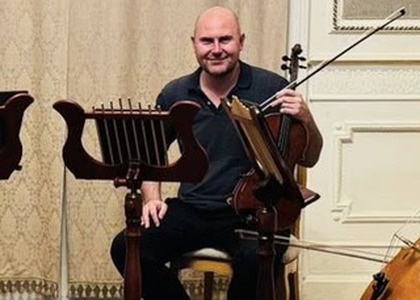
Interview with violist Cristian Andriș, member of the Romanian String Quartet
Cristian Andriș: "Every time, we aim to create unique projects for the Romanian cultural scene. In this endeavour that we propose, we have rediscovered two pieces that have, probably, never been played in the last hundred years."
On Saturday, the 4th of October 2025, the Small Hall of the Romanian Athenaeum will host a recital given by the Romanian String Quartet, in which the public will be able to listen to Romanian creations for string quartet, written by important composers of the 20th century, as well as to a contemporary sheet. More details are provided by violist Cristian Andriș, the artistic director of the band, in a dialogue with Ioana Țintea.
Mr. Cristian Andriș, Rediscovering Romanian Music is the title of the recital proposed by the Romanian String Quartet. To begin with, I would like you to tell us a bit about this concept. What does this title mean for the Romanian String Quartet?
Every time, we aim to create unique projects for the Romanian cultural scene. In this endeavour that we propose, we have rediscovered two pieces that have, probably, never been played in the last hundred years. One of these is Quartet no.2 by Sabin Drăgoi, which was composed in Prague. In our program, we also have Quartet no.1 by Sabin Drăgoi. We will reissue both scores; we discovered that the parts for all instruments, written by hand, the staves were barely visible, and we will print new scores made by Corina Ciuclea and edited by every member of the Romanian String Quartet. There have also been discrepancies between the parts of each player and the general score. Thus, we wish to offer the future generations clean scores with correct indications.
We have also taken up in the program of our tour - for it is a six-concert tour, three in Romania and three in Europe - another special quartet written by Mihail Andricu. From what we know, this piece has also been played only by our quartet line-up in the last tens of years.
And, last but not least, we have a piece which came from Call for Scores, written by Cezar Cochisă, called Vestirea mioriței, whose base is a theme from Miorița from Belinț, a theme that has also been used by Gyorgy Ligeti in The Romanian Concert. It was a given theme on which several composers had written pieces, and Cezar Cochisa and his piece had won this call for compositions.
How do you describe Sabin Drăgoi's string quartets for the public that will, perhaps, listen to them for the first time?
They are very different. We had Quartet no.1 in our concert program and, for the first time, we played Quartet no.2 at the end of August, in Timișoara, and we initially had the impression that it had been written by another composer. The compositional language is totally different. Quartet no.2 was written for a composition competition; it has won second place in the Praga Competition and it is a quartet with an impressionist language, I would say, under Enescu's guidance. Quartet no.1 is based more on folk language, as many folklore elements can be found.
What can we discover in String Quartet op.14 by Mihail Andricu?
Quartet op.14 also has, at its base, folklore elements and, somehow, it is the bridge. Mihail Andricu studied in Paris with Gabriel Fauré - let us remember the strong connection between Romania and France - alongside George Enescu. So, it may somehow be a language which very well connects Sabin Drăgoi and Quartet op.14 by Mihail Andricu.
What is your opinion on the role of Romanian chamber music on international stages? What do you think it should be done for it to be promoted it better?
First of all, it is our duty as Romanians to perform this music, to perform it as often as we can, to take all up alongside other renowned opuses from the chamber music repertoire and, thus, to have the public come in contact with them.
They are in no way inferior to pieces written by Dvorak or by Schubert, especially because we are dealing with composers who have studied in Paris or Prague; somehow, they had permanently been connected with what had been happening in the European musical scene of that time.
What are the next stages of the Rediscovering Romanian Music project and what other Romanian scores do you have in mind to bring back to the public attention?
The bright side is that we have also rediscovered, so to speak, scores; some even written by very well-known composers in our country, but we prefer to not reveal all the surprises yet. We will take them up in the tour that we will do next year.
Translated by Ana-Maria Duță,
University of Bucharest, Faculty of Foreign Languages and Literatures, MTTLC, year I
Corrected by Silvia Petrescu


