



> Interviews
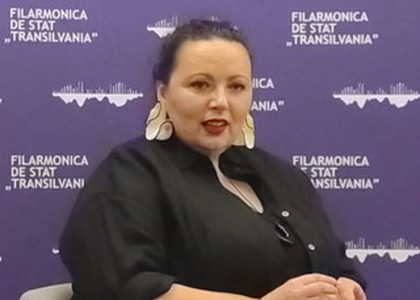
Interview with Silvia Sbârciu, “Transilvania” Philarmonic’s manager
The manager of Transylvania Philharmonic, Silvia Sbârciu, discussed in an interview with Ana Sireteanu about the events marking the institution's 70th anniversary, which takes place in December 2025.
Ms. Silvia Sbârciu, the Transylvania Philharmonic Orchestra in Cluj-Napoca celebrated its 70th anniversary on the 4th of December, 2025. Firstly, I would like to ask you to join me in recalling some of the most significant moments in the history of this institution.
The Transylvania State Philharmonic Orchestra was, as is well known, founded in 1955 by an official decree of the Council of Ministers. At the time of its establishment, the ensemble consisted of a large symphony orchestra with approximately 75 musicians, picked by a highly prestigious committee chaired by the great conductor Antonin Ciolan and a traditional music orchestra of 20 musicians.
On the 4th of December, 1955, the Philharmonic Orchestra had its first concert, an extremely large-scale event with a very rich repertoire, a veritable tour de force, featuring Wagner's Prelude to the opera "Die Meistersinger von Nürnberg", Toduță's Concerto for String Orchestra and Rachmaninoff's Piano Concerto No. 2, performed by Silvia Șerbescu. In early 1956, Antonin Ciolan took over as director of the Philharmonic.
The music tradition in Cluj dates back to the late 18th and early 19th century and against this backdrop, thanks to the training provided by maestro Ciolan and the education given to young people by the Academy of Music, then known as the "Gheorge Dima" Conservatory, this institution progressed particularly fast and in a short time, the "Transylvania" State Philharmonic Orchestra became one of country's most important.
Then, of course, conductors such as Emil Simon, Erich Bergel and Cristian Mandeal made their mark on this orchestra, with Mandeal enjoying one of the most beautiful and fruitful periods of his early artistic career at the orchestra's helm.
In 1965, the Philharmonic launched the "Cluj Musical Autumn", which is a very important festival that has been held without interruption.
And in 1972, when Sigismund Toduță was the director, when the Philharmonic Choir was founded, today being one of the best choirs in Europe, founded by Dorian Pop and followed by his disciples Florentin Mihăescu and now, Cornel Groza.
Of course, among distinguished guest of the Philharmonic such as Kurt Masur, Kirill Kondrashin, Witold Lutoslawski, Carlo Zecchi, Iannis Xenakis, Aldo Ciccolini, Krysztof Penderecki, Sir John Pritchard, Andre Jolivet, Maurice Handford, Valery Gergiev, Aleksandr Dimitriev, Lawrence Foster, of course who stayed with the Transylvania State Philharmonic and now is, in fact, conductor emeritus, Antonello Aallemandi, Sascha Goetzel, John Axelrod, Jörg Widmann, even Sviatoslav Richter, many years ago, Friedrich Gulda, Annie Fischer, Dmitri Bashikov himself, Lazar Berman, Radu Lupu, Silvia Marcovici, Mihaela Martin, Bruno Leonardo Gelber, Philippe Entemont, David Grimal, artists of great value who have contributed to the establishment of an international standard of excellence.
Following the two great musicians I mentioned, the Philharmonic was led by the writer Dimitru Mircea, Rodica Pop, musicologist, the composer Adrian Pop, under whose direction, the current name of the Transylvania State Philharmonic was adopted, the violinist George Dudea, the conductor Emil Simon, Denisa Piteiu, the violinist Dorina Mangra and the pianist and translator Marius Tabacu.
In the recent years, the Philharmonic has gained significant international recognition through its recordings with major recording labels and continues on this path, in a natural, self-evident way, as an extremely valuable concert institution, a true jewel for Cluj and for Romania, in fact; it is one of the best performing arts institutions in the country.
You have already marked the 4th of December with an OpenDoors Day, during which the audience from Cluj was able to attend the dress rehearsal before the special vocal-symphonic concerto featuring Joseph Haydn's "The Creation". What impact did these encounters with the audience have?
In fact, the anniversary period was perhaps longer because we wanted to mark this moment with a series of events that began on the 2nd of December, with chamber concerts, short interludes over several days, meetings with the audience, a journey through time by making older recordings of the Transylvania State Philharmonic available on vinyl, which the Cluj audience could listen to at the Edison Music House, a newly established location that we now use, meaning we have become partners and made it available to the general public. It was a beautiful journey of a series of events through time, that took place both Edison House and at the Academic College.
The general rehearsal attracted a young and a very enthusiastic audience, whom we hope to see again in concert halls. In fact, all our efforts are aimed at diversifying our repertoire a little, but also attracting a new audience, which may not have been very interested in classical music until now, but is gradually becoming very enthusiastic audience, interested in cultural events rather than entertainment, and even filling our concert halls. And because it is extremely important, the survival of classical music is also determined by this interest of people, we opened the doors, took them on a journey through time and brought them closer to classical music through all the events we made available.
What other concerts have you prepared for the anniversary series of events?
Of course, the entire season is dedicated to celebrate 70 years of existence. We will continue to have many concerts around the winter holidays, concerts through which the members of the Transylvania State Philharmonic Orchestra will perform a symphonic repertoire, even if it is Christmas or New Year's Eve, but which will once again bring us closer to the general public.
In fact, the events are almost sold out, a very clear sign that public interest has grown significantly in recent years, and in the future, we will of course, continue this trend of bringing great artists, great conductors, great soloists to the philharmonic stage and to be able to keep up with what is happening around the world in terms of schedule diversity, but also in terms of the artistic act and the level of the artistic acts itself, because, finally, the Cluj audience can attend concerts that can stand on any major stage in the world.
What thoughts come to your mind thinking about the anniversary and what are your plans for the future?
In the future, we will certainly continue our current efforts to attract audiences, because it is very important for the audience to maintain their interest in the arts. We strive to offer concerts of the highest artistic quality, which not only propose new and interesting repertoires or established, interesting repertoires that public expects, but also offer an impeccable artistic level worthy of the world's greatest stages.
Translated by Cosmin Marinel Șerban,
University of Bucharest, Faculty of Foreign Languages and Literatures, MTTLC, year I
Corrected by Silvia Petrescu


