



> Interviews
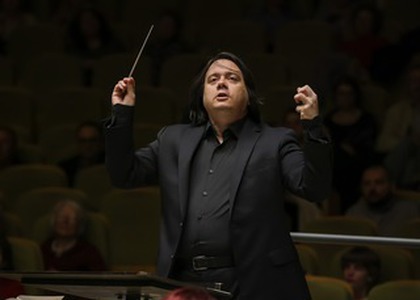
Interview with conductor Gabriel Bebeșelea, artistic director of the “Musica Ricercata” Festival
Gabriel Bebeșelea, artistic director of the Musica Ricercata Festival in Timișoara, will be on the rostrum for the two concerts that bring the current festival edition, op. 8, "Triads", to a close. This edition celebrates three major composers in the history of music - Johann Sebastian Bach, Georg Friedrich Händel, and Domenico Scarlatti - marking 340 years since their birth. Gabriel Bebeșelea spoke about the concept, programme, and guest artists of the two concerts, as well as about future plans.
You are about to conduct two concerts as part of Musica Ricercata Opus 8 - "Triads," a festival of which you are the artistic director. On Friday, December 12th, 2025, together with the "Banatul" Philharmonic Symphony Orchestra, you will present The Art of Fugue by Johann Sebastian Bach. How does this Bachian masterpiece, considered a sort of synthesis of Bach's contrapuntal art, fit into the programme dedicated to the three anniversaries - Johann Sebastian Bach, Domenico Scarlatti, and Georg Friedrich Händel?
This is precisely where the title of this edition, "Triads," comes from. Everything revolves around the three composers: we have programmes built around sets of three works, or structures that place this symbolism-so important to the Baroque era-at the forefront.
In my view, The Art of Fugue is not only the quintessence of Baroque counterpoint and polyphony; it is one of the most representative works of Western European culture as a whole. Moreover, the version we will perform on Friday is the one created by Erich Bergel, who not only orchestrated Johann Sebastian Bach's Art of Fugue, but also completed the final fugue, Fugue No. XVIII, while imprisoned in a communist jail, where he was incarcerated between 1959 and 1962.
There are numerous accounts from his brother describing how, while in prison, in order not to lose his sanity, he worked on The Art of Fugue, searching for solutions to complete the fugue left unfinished by Bach himself.
Why did we choose this particular version? Because this year also marks the 95th anniversary of the birth of Erich Bergel, one of the most important Romanian conductors, who served as a role model for subsequent generations of conductors and musicians alike.
And in the second concert you will conduct, on the 14th of December, entitled "Händel Gala," the Musica Ricercata Ensemble will welcome two outstanding guest soloists - soprano Julia Lezhneva and countertenor Valer Sabăduș…
This is a concert that gives me great joy, as it is the first time we have invited Julia Lezhneva, alongside Valer Sabăduș, who is appearing at the MusicaRicercata Festival for the second time. He is a Romanian-born countertenor whom I have also previously invited to perform at the George Enescu Philharmonic, in Johann Sebastian Bach's St Matthew Passion.
This time, we will present a Händel Gala, featuring excerpts from operas and oratorios by the great composer born in the same year as Johann Sebastian Bach and Domenico Scarlatti, 1685. Beyond the fact that Julia Lezhneva is one of the most important voices in the field of Baroque opera, possessing exceptional virtuosity, and that Valer Sabăduș is among the leading countertenors of our time, we are also delighted to have musicians such as Hiro Kurosaki in the MusicaRicercata Ensemble - one of the foremost specialists in Baroque music - with whom we plan to develop several future projects.
Therefore, it's a concert that I consider unmissable, as it offers a very rare opportunity to see Julia Lezhneva in Romania, especially performing the repertoire that made her famous - excerpts from the operas of Georg Friedrich Händel.
I understand that this is the first edition of the festival to be split into two parts, with what has begun now continuing into the spring-summer season. What are you preparing for the audience then?
In April, in… let's say Opus 8 Bis, we are preparing a project with baritone Michael Spyres, one of the most important voices of our time. It will be a Verdi project, but performed on period instruments. It is a project built around and inspired by Verdi's letters, in which he expressed concern about the rising pitch standard. All the works we will perform in this project are, in fact, pieces that Verdi mentioned in his letters should be played at a lower pitch - specifically 432 Hz, nearly a semitone lower than what happens with the tuning fork nowadays.
What other plans do you have for the near future?
First of all, to complete the research with Michael Spyres for this Verdi project, because it is an extremely laborious task and requires examining many of Giuseppe Verdi's manuscripts, which are held in various archives across Europe.
After that, I will return to Bucharest with the "George Enescu" Philharmonic. I will also return to the Concertgebouw in Amsterdam with the Ulster Orchestra. Further concerts are planned in Vienna, in Bochum, Germany, and I will return to the Philharmonic in Cologne…
So, a rather intense and busy period lies ahead.
Translated by Ruxandra Ioana Șerban,
University of Bucharest, Faculty of Foreign Languages and Literatures, MTTLC, year I
Corrected by Silvia Petrescu


