



> Interviews
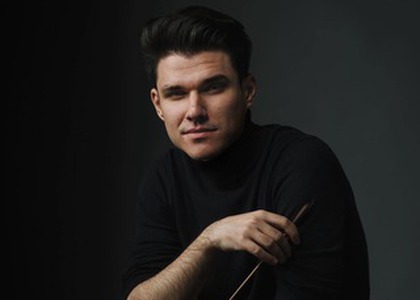
Interview with Andrei Stănculescu, conductor of the “Prelude – Voicu Enăchescu” Choir, guest on Perpetuum Mobile
Tonight, on our show's broadcast, you will be able to listen to the "Prelude - Voicu Enăchescu" Choir's Christmas concert live, right off the stage of the Romanian Athenaeum. Starting at 7 PM, the performance will include pieces that are customary for this time of the year, as well as works by Pyotr Ilich Tchaikovsky, Paul Constantinescu, Alin Chelărescu or Jose Feliciano, among others.
The concert is Romania's proposal for the European Radio Union's Christmas project, on the initiative of Radio Romania Musical. So, tonight's concert will be broadcast by 17 European radio stations, 9 of which will air it on December 14th, which is 2025's Euroradio Christmas Music Day.
The musical lead will be Andrei Stănculescu. The conductor is with me today in the Radio Romania Musical studio. Good evening!
Good evening!
Andrei, I'm happy to see you again on this occasion. You were telling me that you hadn't seen us in a long time. Each time, I'm glad to have guests closer to me in age and each time, I'm glad to have former college classmates. Before anything else, what I'd like to know is how have the rehearsals been going so far?
Very well! My colleagues are overjoyed and excited for this project, and they were graciously patient, as I was in Italy for two weeks. When I came back, everything was in perfect order. And I'm glad to say that in this last week of rehearsals I'm seeing my colleagues' professionalism and I can assure you that this will be high quality concert.
Let's discuss a bit about what this kind of concert means. How is it organized? How far in advance do you think of the program? How far in advance do you decide? Who will perform and what? Where will you play?
Regarding this program, I made the repertoire myself about a year ago. Because I'm trying to think about my own projects over at least a year, if not two. At first, I conceptualized it as a concert in three parts that would feature extra-European, European, and especially Romanian music and I fleshed it out five months ago. I started implementing it about two and a half months ago, maybe even three, if I'm not mistaken, because I knew a very busy period was coming up for the "Prelude - Voicu Enăchescu" choir. So I started it early and my colleagues were happy to play Christmas music in September.
What is the actual argument behind this project?
Ever since I took over this wonderful choir… Okay not just since I took over, I've always had an affinity for concept concerts or an idea that would birth an entire concert program, so I tried to show this in the way the "Prelude" Chamber Choir performs its repertoires and concerts. So, every year we've tapped into a different aspect of the winter holidays. A year ago we organized a concert, at the Athenaeum, with a band, and we played jazz arrangements. I remember that three years ago, we had a Christmas concert in memory of Voicu Enăchescu, where the repertoire was eminently Romanian and the focus was on 20th and 21st century music, because that's also a benchmark I tried to introduce into the way the "Prelude" brings to life the pieces of Romanian composers. And this year, because I was somewhat, gently criticized, like the choral music-loving audience tends to do, because Romanian music was absent last year, and part of the public told me I should organize more concerts that features jazz music and music with percussion instruments, I decided that this year I would create a program that satisfies every type of audience. And, as I was saying, I'm starting from the elegance of traditional English Christmas carols, Italian, Spanish Christmas music, the refinement and exuberance of Russian Romanticism with Tchaikovsky's "Elegy", and going through 20th and 21st century Romanian music. You mentioned our classmate, Alin Chelerescu, good friend of ours. I'll have the honor of playing this suite again. I performed it when it premiered, a few years ago, when we were classmates in the Conservatory's bachelor's program, and now I have the opportunity to bring it to the stage of the Romanian Athenaeum, together with the "Prelude" Chamber Choir. As I was saying, lastly, I decided on an extra-European repertoire, part religious and part secular, because in Africa there are songs about the winter holidays, but aren't necessarily about the sacred aspect. One of the pieces is from the tradition of the Indigenous people of what is now Canada, and American music with Latino influences, such as "Feliz Navidad", of a composer you mentioned towards the end of the presentation.
I'm very pleased with this concert, this project, this repertoire, and I hope people will be pleased together with us.
The Romanian audience isn't the only one who will be able to enjoy this concert. From what I understand, there's also 17 European radio stations. What does this mean for you? I know your choir is almost like a family. How did you celebrate these news and what does it mean for you?
It means so much to us. Every time I go abroad, I insist on showing Romanian music to my fellow conductors. Recently, like I said to Italy and gathered a few of my conductor colleagues and put on Enescu's music; we listened to Enescu's symphonies, we listened to Paul Constantinescu… And conductors, musicians outside Romania are still amazed by the quality of Romanian music. As such, the fact that there are these two parts of the concert that also address the music of some of the people from places where the radios broadcast, but the most important part of this concert for me is Romanian music, which will reach people outside Romania, thereby bringing to attention some composers that are as good as composers abroad. And here he is, a very young composer who has huge perspectives, that I'm proud to call a friend, Alin Chelerescu.
Sus la drumul mare ("Up at the highway"), a piece by Gelu Stratulat, performed by the "Prelude - Voicu Enăchescu" Choir, conducted by Andrei Stănculescu, who is with me in the Radio România Muzical Studio, a piece that you were telling me is by a composer that was you professor.
Yes, maestro Gelu Stratulat was my professor at the "Victor Giuleanu" High School of Arts in Râmnicu Vâlcea and was my mentor for many years, even after I finished school. He's one of the people who infected me with the virus of love for choral music, he's a man who listened with me to recordings of the "Prelude" Chamber Choir, the "Madrigal" Choir, recordings and choral music sheets that we used to comment on together. And at some point, when I was in my first year of college, he gifted me a score that we didn't perform as a premiere, I think that was a version for men's choir. For many years, he was a professor at the Râmnicu Vâlcea Theological Seminary. But this piece is very dear to me because it was gifted to me by my professor, and more than that, because it's from the Lipova area, and part of my mother's family is from Lipova, somewhere between Arad and Timișoara. So it's a very special piece for me, the choice made me happy.
I'd like to talk a little about the projects you had recently and the projects that are next… I want to make it clear that an opportunity such as the one we have tonight, to hear you, and for you, to belistened to in 17 European countries, doesn't come from nowhere. So, let's talk about how we got here? I understand you came back from Italy…
I participated at an Italian opera academy led by maestro Riccardo Muti. I had the opportunity to meet the legendary musician and work with him for two weeks on the opera "Don Giovanni" by Mozart at Fondazione Prada and it pleases me to say that the great people, I mean, I knew this from my previous meetings with Paavo Jarvi, François Xavier Roth, Cristian Măcelaru, great musicians, great artists, are people of great, great quality, immense modesty and extreme generosity for young conductors. So I came back with a lot of information that I'll try to put in practice.
And you'll be able to use them, from what I understand, in many concerts that will happen in January. First of which is a concert on January 14th.
January 14th, at the Oltenia Craiova Philharmonic, a concert dedicated to National Culture Day, Romanian music. Then, on January 15th, I'm coming back to Bucharest for a concert with the "Prelude" Chamber Choir, with a repertoire of choral music based on Mihai Eminescu's poetry, together with the "Arcadia" Quartet, at the Romanian Youth National Arts Center. Then, on January 29, the public can see me at the Arad Philharmonic, where I'll be conducting choirs by Verdi and a piece that's very important to me, Quattro pezzi sacri - "Four Sacred Pieces" by Giuseppe Verdi.
I can't help but notice the diversity this January. How do these projects reach you? How do you participate in so many concerts? And how much work is there behind preparing such a concert by yourself?
The work is permanent and unquantifiable, if you'll allow me. I couldn't pour salt on the wound. Anyway, the diversity of the projects I'm involved in comes from a life philosophy, from a choice I made some time ago, to dabble in all aspects of conducting, to conduct opera, vocal symphony, choir music, acapella music, accompanied, and so forth. I wanted to gain as much as I could from these domains to be able to call myself a musician, not just a conductor. And I'm sure that things will settle and I'll choose a main domain, or not. But, for now, I'm trying to do as much and as well as I can in all musical aspects I tackle.
And I'm sure we'll have the opportunity to meet again, and again, and again, because we're dealing with a great musician. Tonight, you'll be able to hear Andrei Stănculescu conducting the "Prelude - Voicu Enăchescu" Choir live, right off the stage of the Romanian Athenaeum's Grand Auditorium.
Andrei Stănculescu, thank you for your presence in the Radio România Muzical Studio, and good luck with the concert. From what I understands, it starts in an hour.
Photo credit: Florin Ghenade
Translated by Alexandra Teodora Ciolacu,
University of Bucharest, Faculty of Foreign Languages and Literatures, MTTLC, year II
Corrected by Silvia Petrescu


