



> Interviews
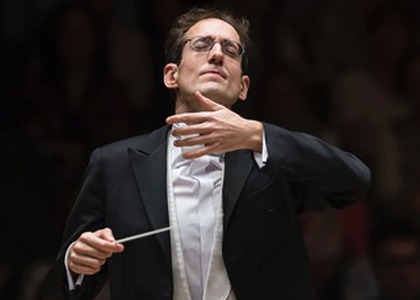
Interview with conductor Pablo Gonzalez
The Spanish conductor Pablo Gonzalez will conduct the National Radio Orchestra concert on Friday, December 12th, 2025. The soloist of the evening will be the cellist Răzvan Suma.
You conducted the concerts of the Spanish Youth Orchestra of the "Magic Summer" Festival at the Romanian Athenaeum and the "Enescu and the Music of the World" Festival in Sinaia back in 2018. How would you describe your encounters with the Romanian public?
They were a very warm and enthusiastic audience! I remember performing Bartok's Concerto for Orchestra and felt a very welcoming energy from the audience. So, I am looking forward to this concert, as well as a new encounter with the Romanian audience!
What do you think of the National Radio Orchestra after the first few rehearsals?
The orchestra has a lot of energy and I feel a very strong expressive force coming from them! I could compare it to that of a wild animal, in the best sense of the word. It is an extraordinary energy, and we are looking for the best ways to channel this energy to serve us during the performance. I am very pleased with the material that I am working with; the sound of the ensemble is ideal to me! This is an important asset, because it is difficult to create special moments when you have to work with an orchestra that does not have this sort of energy. In the symphonic poem that we will present in Friday's concert called "Death and Transfiguration", the passages where the composer wrote appassionato and espressivo had the right vibe from the very first rehearsal. It's really nice to be able to work with stuff like this. It's kind of like what Michelangelo said about sculpture: you have the block of stone and then you just chip away and remove the parts you don't need, and here it's kind of the same thing, which is fantastic!
When asked about his view of Spanish musical life, your fellow Javier Perianez told me that Spain has evolved considerably over the last 30 years. Do you agree with this statement?
Absolutely! We are very happy and fortunate to have so many new concert halls and orchestras that have been built within recent decades in Spain. Of course, our musical tradition is not as long as that of countries such as Germany or Russia, so it is a young country in terms of classical music tradition in a way, and I think we are still in development.
And the audience is quite loyal, indeed. There has been an orchestra in each region for about 30-40 years, and the media would report from time to time that there was a possibility that certain orchestras would disappear during the great economic crisis from around 2010. Then people went out in the streets and fought for music! No orchestra was disbanded during those days, and we are very lucky as such. There were such unfortunate actions happening in other countries such as Germany, the Netherlands, or the United Kingdom, which all have a deeper tradition for classical music. So, I am grateful for the audience that we have in Spain!
You regularly work with all the orchestras from your country, including the Spanish Youth Orchestra. What do you think of the younger generation of musicians?
I particularly enjoy working with young musicians because they have incredible energy and passion for music, and they don't have much experience besides that. So, for many of them it will be a first to perform certain pieces in an orchestra, such as Beethoven's Fifth Symphony, and that is a luxury for a conductor. Of course, musicians from a more experienced ensemble will respond more quickly to what you ask of them, but first you will have to "erase" the other versions that these musicians have performed, or which have turned into reflexes from their previous conductors. But you can build the interpretation from scratch with a youth orchestra, and that is a great opportunity to try to get as close as possible to the original text, to what the composer actually wanted, because it's like writing on a blank page.
What are your strategies when working with an orchestra for the first time? And how do you approach the rehearsals with a soloist before the concert?
I listen! I come with many ideas, but each ensemble has its own style. I have recently collaborated with the London Philharmonic Orchestra and we had a total of three hours of rehearsals: the concert was at 7 P.M., and we only started rehearsing from 3 P.M. onwards. I have had rehearsals over five days this week with the National Radio Orchestra. You have to try to adapt to the environment, to get a feel of the situation, to learn about the expectations of the orchestra members, and if they feel comfortable every single time. So, the most important thing in this case is to keep an open mind.
As for the first collaboration with a soloist, we have prepared Dvořák's Concerto for Cello and Orchestra for the upcoming Friday's programme, which is a work that we both know well and have performed many times beforehand, all that we have to do is to find common ground over this particular piece. For pieces such as Saint-Saëns' Cello Concerto or those signed Elgar place the cello as the undisputed protagonist, and in these cases I feel that the conductor must be at the soloist's disposal. But pieces such as those signed by Dvořák or Brahms' piano concertos have a strong concertante character, so to speak. The solo instrument is the protagonist for sure, but we have to find ways to bring the conductor's and the soloist's overall visions together, and I believe that dialogue is important in this case. As a conductor, I think that it's my duty to take a step back so that the soloist's vision must be in the spotlight when I collaborate with one, even when we don't agree about everything. However, I try to be convincing, in my own way, of course.
Translated by Andrada-Teodora Ivanov,
University of Bucharest, Faculty of Foreign Languages and Literatures, MTTLC, year I
Corrected by Silvia Petrescu


