


> Interviews
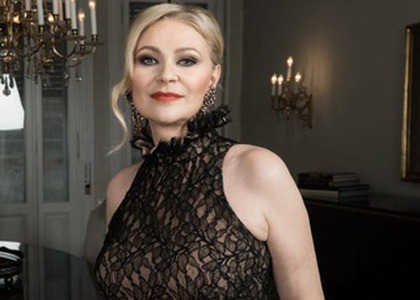
Interview with mezzo-soprano Ruxandra Donose
The famous mezzo-soprano Ruxandra Donose, acclaimed on the world's greatest stages, is the Radio Chamber Orchestra's special guest on Wednesday, December 17th, 2025. The evening's schedule includes Baroque arias by Antonio Vivaldi, Georg Friedrich Händel and Henry Purcell, among others, as well as the well-known "Cantique de Noel" by Adolphe Adam. Jonathan Bloxham will be conducting. The concert begins at 7:00 p.m. and will be broadcast live on Radio România Muzical.
You are based in Austria and perform on stages all over the world. How does it feel to return to your home country and especially to perform on the Radio Hall's stage?
I have been living in Austria for many years now, and I spend most of my time travelling.
Every time I return to Romania I feel a sense of joy, that feeling of coming home. No matter how often or rarely I manage to do so, every time I feel the same.
When it comes to the Radio, I feel even more like I'm coming home because I spent my childhood in the radio's concert studio as a music school student and as the daughter of the composer and musicologist Vasile Donose, who was the editor-in-chief of the music department at the Radio station for many years. So, I could say that I have a close and emotional connection with the Radio.
Regarding the concert's schedule at the Radio Hall, what do you consider to be challenges and particularities of the Baroque repertoire?
I am one of the singers who have not limited themselves to a particular category of music. I would even say that this is what characterizes me and what people know about me, the diversity that I always try to maintain in my repertoire.
There was a period of time when I played a lot of Baroque music and recorded, four of maybe even five complete Baroque operas, I think, and so what I can say about this genre of music is that it is full of delicate beauty. It doesn't have the violent power of a Wagner opera, for example. Ever since I played the piano, I have taken great pleasure in playing Bach. It seemed to me that it tuned me internally, brought me harmony, balanced me… And later, with my voice, I had the same feeling.
At the same time, I have read many specialized books and I would like to quote here something that I think is very important both for those who sing Baroque opera and for those who listen to it. It is an excerpt from a book by the great conductor Nikolaus Harnocourt, a specialist in Baroque and Mozart. He wrote that we should not forget that Monteverdi speaking of a Baroque even earlier than what we have here, was also Italian, also Mediterranean, had boiling blood, liked to drink a glass of red wine from time to time, liked the love and to singing.
So, what I quoted was from memory, but this is the essence, what I mean by this is that we, the performers, are not archaeologists who discover and research scores in the library, but we are people who try to bring that music to life, those people who wrote it, those times, those scores, with just as much passion and emotional involvement as with any other genres of music.
For you, does the mentoring come as a natural development of your stage work?
For me, yes. It's a natural consequence, a kind of fulfillment, the way I see it, the change I have to pass on all the experience I've accumulated and everything I've learned during my fairly long career. I know that not everyone has this joy or interest and it's not mandatory.
So, I believe that to be a mentor you need something more than just the experience you have accumulated. You need a certain aptitude and a great deal of love for young people who are trying to step through the gates of mastery. Maybe you need to remember the first steps you took yourself, and how happy you were when you received help.
It's a kind of communication that is both intellectual and emotional. I believe it's very important for a mentor to also be a good psychologist, to be a very open person with a lot of patience, but also with a lot of joy and passion for what they do.
You are one of the greatest lyrical artists born in Romania. What advice would you have for the new generation?
I believe nowadays that, more than ever, we need authenticity. We now have all the technical means at our disposal to access all music at the same time, both scores and recordings. We should never be tempted by the idea of sounding like someone else, of copying someone else; and at the same time, we should not be tempted, and I know this more difficult, by the idea of comparing ourselves directly with someone else. Because, yes, in any profession, and perhaps especially in ours, competition exists and is fierce, but you cannot win any competition unless you are truly yourself, the most authentic and unique version of yourself, precisely so that you cannot be compared to others.
What each person has to offer is the most important thing-to put all their work and study into the service of this becoming of the self, the best and most authentic version of each person.
You have had an international career spanning more than three decades. What does musical performance mean to you?
We're talking about an international career spanning three decades. I've been into music since I was six years old, so music is my life.
The fact that I have been pursuing a career in music education for several years now, while still playing quite a lot, is proof that music and my connection to music will never end for me. Even when my stage career ends, my connection to music will not end, because music is my passion and meditation, my escape, may help and support, my nourishment. Yes, it is my life!
Finally, what projects do you have on your agenda for the next period?
I am currently involved in a production of Richard Strauss's opera Die Frau ohne Schaatten (The Woman without a Shadow) at the Bonn Opera House - a new production with an extremely bold staging by the great senior German director Peter Konwitschny. We had the premiere two weeks ago and will continue to perform until the end of January. From Bucharest, I will go directly to Germany for a performance.
In February, I will return to Bucharest, to the Athenaeum, with a recital and a small tour of the country in the "Melodie Dor Magie" series, which I started with the pianist Sergiu Tuhuțiu last year - and it is an idea that has been very successful.
And then, starting in April, rehearsals begin for Verdi's Don Carlos at the Grange Park Opera Festival in England. I will also be performing there until July.
And throughout all this time, I am continuing my teaching career, continuing my contribution to the Anton Bruckner University of Arts in Linz, and I will also continue with some master classes in Romania, Hungary and Austria.
And, in fact, I have another project that does not fit into any of the categories mentioned so far - namely, another level at which I express myself creatively, namely writing. A book will probably be published in the spring or summer next year
Translated by Cosmin Șerban,
University of Bucharest, Faculty of Foreign Languages and Literatures, MTTLC, year I
Corrected by Silvia Petrescu


