



> Interviews
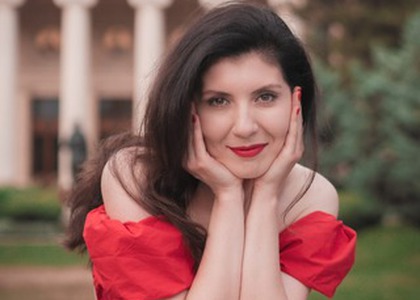
Interview with soprano Florina Ilie
The Vienna State Opera will premiere a new production of Ludwig van Beethoven's Fidelio on December 16th. The performance will be broadcast live by Radio România Muzical. As a singer of the Viennese institution for the 2023-2024 season, the soprano Florina Ilie would have played the role of Marzelline if it weren't for a health issue that arose during the main rehearsals. But I would like to offer you her interview and I hope to hear her voice again soon.
Marzelline is a role you have already played during the previous production in Vienna. How would you describe it in terms of the score and the character?
Yes, exactly. This is the second time I have been entrusted with this role, and it is a great joy and honour, as I have been able to master a major part of the German repertoire. It is a fact that Beethoven's music requires a slightly more robust voice and it is quite instrumental, so I had to adapt my voice to get as close to the German diction as possible, as well as having to keep everything true to the original source. I need to be able to rapidly switch between the sung and spoken parts.
How do you feel towards Marzelline as a character?
Marzellineis a girl who loves sincerely and purely. She hasn't ventured far from the world her father got her into. She hasn't left the world of the prison. She basically loves and falls in love with what she can and what she sees for the first time.
How did the musical instruction with the conductor Franz Welser-Möst go? Did you discover anything new? I know that Axel Kober was in charge of the previous production.
We worked together with a great deal of calm and tact. Franz Welser-Möst is one of Austria's most beloved conductors, and he came up with a very interesting idea: he mentioned that Fidelio is more of a philosophy and a lesson in humanity than an opera, and we went along with this idea and let the text to lead the music.
The show is directed by Nikolaus Habjan, a graduate in musical theatre directing and a major activity in puppetry. His passion for puppets is obvious in this production, as I've noticed that there are three puppeteers in the cast. Please tell us what the production will look like, how it is directed, and what role will the puppets play, since we will not be able to watch this show.
Nikolaus Habjan is making his debut at the Vienna State Opera, but he is quite well-known in Austria for his puppet shows. He basically is an actor and master puppeteer, as well as a professional classical music whistle player. His direction for Fidelio is classic but with two surprise elements. As you have mentioned, there are two life-sized puppets that represent the outer world of Leonore and Florestan. The singers' role is to portray the inner world of the characters as truthfully as possible with the help of their voices and Beethoven's music. The puppets are present and add a very interesting touch to this classic production.
If you were to compare it to the previous production, which one do you like it better?
I can't help but be biased since I worked harder on this one. I identify more closely with the current production, but Otto Schenk's production didn't leave me unfeeling, either. I'm glad I got to be part of both.
The European Broadcasting Union declared that it will used a recently edited score, which contains spoken parts written by Paulus Hochgatterer. Can you tell us more about this?
The dialogues have been rewritten to bring them up to date but meant to preserve the narrative by keeping changes minimal. What Nikolaus Habjan wanted was to make the transition between the spoken and sung parts as smooth as possible, so that there would be no awkward pauses. And I think you will appreciate when you'd listen to it and there will be no disruptions in the flow.
The famous Leonora Overture No. 3 is only sometimes included in this opera, but this time we are going to hear it. Is this true?
Yes, it will not be missing and will still be performed with the curtains closed in order to allow the audience to...
To enjoy the music, which would make this a truly classical performance from some points of view, in which the musical interludes - because they cannot be called overtures here - will be left without on-stage performance so that the music can stand out.
Exactly, and I think that's very important. It must also stress that this premiere is probably the most anticipated Viennese premiere within the recent years. It was last performed 55 years ago with hundreds of performances under its belt.
Was the previous performance which you got involved into an old one, of over 50 years old?
Yes, it was a production of over 55 years old.
It really is a reason to celebrate for the Viennese audience.
Yes, and Fidelio practically opened the Viennese opera season every single time. The Viennese stage season of 1869 opened with Fidelio (editor's note: the second title performed immediately after the inauguration), and then again in 1955 after the Vienna State Opera got bombed. And now Fidelio is back in the spotlight, 70 years after its reopening.
You will partake in a new premiere at the Vienna State Opera after Fidelio, namely Mozart's La clemenza di Tito, which I hope that we will broadcast it live in March. Then you will perform pieces written by Mozart yet again as Pamina in The Magic Flute. I am curious to know if you have plans for new debuts. What new roles would you like to play, or perhaps you have already been offered roles for the near future?
Indeed, Servilia and Pamina are my upcoming roles. However, I can't give you any details for the next season. I would very much prefer to be able to perform Italian and French pieces over German ones, but the roles are always split between the performers when you are being part of an ensemble.
Translated by Andrada-Teodora Ivanov,
University of Bucharest, Faculty of Foreign Languages and Literatures, MTTLC, year I
Corrected by Silvia Petrescu


