


> Interviews
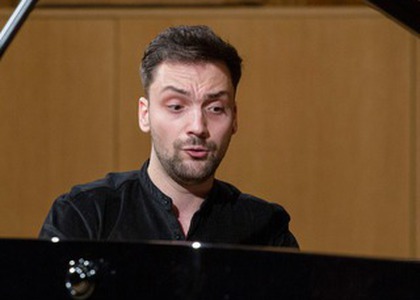
Interview with pianist Cristian Sandrin
On May 16th, 2025, pianist Cristian Sandrin released the third album in his career: the first complete recording of the eight suites for harpsichord by Henry Purcell in a modern piano version. In more details about this unique project, the musician spoke with Ioana Țintea.
Cristian Sandrin, your latest album proposes the world's first recording of the complete eight suites for harpsichord by Henry Purcell, in a modern piano version. What was the starting point for this recording project and what prompted you to explore this English Baroque repertoire?
I have tried to start from an original idea and I really wanted to record a repertoire that is not usually performed on the piano, and these suites were recorded in the past on the harpsichord and I see no reason why they should not be played on the piano. I have explored this repertoire, I had played it in concerts and then I decided it would suit a CD very well.
From an interpretative point of view, what does it mean to adapt to modern piano, a repertoire that was originally conceived for the harpsichord?
It is not the first time when this is done for a modern piano. The principle is that you have to study the music of that era and understand how it was originally conceived for the harpsichord, what was the aesthetic of music at that time, and then try to reproduce it using modern piano techniques.
I would like us to talk a little about the process of preparing this album. Behind any recording there is, of course, an extensive historical research. How long did you work on this album and how did the recording sessions go?
The recording sessions themselves last two or three days, but this is the pinnacle of a preparation process. I would say that Purcell's suites for harpsichord are not very difficult technically speaking, but what is really difficult is to give them a musical meaning that corresponds to the aesthetics of those times. Of course, I have read musical treatises from those times, about agogics. At times, I even tried to improvise with the rhythms, because I know that back then, the rhythms were played quite fluidly, almost improvised, and even the ornaments had to be improvised. Then, in my rehearsal room, I have recorded myself many times and tried to experiment with different nuances, pedalling, articulations, and then, finally, the last phase came, namely the studio recording.
What instrument did you play and where was the album recorded?
I recorded this album in the Yehudi Menuhin Hall, on a Steinway piano.
In addition to Purcell's eight suites, the album also includes other works for keyboard. How did you choose them, and what musical surprises will listeners discover on this CD?
Most of the times, suites for harpsichord and other instruments were not composed to be played in public. The concept of public concerts did not exist. More likely, if you knew how to play a keyboard instrument, if you were a nobleman who had taken harpsichord lessons since childhood, you would probably open a collection of suites and play, perhaps for your friends, your family, or for your own enjoyment. I simply introduced some stand-alone pieces into these suites, with this in mind, for my own enjoyment and for the enjoyment of my listeners.
Specialized critics, including BBC Music Magazine, received very well the album, released by Zoom Records. In addition, the CD containing Beethoven's last three piano sonatas was also honoured with Critic's Choice 2025 by the prestigious American Record Guide magazine. How do you feel about these acknowledgments?
For a young artist like me, it is of course a triumph, it is extraordinary to receive all this appreciation. We must use this appreciation to consolidate our reputation and play in public, to attract audiences to come to our concerts. It fuels our ambition. I already have new recording and concert projects in the making. I will be recording Beethoven's first sonatas, Op. 2, together with piano sonatas by Christian Neefe, who is a little-known composer, but very well known in music history because he was Beethoven's composition teacher in Bonn. It will be a one-of-a-kind recording.
You received your high school education at "Dinu Lipatti" National College of Arts in Bucharest. You graduated the Royal Academy of Music in London, and have won numerous international competitions. How have these stages contributed to your artistic journey?
The environment in which I grew up was very important. My father was a teacher and concert pianist. My teachers at "Dinu Lipatti" National College of Arts and the entire education I received in Romania set a very solid foundation for when I moved to London to study at the Royal Academy of Music. Every stage has some contribution, every step, every competition you win or don't win teaches you an important lesson.
The Romanian public meets you less often on stage. How would you describe your relationship with the Romanian stage at this point in your career?
I love to perform in Romania, and even though I will not be appearing there anytime soon, I will perform together with the Bacău State Philharmonic Orchestra a concert by Mozart in Italy's most prestigious music season in Milan, in May, with maestro Ovidiu Bălan.
Translated by Diana Sitaru,
University of Bucharest, Faculty of Foreign Languages and Literatures, MTTLC, year II
Corrected by Silvia Petrescu


