



> Interviews
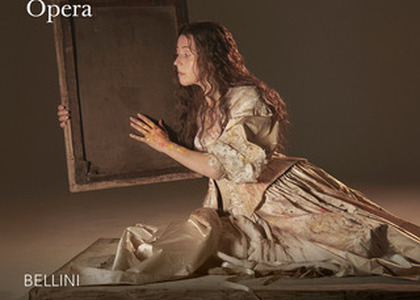
Soprano Lisette Oropesa on Bellini’s opera I Puritani
Lisette Oropesa, you are performing in a series of six shows with Vincenzo Bellini's opera I Puritani (The Puritans), a new production by the Metropolitan Opera in New York. It is a classic staging. How do you feel on stage in these historically inspired costumes, how do you feel, acoustically speaking, in the space created by director Charles Edwards?
Amazing. It's absolutely amazing. The acoustics are amazing. In fact, the acoustics are one of the best things about this production. Because the set is made of wood and it's like a community center, a space that reflects sound in whatever direction you sing. You can sing to the left, you can sing to the right. Plus, the acoustics are beautiful at the Met in general for all of us. The Puritans is bel canto, but many moments have quite rich orchestrations. So from time to time we would worry and wonder-oh my God, is the acoustics going to be a problem? Because you're in a big hall. But honestly, the set is so good that the acoustics are perfect.
This production has a single cast at the Met, which has been common lately. Does this come with a different set of responsibilities? Or are you already used to this type of staging, where you are solely responsible for the role of Elvia in all six performances?
Six performances isn't so bad. Larry Brownlee and I were the only ones in Paris for ten performances. So now, with the experience in Paris, even this one at the Met doesn't seem so daunting. Because there are fewer performances. But the pressure is very high, of course, because it's a new production and because it's the Met. We also have a live broadcast, as you know. So that puts a little more pressure on us, of course, we have even more visibility. But I'm happy that I now have some experience with the role and I don't feel overwhelmed by it. In rehearsals, I sang every day. It's the kind of role you have to sing a lot every day. It's not easy. You really have to put it into your voice.
Please go back to your first encounter with Elvira, with I Puritani, and tell us what drew you to this role in the first place?
My mother sang I Puritani at her recital when she was a master's student at university. She sang this aria. That was her recital. I had a recording of that moment, which I listened to when I was a child. I heard her sing it. I always thought about this role and the one in La Traviata, because my mother also sang La Traviata-they are roles that I always associate with my mother. When I started going to university, when I entered the Met Young Artist program and was studying roles for auditions and arias for auditions, this was one of the ones I worked on because I love it so much and it's so challenging. I wanted to do a good job. So I was already using this aria, Qui la voce, for auditions and things like that all the time. I was already familiar with the aria, then. But not with the role, because I didn't have the chance to really start studying it until I had a contract, an offer. And the offer was to sing the concert I did in Naples, because I was already very interested, I had wanted to sing this role for a year, but it's not the kind of opera that any opera house will just do. You need the right people, all the conditions have to be right. You can't just have the soprano.
You need four people, four extraordinary people to sing-the Puritani Quartet.
Yes, exactly. So even though I was already prepared, everything had to be put together, including the timing and production, and you know how things are these days. Then the pandemic hit, so many things slowed down and the opera houses were just trying to stay afloat. So it's amazing that the Met agreed to stage a big new production of I Puritani, it's absolutely amazing, because it's been 50 years since they last staged it. And even the production we did in Paris, it had been a few years since they had staged it. So it's not an easy opera to perform, so even though I insisted on singing it and prepared for it, I only started singing it when I was 40. I'm happy that it's now returning to the big stages. That's all I can say.
So Naples was your debut in the role?
Yes. Absolutely, it was my debut. Yes, yes, yes, yes. And I was so happy to have the chance to do it first in concert. As I said, it's not an easy opera to do, but it's extraordinary. It's so worthwhile, but you really need to have all the right circumstances.
Bellini's I Puritani is a splendid example of bel canto opera. Many singers say that the bel canto singing technique can be used in almost any other style of opera, whether we are talking about works by Mozart, Verdi, or Puccini, not just Bellini, Rossini, and Donizetti. Of course, it does not really apply to very modern music because there are no longer any melodic lines in the traditional sense of the word.
Yes, that's true.
Do you think this is or could be a valid way to approach the work? With bel canto technique?
I think it depends, actually. The bel canto technique, the Italian technique, is one thing. The bel canto style is, of course, something else. Some composers simply did not compose in the bel canto style. A French grand opera is not written in the bel canto style. You might have a few coloraturas, you might have a few lyrical moments where you use the Italian technique, but you're still singing in French, so you have to respect each individual style in order to get the best result. However, I think you can approach Handel as bel canto, because Handel, for me, is the first bel canto composer. You can sing Verdi. Much of Verdi can be done in the bel canto style because it is truly bel canto opera. Many of Verdi's operas were written in the bel canto style. And also Rossini, and Donizetti, and Verdi all wrote French grand opera. So there are a few examples where you have Italian bel canto, French bel canto. I think it also depends on the timbre of the voice. Then, even some Wagner can be sung with the Italian school technique. There are many who believe that Wagner sounds best when sung as if it were Italian bel canto, as if it were Bellini. But it is true that Wagner was a great admirer of Bellini. So I think it really depends on the composer and the vocal writing, on what the composer wanted. If you can apply the principles, it sounds great. So yes, the answer is yes.
You mentioned one of Elvira's arias, Qui la voce sua suave. What are, in your opinion, the most demanding moments in the opera? Because you have long phrases, very high notes, coloratura, and so on. The role itself is very extensive, you sing a lot here.
Yes, it's a huge role. It's very long. And honestly, the duet with the tenor at the end is probably the hardest part, precisely because it comes at the end, after you've already sung the mad scene, sung the polacca, and sung the grand finale, Vieni al tempio, and you think: Oh, I'm done! And then you realize-wait, no, I'm not done. I still have more to do. And in fact, this duet, Vieni fra queste braccia, is extremely dramatic. It's beautiful, but my God, it's so difficult and demanding! And for me, that's probably the hardest, most demanding part of the role, this duet. Honestly, just because of the timing. Because if you sing it on your own, it's one thing. But when you sing it in the context of the role, it's something else.
I don't know why it made me think of Non Più Mesta now.
That's a very good comparison.
Because it's also placed at the end of the opera (Cinderella), and it's also very long and difficult. Even though we're talking about an aria, not a duet, but...
...everyone is waiting for it. Exactly. Everyone is waiting for Non Più Mesta.
So yes, you need to have a lot of stamina in these operas.
Yes. Often in these bel canto operas there is a big finale for the soprano. Exactly. Well, here there isn't a big finale, because the big aria is actually for the tenor. Because he sings Credeasi, misera with a "Mi contra fa". And it's so difficult. And he's already been singing on stage for an hour by the time he gets to sing Credeasi, misera. So this last act is extremely intense for the tenor as well.
Yes, for everyone. But it's such a pleasure for us, the listeners!
Oh, I know. It's so beautiful. Oh, I know. It's so great.
You also sang with tenor Lawrence Brownlee in Paris in I Puritani and recorded the opera album. How would you describe your collaboration with Lawrence Brownlee, an extraordinary singer? Do you feel that you have a special chemistry on stage?
I think so. Larry and I are friends. We have a good relationship as friends. We respect each other very much. He's a great listener on stage. He's a great colleague. He's very respectful. We have a friendship offstage as well. He's just a wonderful person. He's always doing things for other people. He helps younger musicians a lot. He's wonderful, truly wonderful! I mean, I can only say good things about Larry. He's a really great friend and a great person, and he has all the qualities you could ever want in a person. Plus, he's a tenor. And he's very good. And he's very kind. He's phenomenal. What more could you want?
How wonderful! For this series of performances, you are once again under the baton of Marco Armiliato. How do you get along with the conductor in this context, where the pressure is even greater than usual, given that this is a new production and an opera that has not been performed at the Met for 50 years?
Right. Yes, but Marco is wonderful. I've done a lot of operas with him and he's fantastic. He's a very, very, very good conductor. He's wonderful with singers. He knows the whole repertoire by heart. He's just wonderful. He gives us singers a lot of attention and care, it's amazing. Plus, he's the most positive person I think I've ever met. He's always happy, always smiling, always has something nice to say. Marco is wonderful. He has great energy. And when that energy is transmitted from the conductor to the singers in the cast, things happen naturally.
When it comes to Bellini's last stage creation, do you have any favorite albums or singers, sopranos and tenors from the past or present, whom you greatly admire in this score?
I love Angela Gheorghiu! She is one of my idols. I love her and we are very close. Of course, as close as we can be, considering we haven't seen each other in a long time. But she sends me messages on my birthday, and I send her messages on hers. She is a diva whom I love, with whom I have worked before, and whom I admire. I think she will come to the premiere of I Puritani, if I'm not mistaken. I think her agent or someone told me she would be there. I am looking forward to seeing her.
Do you have a favorite tenor?
Isn't Ștefan Pop also from Romania?
Yes, he is!
We did Lucia di Lammermoor together and then we did La Traviata in Berlin together. He's great, I love him! He's a wonderful person. He's also a lot of fun to be around. He's a fantastic singer, absolutely fantastic! Just brilliant. In fact, my first pianist collaborator here at the Met, Vlad Iftinca, is Romanian. He was one of my closest collaborators, especially when I was a young artist here at the Met. He was my accompanist and taught me so much about bel canto and the Spanish repertoire; Vlad also played the piano on my first recording, the album Within Without, my first recital disc. So you have a wonderful group of incredible Romanian artists with whom I work. I am glad that now, for the first time, I have the opportunity to tell the Romanian media how wonderful your artists are! Thank you!
We are always delighted to hear that! Returning to Bellini's Elvira, which you will soon be performing in London-do you think the role has expanded your vocal identity, changed your relationship with bel canto?
Yes, actually, and I'll tell you why. It's because the role doesn't have a real tessitura. It doesn't! It's high and then it's low, it's high again and then it's low. And it doesn't really fit into any particular register. And because of that, I have to work constantly. I always have to "change gears" with my voice, because I don't sing in the high register, nor in the middle or low register, so I always have to run back and forth, it's like running up and down the stairs. And what happens when you run up and down stairs? You become athletic, you're much fitter. You become stronger. And that's great for me because I really feel like it's a bit like Traviata, but Traviata has more tessitura than Elvira. Traviata sings much more in a certain register, whereas Elvira is really up, down, up, down, up, down. And because of that, it makes me work really hard, which I think really makes me a better singer. It's something you have to train every day, which is why I sang every day at rehearsals. I sang every day because I had to! It's not a role you can just mark. There's too much up and down. By marking, you almost get more tired.
You run not only metaphorically and vocally, but also in reality, physically. Sometimes even marathons. Does this lifestyle help you in your singing and acting?
Yes! Your voice is a reflection of your health. Your voice is a reflection of your health! If you are healthy, your voice, as long as you use good technique, will reflect that. If you are not in good health, it will show in your voice. If you are weak, if you are tired, if you are upset, if you are emotional, if you get sick-your voice is the first to reveal all these things. Yes, I like to run, but I also like to hike, and I like to walk and eat healthy food, because that helps my stomach. Of course, it helps me not to gain weight and stay fit and healthy, but singing also helps me, Irina. Absolutely. Absolutely.
Besides, nowadays there are no productions, even traditional ones like this one, where you just sit and sing. There's no such thing anymore! Those days are gone. Now you sit, then you walk up the stairs, you climb on the table, now you're on the floor, then you're up high. I have to climb the equivalent of two floors in this production, several times. So, it's something you can't avoid. You have to be in shape. At least fit enough for your body. That doesn't mean you have to be thin. It just means you have to be strong.
Translated by Miruna-Andreea Vartic,
University of Bucharest, Faculty of Foreign Languages and Literatures, MTTLC, year II
Corrected by Silvia Petrescu


