


> Interviews
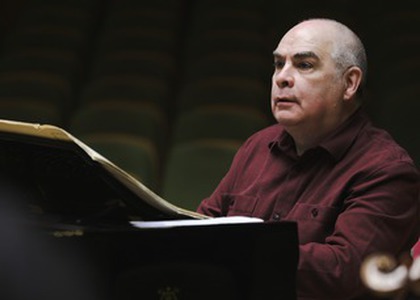
Interview with pianist Philippe Cassard
On Wednesday, January 14th, 2026, at 7:00 p.m., the Radio Chamber Orchestra will welcome Philippe Cassard as soloist and conductor, one of the most highly regarded French musicians of our time. The artist proposes an all-Mozart programme: Piano Concertos No. 20 in D minor, No. 21 in C major, and No. 22 in E-flat major, brought together in a single evening. On this occasion, Philippe Cassard spoke with Ioana Țintea.
With what thoughts do you return to Romania, and how would you describe your work with the musicians of the Radio Chamber Orchestra?
I performed in Romania almost two years ago, at the Enescu Festival, alongside David Grimal, as part of his concert series entitled Lumière d'Europe. At that time, the focus was exclusively on chamber music. This time, however, the context is entirely different: three major Mozart piano concertos-Nos. 20, 21, and 22-written around 1786, in the same period as The Marriage of Figaro. We are performing in a large hall with wonderful acoustics. From the point of view of the instrument, I am truly spoiled: it is a brand-new Steinway, absolutely brilliant for this repertoire. As for the orchestra, I am now accustomed to conducting from the piano most of the time when performing Mozart's piano concertos. And this chamber orchestra feels like a family. I sense an extraordinary unity among them, not only musically. They have known one another for many years; there are many young musicians, supported by more experienced ones, and all of this creates a truly wonderful combination.
You have collaborated with an impressive number of artists and chamber ensembles. What do you look for first and foremost in a stage partner?
For a long time-until the age of 45-I had a great many chamber music collaborators and took part in numerous festivals of this kind. After turning 45, I developed long-term collaborations with three or four artists. For example, with the great French soprano Natalie Dessay, I performed throughout last year and, to a lesser extent, this year as well, in a farewell tour following nearly 150 concerts over 14 years of intense work. We spent thousands of hours rehearsing, constantly striving for improvement, and performed together all over the world. I also have a trio with the violinist David Grimal-whom you know very well in Romania and in Bucharest, and who has been my friend for almost 30 years-and the cellist Anne Gastinel. We have had this ensemble for nearly 25 years; our anniversary will be in 2028. We have performed all of Beethoven's trios, numerous French trios, and many others, including works by Schubert and Brahms. Alongside all this, there is a wonderful friendship between us. We enjoy travelling together and sharing the music we love. I have a third partnership with Cédric Pescia, an extraordinary Swiss-French pianist who lives in Berlin. For 13 years, we have been developing a project for piano four hands and two pianos, and so far we have made three recordings. From time to time, I collaborate with Samuel Hasselhorn, a marvellous German baritone, or with Karine Deshayes, an outstanding French mezzo-soprano, one of the very best in France. For me, this is enough. I also need to perform solo recitals, prepare new repertoire, and face challenges such as the concert in Bucharest, with three Mozart piano concertos. My life is full, but not exhausting. I am 63 years old and I have never been as happy as I am now, because I have these wonderful friends-talented and trustworthy.
You have produced nearly 1,000 programmes for Radio France Musique, dedicated to the piano. Do you believe radio remains an essential tool for musical education in the digital age?
Yes, I do. I believe the presence of classical music is absolutely essential, because we are speaking about a heritage. It is the same as when you go to a museum and see extraordinary paintings by Rubens, Rembrandt, Van Gogh, or any other great artist. Why should the same not apply to classical music? If you listen to Mozart, Monteverdi, Beethoven, or Debussy, you realise that this music is not dusty at all and that it was created by so many geniuses. Therefore, radio remains one of today's essential platforms, especially because, for example, at Radio France Musique-the classical music channel in France-programmes can now be listened to in podcast form. Thus, my programmes can be accessed very easily: with the press of a button, you can listen to them. I speak about performers or about great Romanian pianists-Radu Lupu, Clara Haskil, Dinu Lipatti… In fact, Radio France Musique is currently building its own archive in what we call podcasts. In this way, after broadcast, the programmes can be accessed whenever you wish.
Has the research work you carry out at the radio influenced your own interpretative approach to music?
Of course. If we think of great interpreters such as Nikolaus Harnoncourt, we are speaking about a particular approach to Mozart's music and, more broadly, to classical music-one that includes all those elements that make Mozartian music less romantic. Mozart is classical in the strictest sense of the word: he belongs to the eighteenth century, not the nineteenth. Consequently, his music cannot be performed with the same kind of sound that an orchestra would use in a symphony by Brahms or Bruckner. And now, for instance, here with the Radio Chamber Orchestra, I am extremely happy to see that they immediately understand the direction in which I wish to go together with them.
You have published several works in which artistic reflection intersects with performers' biographies and with your own experience as a pianist, critic, and radio producer. Do you feel that writing allows you to explore dimensions that the stage does not offer you?
Oh, it is different. My life finds its explanation on stage. The stage is truth. That is where I live at 300%. With all the risks involved: it can be a bad day, or anything else-a bad mood, a poor instrument-but the stage always remains the place of truth. That is where my daily work opens itself to the public, in a direct and honest way. I could not live only by writing books or making radio programmes; these represent only a part of my work. For example, I do not teach. I have never been a professor in a school. Sometimes I give masterclasses-I enjoy following new talents and seeing how they develop. But radio, writing, research-nothing compares to a live concert.
Translated by Miruna-Camelia Baicu,
University of Bucharest, Faculty of Foreign Languages and Literatures, MTTLC, year II
Corrected by Silvia Petrescu


