



> Interviews
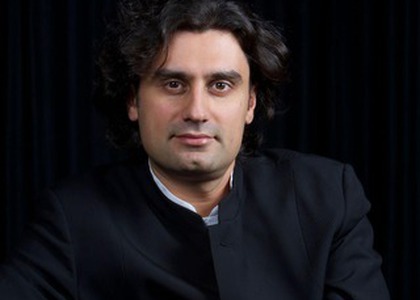
Interview with conductor Mihnea Ignat
Mihnea Ignat returns today to the rostrum of the Radio National Orchestra, on the occasion of the concert dedicated to National Culture Day which will take place at Sala Radio, starting at 19:00. In the program: Isbuc (Tarantella) from the suite "Through the Apuseni Mountains" by Marțian Negrea, Concerto for two cellos and orchestra op. 180 by Dan Dediu and Symphony in D minor by Cesar Franck. The soloists of the evening will be cellists Ștefan Cazacu and Mircea Marian.
In the concert dedicated to National Culture Day, you will approach two Romanian works: the final part of the suite "Through the Apuseni Mountains" by Marțian Negrea - Izbuc (Tarantella) and the Concerto for two cellos and orchestra by Dan Dediu. What aspects of Romanian creation do these two works reflect, from your perspective?
I believe they are somehow on the same side of Romanian musical creation - because, you will see, the Concerto for two cellos by Dan Dediu is very much inspired by what Romanian folk musical tradition means - with different themes, but which he dresses in new garments and brings that point of humor which I believe is also specific to the Romanian people.
Marțian Negrea's work is purely a symphonic suite in the most popular style possible - of course, passed through the symphonic filter of classical music, but with a strong influence of Romanian folk music, which, as I was saying, we will also be able to find in Dan Dediu's work, but to a much lesser extent.
I think they are two works that will delight the audience. I wouldn't want to say especially Dan Dediu's work, but it is for me an extremely pleasant surprise, not Dan Dediu's music, but this work that I did not know. And the soloists are at an exceptional level, the orchestra as well.
I think the audience in the hall and those who will listen to the live broadcast on the radio will greatly enjoy these two pieces.
About the collaboration with the two soloists of the evening, what can you tell us? Have you worked with them before?
With one of them, yes - with Ștefan Cazacu I collaborated a long, long time ago. With Mircea Marian, no, but the collaboration was extraordinary, excellent. They are extremely well prepared, young musicians of great perspective, with much talent, much sensitivity, and very serious. I believe we are on the right track regarding the Romanian cello school.
To the creation of which Romanian composers do you feel closest?
To Enescu, first of all; after that, to Paul Constantinescu. Marțian Negrea, of course, is one of the basic exponents of the old Romanian school. And surely there are many unknown ones... Bobescu, for example, who wrote a fantastic rhapsody, and many others.
You carry out an extensive activity both in the country and abroad. What does National Culture Day mean for an artist with a career developed largely abroad?
It means a moment in which we all must think about the fact that our cultural identity, as a people, is given by these small or large artistic works - whether we are talking about music, or we are talking about painting, we are talking about theater, we are talking about literature, we are talking about philosophy… it is the compendium of the entire Romanian cultural creation that makes the Romanian people have this cultural identity.
This day is, for me, about this thing, about protecting these values, about highlighting, I use the same word once again, highlighting this heritage. And, of course, to take care that future generations have the same opportunities that we had, at least the same opportunities, if not, much better.
You have been invited several times to conduct the Radio National Orchestra. How would you appreciate the collaboration with this ensemble?
I find the Radio National Orchestra in an upward form compared to the last collaboration. I think the last collaboration was three years ago. I felt understanding from colleagues, I found sensitivity, I found much talent and that is the most important thing. We made music on stage during rehearsals and I am convinced that the audience will also realize this tomorrow evening. There are absolutely wonderful moments of music that we obtained in rehearsals and I look forward to offering them to the public as well.
Again, considering your conducting activity abroad, how would you appreciate the particularities of the Romanian musical scene?
I believe that in recent years, especially in the last two years, the Romanian musical scene, from what I have seen of the seasons, especially of the orchestras in Bucharest, I am referring here primarily to the "George Enescu" Philharmonic Orchestra and the Radio National Orchestra, but also the Radio Chamber Orchestra, has opened up a lot to artists of great international value, which is extremely encouraging.
We needed such a thing, not only within the Enescu Festival, which is once every two years, but also the consolidation of the seasons of orchestras in Bucharest and in the country must be done based on these collaborations. But in my opinion, Romanian artists must be viewed with the same seriousness with which high-quality external guests are viewed. We have many high-quality musicians and I believe that a very homogeneous mix, a melange, must be made between international artists and Romanian artists, who, as I was saying, are of great value.
And, last but not least, chances must be given to the generation coming from behind, because without them we are nothing. We must leave something behind us and we must educate them in these values.
Translated by Ioana Nicolescu,
University of Bucharest, Faculty of Foreign Languages and Literatures, MTTLC, year II
Corrected by Silvia Petrescu


