


> Interviews
Interview with pianist Andrei Gologan
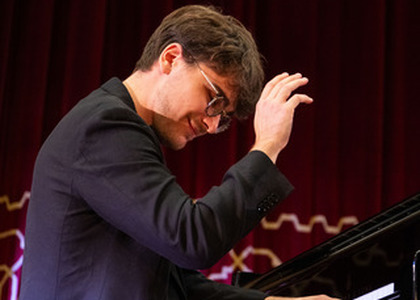
Pianist Andrei Gologan is the protagonist of tomorrow's concert at the Timișoara Philharmonic, as well as a recital titled "An anthology of love" that will be taking place in Iași on the 19th of January, 2026. In this interview, Andrei Gologan tells us more about these events, as well as his journey, what he wants to pass down to his students, and rediscovering one's identity as an artist, among other things.
At tomorrow's concert in Timișoara, titled Portrete românești ("Romanian Portraits"), you will be playing Nicolae Kirculescu's Musical moment for piano and orchestra and Carmen Petra Basacopol's Concerto for piano and orchestra. What do you think defines these pieces?
Both opuses are very interesting in their own way. Nicolae Kirculescu's piece is basically part of every Romanian's modern history, because it's used in the credits of the well known TV show Teleenciclopedia I admit that, until recently, I had no idea that famous soundtrack was a piano and orchestra piece. Well, I found out, and now it will be my pleasure to perform it! I look back fondly on those Saturdays when you'd hear the intro play and you knew Teleenciclopedia was starting. It's probably one of the most well known pieces by a Romanian composer and, uniquely, a piece whose name is not well known by the audience. I'm glad to be playing this piece. The second one, Concerto for piano and orchestra by Carmen Petra Basacopol, has a Romanian core. The traditional sound of Romanian music incorporated into this concerto is very strong. It's an interesting piece, because, even though it's written for a very large, diverse orchestra with many instruments, it ends up having chamber proportions. I often find myself only collaborating with certain instruments. I discover moments of intimacy combined with a certain something that's specifically Romanian, a little Romanian nostalgia. It's probably what makes this concerto so interesting. Overall, it's a beautiful experience. I'm in Timișoara for the first time and I'm glad to be making music together!
To which Romanian composers' work have you felt an affinity so far?
George Enescu is, naturally, part of the life of every Romanian person or musician. Over the years, I dedicated a great part of my time to his exceptional work, solo piano and chamber pieces. Lately, however, I discovered other interesting pieces from interesting composers. I had the pleasure and honor of performing Valentin Gheorghiu's Concerto for piano and orchestra together with the Sibiu Philharmonic Orchestra at last year's "Enescu" Festival, and this was when I discovered a truly exceptional piece. Romania has composers it can pride itself with.
On January 19th, 2026, in Iași, you'll be the protagonist of the event that starts the season of the "Gaudium Animae" Cultural Foundation. Where did the idea for the recital come from and how does the chosen program reflect the theme "An anthology of love"?
Often, when I schedule recitals like that, I think to myself that there has to be some sort of story or a message the music should convey on that evening. While thinking this and listing out certain pieces I would've wanted to perform, I discovered a narrative thread of love across a few of these pieces and, developing this program, I managed to make an anthology of love, as the title well says. It's a recital that features pieces in different styles, from Bach to Debussy, through Brahms, Beethoven and many others, and every piece explains the different kinds of love. We explore the various aspects and identities of the love that we all know and experience every day.
The recital begins with a Tchaikovsky piece, "January". Here, I imagined maternal love. The warmth in this piece, Tchaikovsky's expression of that unique feeling at the beginning of the year, of peace, optimism, tenderness, reminded me of the familial love between parents and children, that maternal love of an extraordinary purity. It's a special kind of love. Another example would be Bach's music. Here, it's a sacred love, love of God, of religion, of a superhuman force. There are other types of love that we'll explore together in this recital. For example, the recital ends with a Debussy piece, L'isle joyeuse ("The Joyful Island"). Here, it's extasy, carnal love, without bounds, maddening. There are many other pieces that display, through music, various human states associated with various types of love.
How did you feel about the transition from student to teacher?
It was a natural transition, from studentship to real life, if you will. It was a great pleasure to learn from great masters, András Schiff, Pavel Gillov and the University of Salzburg or Claudio Martínez Mehner in Köln. Towards the end, I had an inner drive, a desire to be independent, to think independently on a musical level. I continued to find my own answers with great joy. Since 2024, I've been teaching at the Freiburg Conservatory of Music. The professor role is still new to me, I'm still settling in, but I do it with pleasure. The students want to learn, we speak to each other like equals. It's a pleasure to work with the students.
What would you like to pass down to your students?
Most of all, a certain honesty. I think that in times such as now, when we're, maybe, directed, influenced in a way by the speed of time, by the speed of social media, a ceertain kind of honesty may be something that would help us, humans, to want to seek answers in peace, to be honest to ourselves and to music. And I think that after the audience opens their heart and ears and tries to recognize the message an artist honestly and patiently wants to convey, then that moment could be a truly sensitive and important one.
It's about being honest to ourselves, to what we wish to show, who we are as artists and what message we truly want to send, without it being altered in any way by forces such as social media or the speed of time, as well as beinghonest to music, because that's where it starts. We're working with extraordinary pieces so often. I can list Schubert, Mozart, Beethoven, people who had something to say and from who we can learn with every note and mark on the music score, so, yes, this honesty towards music and the score is perhaps the key to honesty toward oneself.
In your case, was rediscovering your identity a natural result of the process of maturing as an artist?
Sure, there are two sides of the coin. On one hand, we want to get out of our student shell. So, there's a certain inner force that wants to break through into another realm, a realm of independence, but it only actually happens if it comes naturally. We can't force these things, we don't master ourselves by forcing things, but by accepting who we are and what we want to do in the future with warmth and honesty.
I saw that in your biography, you said you were inspired by pianist and composer Ignaz Friedman, jazz pianist Bill Evans and conductor Sergiu Celibidache. How did you arrive at those three names?
I was actually listening to an interview with director Béla Tarr, who died recently. He was saying, and he put it in an extraordinary way, that we artists, all of us, be it directors, plastic artists or musicians, are seeking freedom, because if we're not seeking freedom, we have no reason to create art. It might be an abstract way of explaining the artistic phenomenon, but I find this freedom in these three musicians, Ignaz Friedman, Bill Evans and Sergiu Celibidache, freedom that I understand as a way to express oneself without limits, almost without wanting. There aren't many artists that would express a musical thought wihtout wanting to, but by being a wellspring of art in of themselves, basically an instrument of music and artistic form. By exploring these three great musicians, I might be getting closer, step by step, to that ultimate form of expression, a form that is free and without limits.
Translated by Alexandra Teodora Ciolacu,
University of Bucharest, Faculty of Foreign Languages and Literatures, MTTLC, year II
Corrected by Silvia Petrescu


