


> Interviews
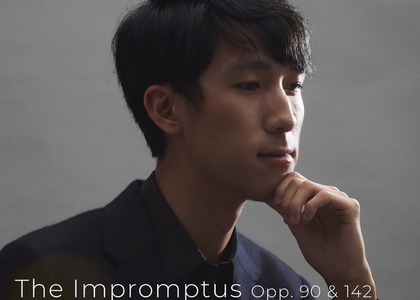
Interview with the pianist Eric Lu
Eric Lu: Well, to be honest, Radu Lupu is one of my most favorite pianists of all time. He really, in a way, changed my life, even though I never met him on a more personal basis. And for me, Schubert, I think it's been well documented, one of my favorite composers. I love him very deeply. I think his music is so profound, so moving. I mean, perhaps, yeah, one of the most moving composers that ever lived.
And I would... I think that Radu Lupu would say similar things about Schubert.
Clearly, he loved him throughout his life and played him. He was one of the most central composers in his repertoire. And these Impromptus, he played all his life, and he made a very iconic recording, I believe, in the 80s. And this recording of the H-Impromptus is my favorite recording of them ever. And seriously, it really inspired me to also do them myself. And I spent a lot of time on these works over the years, and I took this recording process also very seriously. And I tried to do them as best as I could. And, yes, I hope that you'll enjoy it and a little bit of the great Radu Lupu could possibly be heard in them. That would make me very happy.
This is Eric Lu, the pianist who won one of the world's most difficult competitions last year, the Chopin Competition in Warsaw, and who is the protagonist of the album featuring Franz Schubert's Impromptus D 899 and 935, recorded for the Warner label on an album released on January 9th, 2026.
Eric Lu, who at 28 is a mature American pianist with an important international career, has released his second album dedicated to the music of Franz Schubert-the first was also released by Warner in December 2022.
I was delighted to have the opportunity to talk to pianist Eric Lu. After listening to this album, I imagined him to be a very sensitive, special person, attentive to detail, a pianist for whom poetry and philosophy are of great value. That is why I asked him what his artistic credo is.
Eric Lu: I think the goal as an artist, as a pianist, is to express everything in the music, the wide array of emotional content that is in the music, as well as different characters, different moods. Because you cannot be a one-dimensional artist, or else then it's not enough. But I think that art, any great art needs to be listened with great care and concentration, thinking, focus, as well as a psychological, to dive into it. A lot of these great pieces, they all have very complicated narratives, as well as complicated form, and many different sections that hold them together.
And I think in today's fast-paced world, it is more and more difficult for people to get into this mindset. I think it's scientifically proven that because of our fast-paced world, our phones, the internet, our concentration spans are shorter and shorter, attention spans. So, I would hope that just through music, and then my music, I guess, in this case, I would hope to bring a little piece of great art to people. And that they can kind of escape a little bit of our reality and experience the music in a deep way, as art. And that hopefully it can connect, it can make you think, make you ponder about life, about one's personal life, about the world, and about these great composers' lives and the human emotional content in them.
I believe human nature is so complicated, and our lives are very complicated.
So, in my opinion, music is the best way, the most direct way of expressing this.
Eric Lu is a 28-year-old American pianist who won first prize at the 2025 Chopin Competition in Warsaw, one of the most difficult competitions for pianists in the world, which takes place only every five years. In 2015, Eric Lu also participated in this competition and won fourth prize.
Eric Lou: I thought about it for a very long time, and I almost did not go.
So I was really back and forth, struggling between this decision to go or not for many years.
Ultimately, first and foremost, if we talk about when I did it 10 years ago, I was only 17, I was such a little totally naive and fresh, not ready to play on such a stage.
And I think on a practical level, the Chopin competition stage is, in terms of sheer numbers of people watching, it's perhaps the biggest stage in the world. And I think I was not ready to show my full self as a mature artist 10 years ago. I knew that I had changed a lot and I experienced so much more as a musician, as a pianist, so I wanted to come back and show this new side of me as well.
Also, on a practical level, trying to be a concert pianist to have a, let's say, stable level of top good concerts is such a difficult thing in this day and age and really, so few people have this in this world.
Truthfully, I felt that my career needed this boost from the Chopin competition to possibly win the first prize and then more doors would open, in such a competitive world.
And yes, so far, since I've won, it's been a big difference.
There's a lot of competitions in the world. In terms of really opening doors for international career, there's only a few. But unfortunately, the reality of the world is it doesn't go to all the finalists, only to the first place, even though all the prize winners are so wonderful.
So, yes, even 10 years ago, I got a prize, but it was not the first prize, not even in the top three. And this difference of opportunities of how the music business views you and whether they're willing to invite you amongst so many other pianists that they could invite and who are already established, who are already been playing for many years around the world or who have good connections or whatever. There's so many factors that go into career that are not related to how well you play.
So, I felt that I also wanted to prove to myself that I could do it and that I could take this opportunity, since it was my last opportunity to do so, because the next time I would be too old. More so, I really wanted to show the world my love for Chopin, as well as my own personal development over the years.
Eric Lu is already a name that has evolved alongside the great American orchestras and won another major award in 2018-first prize at the Leeds Piano Competition. A trained artist who has been collaborating with the famous Warner label since 2020 and has already released five albums. I thought we should get to know him better.
Truth or beauty in interpretation?
I cannot choose, because you must have both, I think both elements are very important.
Do you feel more like Prospero or Don Quixote in the musical environment in our days?
It's a very tough, tough world out there, and very difficult life to pursue, to be a pianist. In a way, you do have to fight so many things, but mostly, fight your own self, the doubt that might be within you, within everyone, who is a vulnerable human being. But, in a way, you have to be like that to create great art. Or else, if one is too sure and confident about oneself, then, I think the music cannot go deeper.
A recital or a concert with an orchestra?
I would like a good balance of both, because I think there's irreplaceable elements in both, but, if we talk about the ability to fully express oneself as an artist, then, for sure - a recital, yes.
Schubert or Chopin?
Very difficult.
Obviously, both.
Coming back to childhood now, why did you start to play the piano? Because you are not coming from a musician's family. How did it happen?
Well, yes, my parents were not musicians.
But my father especially loved classical music. He grew up in Taiwan, where, during that time, it was not like growing up in, let's say, Europe or in New York City. It's not so much access to music, but it is amazing how much he was drawn to it.
He collected CDs. He went to the local library, borrowed the CDs, burned them onto a separate CD. There were so many of those around the house, so I listened to these recordings, some of them. And I just loved music, I immediately was drawn to classical music from a very young age. So, I wanted to learn.
But I think ultimately this sensitivity towards music is something one is born with. Either you have it or not.
And I think I'm not talented in so many different ways. I don't even have perfect pitch.
I don't have a great memory, my brain is not working any faster than normal people, I think, at all, and pieces for me to take a long time to learn. Also, I was not blessed with a sort of superhuman technique from an early age, like some others have.
But I think what I was born with was a sensitivity to music, to the sound, and then to directly connect it to emotional worlds in myself. I think everyone is different and music hits people in different ways. And that's what makes art, art. It's so subjective, ultimately.
Do you have a supreme goal for your career or is it just the music?
Yeah, it's just the music. I want to be able to make great music for as long as I can and to reach many people, hopefully.
In the age of AI, this matters a lot, doesn't it?
Yes, I think so.
It is somehow getting more and more difficult for people to appreciate art in a deep way. Classical music is one of the ultimate forms of great art.
These compositions can be endlessly listened to and analyzed and experienced, and there can be a great companion in one's life, if you love classical music.
You can never get tired, never get bored of great pieces.
You cannot replace how the human being plays music, it's just not possible. We've seen some examples of robots playing music, and it really sounds quite terrible so far. It's no comparison to how a human being would do it.
I think it's able to do some tasks on a far superior level to humans, but in art, in music, I think not at all, not even 1%.
The 28-year-old American pianist, winner of the 2025 Chopin Competition in Warsaw, impresses with his sensitivity, attention to detail, touch, and poetic conception, creating this sensation of suspended time, of weightlessness, as noted by the critic from The Guardian. An album to listen to carefully: indeed, there is something of Radu Lupu's finesse in these interpretations, alongside the experience of an introverted young contemporary artist with a rich inner world. Who truly has something to say.
Translated by Miruna-Andreea Vartic,
University of Bucharest, Faculty of Foreign Languages and Literatures, MTTLC, year II
Corrected by Silvia Petrescu


