



> Interviews
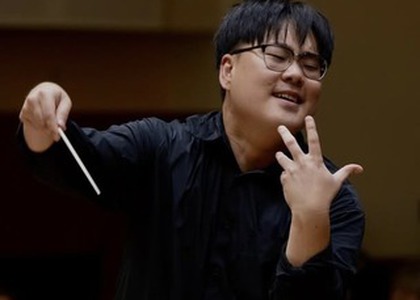
Interview with conductor Hyunsik Shin
Selected as the winner from among 170 candidates in the International Conducting Competition "Orchestra's Conductor," organized in the spring of 2025 by Radio România, Hyunsik Shin now returns to the Romanian stage. Audiences will have the opportunity to see the young Korean conductor once again at Sala Radio on Wednesday, February 25, 2026, leading the Radio Chamber Orchestra. The program features Symphony No. 1 in D major, Op. 25, "Classical" by Sergei Prokofiev, the world premiere of Cello Concerto No. 1, Op. 41 by A. G. Weinberger, and Symphony No. 2 in D major, Op. 36 by Ludwig van Beethoven.
You have previously appeared on the stage of Sala Radio with the Radio Chamber Orchestra, during the final of the International Conducting Competition "Orchestra's Conductor." What memories do you retain from that occasion?
It was a truly extraordinary experience for me. In fact, it was the first conducting competition of my life, and fortunately I was awarded First Prize. What deeply impressed me was the atmosphere within the orchestra. I remember the way the musicians responded, even today, I can still hear in my mind how immediately they adjusted their sound. I recall how swiftly they reacted to a conducting gesture or suggestion. For a conductor, encountering an orchestra of such quality and responsiveness is an extraordinary opportunity. Even though it was a competition, we worked with great joy. It was a genuine pleasure.
You mentioned that this was your first competition, yet you subsequently took part in others, in Hungary and Germany. What differences did you observe? What distinguished the "Orchestra's Conductor" competition in Bucharest?
The major difference lies in the fact that, in the Bucharest competition, the orchestra members are the ones who vote for the conductors. I consider this a very transparent system and, in my view, extremely relevant for us. Conductors' opinions can vary greatly, my colleagues often hold differing perspectives regarding another conductor's performance. By contrast, orchestra members, from my standpoint, tend to share a more unified perception: they sense very quickly whether the conductor standing before them is truly well prepared. Thus, for a conductor, the orchestra's impression represents an honest assessment of one's level and of one's professional stage at a given moment.
Musicians know immediately from the very first gesture, whether the conductor is in control. It may be a painful experience for some, but it is undoubtedly invaluable for growth.
You were awarded First Prize at the International Conducting Competition "Orchestra's Conductor." What would you say is the key to your success? What characterizes you as a conductor?
I would say it is one essential principle, which I learned from my professor in Germany. He constantly encouraged us to stand beside the orchestra and to support it genuinely. First and foremost, not to interrupt unnecessarily and always to seek ways of helping. Not to waste the musicians' time. Some conductors tend to speak at length, which can certainly be important, but for an orchestra it is often more effective simply to repeat a passage than to explain it extensively. I try to demonstrate more and speak less. Gesture is extremely powerful: if I can express the music through movement, attitude, and my entire presence, there is little need for words.
Another important aspect is to show the musicians that my intervention brings real added value. Of course, poetic metaphors can be beautiful, to say, for instance, that "the music is like the winter wind." But if the ensemble is not cohesive and synchronized, such imagery does not help. First, we must be together; cohesion must exist. Only then can we speak about the poetic dimension of music. This is a precious lesson I have received.
The program you are preparing for Wednesday's concert includes a world premiere. Cello Concerto No. 1 by A. G. Weinberger. How would you describe this work?
It is music deeply marked by jazz influences. There is a blues and jazz atmosphere, particularly in the first movement. The rhythmic element especially reminds me of traditional jazz ensembles, of that characteristic swing. Although we are dealing with relatively calm music, the jazz spirit is very present and vibrant. One can sense, in the language of the work, a dialogue between jazz and elements of musical modernism. The solo part is highly active, virtuosic, and full of energy. I like this piece very much, I feel its jazz rhythms throughout my entire body.
How do you see yourself evolving in the future as a conductor? What do you intend to focus on?
Naturally, I would like at some point to hold a permanent position as a principal conductor, for example. Yet it is equally important for me to encounter diverse orchestras and to discover how one interacts with them, how each makes music, what defines its particular character. It is fascinating to observe the differences between ensembles, traditions, and cultures. Each country has its own history and its own way of understanding music. I wish to travel, to work with a wide variety of orchestras, and to accumulate experience. That is my aspiration.
Translated by Carmen Badea,
University of Bucharest, Faculty of Foreign Languages and Literatures, MTTLC, year II
Corrected by Silvia Petrescu


