



> Interviews
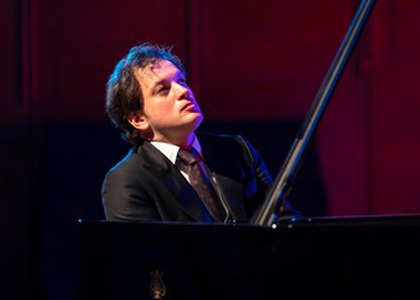
Interview with pianist Mihai Ritivoiu
Pianist Mihai Ritivoiu will present an extraordinary piano recital entitled "Inner Landscapes", as part of the chamber season of the Cultural Foundation "Gaudium Animae". About the event, which will take place on Saturday, February 28th, at 6:00 p.m., in the Aula of the "Mihai Eminescu" Central University Library in Iași, the musician spoke in an interview conducted by our colleague, Cristina Cîrjan.
"Inner Landscapes" is the title of the recital. What do you wish to convey to the audience through this choice?
When I received the proposal from the "Gaudium Animae" Foundation to return to Iași and to propose a recital program built around an idea, I first thought of a few programs I had already performed - for example, a program I presented at the International "St. Magnus" Festival in the Orkney Islands, structured around the connection between nature, culture and art. Going further, I arrived at this idea of "inner landscapes", also inspired by a particular formulation by Alfred Brendel - who, referring to the cycle "Years of Pilgrimage" by Franz Liszt, spoke about the nature around us and about inner nature. Thus, the landscape becomes a source of inspiration. There are programmatic works, obviously influenced by elements of nature, but which at the same time reveal the composer's inner world and a certain state of mind. That is how I arrived at this title - "Inner Landscapes". The program includes programmatic works, clearly inspired by nature, but also absolute music, where the idea of landscape becomes somewhat abstract.
You said that you grew up in a family with a painter father and that you were fascinated by the power of landscape to evoke an inner state. In what way did this closeness to the visual arts influence the way you think about or feel music?
I think I have always tried to search for the idea of color in music. I have been and still am particularly attracted to the creations of early 20th-century French composers - the Impressionists - where perhaps this connection between music and the visual arts is most evident. This is also reflected in the program, where we find works by Maurice Ravel and Claude Debussy. Of course, it was a privilege to be able to discuss with my father various principles and ideas that apply to both disciplines, such as the idea of contrast, proportions, and so on.
The program starts with the Baroque and reaches Romanticism and even Impressionism. How did you construct this journey and what guided you in choosing the works?
I chose works in which I feel "at home" - I feel them very close to me and feel that I can perform them well. I selected works that have coherence among them, through various structural and coloristic elements. I believe there are certain associations, perhaps even surprising ones, for example between the music of Johann Sebastian Bach and that of Sergei Rachmaninov. Likewise, Maurice Ravel and Claude Debussy take much from the pianistic writing of Franz Liszt. I believe I have arrived at a program that is balanced and contrasting, yet coherent at the same time.
You are pursuing doctoral research dedicated to classical piano improvisation in contemporary times. Is there a connection between this research direction and the way you interpret the repertoire in this recital, especially the Baroque work?
Yes, of course, I can apply my research activity on this topic here. There are things that I apply in the other works as well, though not in an obvious way. Of course, I do not change notes in works by Liszt or Ravel. In Bach, there are certain ornaments that I always perform slightly differently and I believe these bring an added freshness to the interpretation.
You have an intense activity - both solo recitals and concerts alongside orchestras. What directions do you wish to focus on in the near future?
I have several projects. I have a few concerts with orchestra in the very near future. I will perform Piano Concerto No. 2 by Camille Saint-Saëns in Bacău and the Ballade by Gabriel Fauré and the "Concertino in Classical Style" by Dinu Lipatti with the Sibiu Philharmonic. I am also preparing, quite soon, to record a new album, whose repertoire I will not disclose for the time being. An intense activity is taking shape, especially pianistically. At the same time, I am working to finalize this doctoral thesis, which has given me the opportunity for very interesting readings, analyses and research. Although it concerns improvisation, there has also been much research and analysis related to works from the repertoire, because that is where we draw our inspiration from, of course.
Translated by Darius Baciu,
University of Bucharest, Faculty of Foreign Languages and Literatures, MTTLC, year II
Corrected by Silvia Petrescu


