



> Interviews
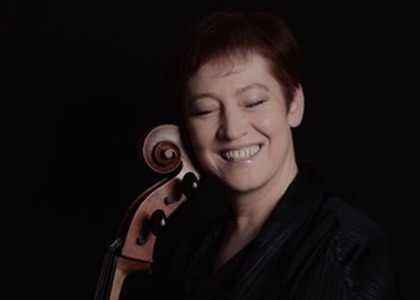
Interview with cellist Diana Ligeti about the “Musique & Solidarité” concert
Diana Ligeti, violinist Deborah Nemțanu, and pianist Dana Ciocârlie will perform on Wednesday, March 4th, at 7:00 PM, on the stage of the Romanian Athenaeum, in a concert celebrating 30 years of activity of the SERA Romania Foundation. On this occasion, cellist Diana Ligeti spoke with our colleague, Cristina Cîrjan.
On Wednesday, March 4th, you return to the stage of the Romanian Athenaeum. What does this reunion with the Bucharest audience mean to you?
I am very happy about this opportunity for two reasons. The first is that I am taking part in this act of solidarity - a noble cause into which I put a great deal of heart. The second is, of course, the fact that I am reconnecting with the Romanian Athenaeum and the Bucharest audience after 35 years. I have not performed in Bucharest for a very long time, and I am truly glad that this connection can be renewed.
You will be joined on stage by violinist Deborah Nemțanu and pianist Dana Ciocârlie. You are performing in this trio formation for the first time. How is this collaboration taking shape?
I am very happy, because I have known Dana Ciocârlie since our school days, and Deborah Nemțanu was my student at the National Superior Conservatory of Music in Paris. This concert is an opportunity for us to meet in a different capacity - as colleagues, sharing the stage and creating an artistic unity together. I am truly delighted about this collaboration. I have performed extensively here in France with Dana Ciocârlie. We have recorded together and have had many collaborations. I am very happy that we are transforming this duo into a trio with Deborah Nemțanu, who is an absolutely fantastic violinist and person.
You will perform works by Romanian and French composers. What guided your choice of repertoire for this program?
The choice was difficult, because we wanted to perform many works together. In the end, we selected the most representative composers of French music - Claude Debussy and Maurice Ravel - as well as leading figures of Romanian music - George Enescu and Paul Constantinescu. I will also perform an arrangement of the Romanian folk song "Ciocârlia" ("The Lark"). We are deeply attached to both the Romanian and French repertoire. Our connection to the Romanian musical tradition is very strong. At the same time, living and studying in France has taught us to love and understand French music as well. This dialogue between Romanian and French music formed the basis for our program selection. For example, George Enescu lived in Paris and was very familiar with French musicians and their music. The French have great appreciation for Romanian musicians and composers. Therefore, this dialogue was at the heart of our choice of repertoire.
The concert "Musique & Solidarité" celebrates the 30th anniversary of the SERA Romania Foundation. How do you see the role of the musician in supporting social causes through art?
Our role is essential because music is a universal language. We do not need to know the words to be able to communicate. Music is a language of emotions, through which we can convey many things to any person who listens to us, without the need for an articulate language. And I believe that our role in society and in solidarity actions is absolutely fundamental. Thanks to this credo, all three of us are involved in many such actions and we will continue to carry out such projects.
You perform frequently abroad. What projects do you have coming up, and where will we be able to hear you?
After my return to Bucharest, I will be traveling to Japan. I collaborate with Japanese musicians and institutions. This time, at the end of March, I will be at the French Institute in Kyoto, at the French Music Academy. We will perform French music, but not exclusively, alongside French artists participating in the academy, as well as with our Japanese students. In this way, we create a "transversal" pedagogy rather than a "vertical" one - not from teacher to student, but from artist to artist, through the non-verbal communication of emotions conveyed by music. After this two-week visit to Japan, we will begin preparations for the International Cello Festival in Beauvais. Before this festival, I will also take part in another chamber music festival in western France, in the Charente region, with international musicians. We will perform masterpieces of chamber music by composers such as Felix Mendelssohn and Maurice Ravel. We will also perform a work that I particularly love - Maurice Ravel's String Quartet. It is a joy for me to take part in this. After that, of course, my academic schedule continues with my students, who will have exams and other commitments.
Translated by Ruxandra-Ioana Șerban,
University of Bucharest, Faculty of Foreign Languages and Literatures, MTTLC, year I
Corrected by Silvia Petrescu


