



> Interviews
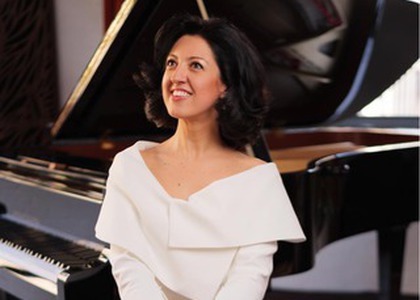
Interview with pianist Alexandra Dariescu about the album A child’s dream
On February 23rd, 2026 Radio România Muzical's Music Box premieres an album released by Signum Classics on February 6: the 10th album by Alexandra Dariescu, bearing the evocative title A child's dream.
I had the opportunity to talk to Alexandra Dariescu about this album and I asked her, first of all, what was the idea behind the creation of such a special record, in terms of its repertoire selection and meanings.
"It's very special anniversary because it's been 30 years since my debut with the orchestra and I really wanted to go back to the beginning and I had, a moment of reflection, so to speak.
This album is a musical diary of my entire life and career to date, I might say and I began with Mozart's Rondo KV 392, which I performed with the orchestra and on this album it is recorded with the Academy of St. Martin in the Fields, so it was another dream come true, because as a child I listened to these albums by the Academy of St. Martin in the Fields and grew up with them, I learned from these recordings and now to be on the same stage and record this album together was incredible.
And this album repertoire is very extensive and varied. We have four world premieres, we have eight pieces by composers, including some of the encores I perform all over the world where I perform and it is simply my signature and a celebration, a thank-you letter to the 9-year-old girl who had a dream and who worked very hard, persevered, did not give up, didn't quit, which is very important, and now sees her encore with her own eyes.
I listened to this album with a lot of emotion, I must admit, and I thought, for the average audience, when he sees a title like this, A Child's Dream, he wonders, is it and album for children, an album for adults, is it actually what Schumann did in Scenes from Childhood? How did you feel about this and how did you balance these things?
I don't know, for me, music is very universal, so I couldn't say that it's for the children or adults. It's for everyone, I hope it inspires the younger generation and others because having a dream in general is a very beautiful thing, and when you're a child, knowing what you want to be in the future when you grow up is a real blessing. And I think music has this ability to speak to any generation, you just simply just have to open your ears and the heart and listen. And I think this album is for everyone.
Tell us exactly what was your dream 30 years ago, how did you put it? Surely, you see yourself on the stage with an orchestra, which already happened when you were 9 years old, which is already something out of the ordinary… Tell us exactly about that moment, who was in the orchestra and what was the 9 year old thinking at that time?
The orchestra was the Chișinău Chamber Orchestra, at the Keyboard Hall, conducted by Nicolae Tatarinov. The entire orchestra was made up of adults and I was the only child, I was wearing a very beautiful maroon velvet dress made by my mother, with a large withe bow, of course and I stepped onto the stage I tripped. All the music sheet was on the floor, the stands fell over, the conductor behind me said "oh, no, that's it, she's not going to get up again.." My mother, was very emotional. But at that moment, it's a life lesson you learn, and you have two choices. You either, give up, cry and run away or you get up and keep going, you don't give up. And of course that's what I did, a little embarrassed, but when you're a child you don't really feel every emotions as you would now. And I remember singing the whole concert and it was such a joy, such beauty, I don't know when I bowed down at the end and received the people's applause, it was a joy! That is the word I would use to describe the joy that music brings to you. And I remember coming off stage and telling my mother and my piano teacher, and I had a little interview there and I said "I want to be a concert pianist" I didn't know because I don't come from a family of musicians, I didn't know what it meant to perform, what it meant to dedicate your life to the arts. You never know where life will take you. But it was that specific determination I had as a child and I felt it deep inside my hear, so no matter what anyone said to, it wouldn't have mattered.
And that dream has been with me since I was 9 years old, since the beginning. Even during the pandemic, in the most difficult moments, I never thought about what else I could do. It was simply that specific dream and I always look back at that 9 year old girl who had enormous courage and will to fight.
Now, after 30 years, what does it mean to be a concert pianist who has performed on the world's biggest stages? And beyond this glamour of an extraordinary life, what lies beneath?
A lot of work. Of course, this glamour you see on social media, every artist chooses how they build their image. Mine is one full of light, color, full of good cheer and positive energy. It's a lot of work. It's about passion that comes from within and awakens a curiosity that makes you want to study every day, to become better, to perfect yourself. You have to like living out in a suitcase, which for me is a very beautiful thing because it shows you the roots, that in life we don't need so many things, in general. I a minimalist person, so when someone asks me where I feel at home, I say where I have a piano. So if I have a piano and a cup of tea, it's ok, I don't need anything else. It's a blessing and a privilege to travel around the world and perform with extraordinary artists from whom I learn so much. When you perform with someone, that's when you learn the most.
But it's not always easy, especially due to the schedule being different from week to week, you have to be very organized in terms of learning all the pieces and then, as you may know, I like to tackle a wide and rich repertoire. You have to be adaptable because as a pianist you have to adapt to the the piano you are given there and become friends with every instrument and make it human, give it soul, but at the same time it's about adapting to every human being you come into contact with, from the conductors to the orchestra, to their sound, the teams you're working with. I don't know, it seems to me that I'm in a different city or another country every other week and it's like I'm in a bubble every time because you befriend people and it's feel like we've been friends for years. And then, the next week, you move somewhere else. It's beautiful thing. I like to travel. I like to meet new people, and this curiosity of mine, I don't know, it brings a different energy that makes you happy. As musicians we have to enjoy every moment we have because you never know when we won't be able to perform anymore, for whatever reason. So I'm the kind of person who enjoys every moment. Yes, it's hard, but it's very hard in any field.
Let's go back to this album A Child's Dream, in which I find many of the elements we have already discussed. And I would note, first of all, a kind of brilliance and finesse in repertoire choice. Things that are related to your life, but things that that also matter in your life, referring, for instance, to the works written by female composers, well-known works and works that are discoveries. Let's review this repertoire and the arguments behind these works being included on this record.
We begin with Mozart's Rondo in D Major, KV 382, and the next piece is the title track from the album A Child's Dream, which, if you can believe it, was written 144 years ago by Amy Schaeffer Klein, a German composer whom I had never heard of until the pandemic, but it is a world recording on this record, even though so many years have passed.
From here, we move on to a piece very dear to me, Humble Birth by James Lee the 3RD, and Africa-American composer who also dedicated the Shades of Unbroken Dreams Concerto to me. This composer has become a very good friend of mine, and we are in constant contact, and he dedicated this piece to me. It is a very short piece, but it was written around Christmas and brings so much hope and light. From here we move on to three pieces for piano and cello by Nadia Boulanger, a composer I play very, very often, but I recorded these three pieces with the principal cellist of the Academy of St. Martin in the Fields, Richard Harwood.
From here, we move on to three piano and violin romances by Clara Schumann. Of course, Clara Schumann's Concerto, which I have played all over the world. And I want to say that I always play these pieces for cello and violin as encores after concerts with the orchestra, and it is, I don't know, such a beautiful and intimate moment that we create… The audience, first of all, doesn't expect me to play something with someone from the orchestra, but when we play Clara Schumann's Romance, the third piece, which I also played at the George Enescu Festival, for cello and piano, it brings another level of brilliance. And chamber music, which is present in every phrase, in every piano and orchestra I play.
Then, we move on to something very intimate, Bach's Prelude in B minor, arranged by Siloti. This piece has a very personal meaning for me because in 2006 when my teacher from Manchester passed away, I did kind of a memorial concert and played this piece. And it was so difficult to play three-minute piece that effectively contains the essence of life, as every Bach piece does, but it's very beautiful because the whole Prelude is in B minor, and it ends in B major, which is like after clouds we have in life, there is a ray from the sky and it's like the sky opens up and you see a ray of sunshine and it brings you hope.
Then we go to the composer Missy Mazzoli, whom I met in New York. She is the first composer ever to receive a commission from the Metropolitan Opera House in New York, and she has a very nice piece called A Map of Laughter, which, of course, if we think about the smile or laughter of a child, which is very innocent and spontaneous, and you ever know where it's going to go, this piece is absolutely perfect. From here, from James Lee, to Missy Mazzoli, to Amy Beach next, and then to Florence Price, here I wanted to create a tribute to the 250th anniversary of the U.S.A, a country I visit very often and where I collaborated a lot with orchestras. That's why I wanted to incorporate these composers there, and I don't know, in a way, we think that music can't change politics, but it helps us, especially at this moment, to reflect on where we come from, where we are going, how we work together and I think this reflection is more important now than at any other time.
Goblin and the Mosquito by Florence Price is an encore I play very often and it always brings a smile on the audience's faces. The there is a romance by Germaine Tailleferre, whom I met through Ravel, who had been her student and a very good friend. Then there is a very interesting work by Leokadiya Kashperova, a composer of Russian origin, who wrote the Piano Concerto in the same year that Rachmaninoff wrote his beloved Second Concerto, but because of the politics of the time, Leokadiya Kashperova was completely erased from history and was rediscovered by Dr. Graham Griffiths, who works extensively with Buzi and Kashperova was added to the Buzi record label catalog. I made the world recording of this concerto with the BBC Symphony and found a very beautiful piece, a song without words, a kind of tribute to Mendelssohn arranged by Graham Griffiths.
Finally, at the end of the album, we have two pieces by two Romanian composers. Of course, the record wouldn't have been created without a Romanin presence, Carl Flitsh's Mazurka. Of course, everyone knows about the Carl Flitsch Competition in Sibiu, in which I participated as a child. And of course, Carl Flitsch is known as Chopin's most beloved student, and this mazurka is so beautiful. And after the mazurka, we have Tudor Ciotea's Gypsy Dance, which I understand has never been recorded on a disk before; another world premiere.
And we end with Polichinello by Villa-Lobos, which I always introduce to the audience as encore, "If you blink, it's over", because it's so short, 30 seconds or something like that. And that's pretty much my personal and musical diary on this record.
And to this I would add a very personal style of interpretation. I think this record marks a new stage in your musician life. That personal and youthful brilliance remains, but there is also kind of maturity and a kind of light that comes from another sphere, that of a person who knows himself better, if I may put it that way. I don't know how else to say it. Right? That's what I felt from all of the interpretations, regardless of the music's ethos.
Thank you very much. I'm not sure, I feel like I've entered a new phase. It's been a long journey to find my voice and that's why I try to encourage my students and all the young people I talk to to embark on this journey of discovering their own personal voice, because every musician, and there are many of us, especially pianists, has something special and unique. And this album, from the cover to all the notes in the program notes, absolutely everything, the colors, the font, the repertoire, the orchestra, the producer, I chose them myself. I brought them together, we worked together but effectively, the record is my identity.
Being the 10th album, I felt it was a celebration, a reflection of shorts, looking back, but also looking forward, what I really want my voice to say in the future. I know that every artist has their own voice, but it's very important to use it in a constructive way. To know what you want to say, what you're fighting for and I feel that this is the new stage. I turned 40 and I really enjoyed reaching this age because I think age is just a number, what matters is how you feel inside and not necessarily how old you are, but the innocence of a 9 year old and the experience and the maturity I have at this age is such a beautiful combination. Just like Mozart, I think it is so hard to sing it now, as adults, but when we were children, it was the easiest to sing.
Translated by Cosmin Șerban,
University of Bucharest, Faculty of Foreign Languages and Literatures, MTTLC, year I
orrected by Silvia Petrescu


