


> Interviews
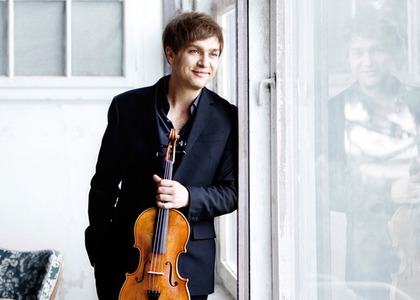
Nils Mönkemeyer: "When I make a recording, I want it to be relevant"
German viola player Nils Mönkemeyer is one of the performers on an album dedicated to Shostakovich Discoveries which has been awarded an ICMA in the Premiere Recordings category. Frauke Adrians form ICMA Jury member Das Orchester made the following interview with Nils Mönkemeyer.
Mr. Mönkemeyer, violinist Carolin Widmann has just succeeded in getting Lufthansa to make its rules for carrying instruments on board more musician-friendly. Have you ever had any problems traveling by plane with your viola?
Yes, that was on board Eurowings. It is part of Lufthansa, but it's a low-budget airline - so you tend to expect difficulties because the dimensions of an instrument case don't fit the carry-on baggage rules. Since then, I've preferred to book a second seat for my viola.
That's understandable, especially since it's even more difficult with the viola...
Traveling - or playing?
I meant traveling, because of the size of the case. But what about playing? The violin is and remains the more popular instrument, but are there children who say right from the start: I want to learn the viola - and who immediately feel at home with this instrument?
There are some really great people who started with the viola right away! The key is to be comfortable with the size of the body from the start. That brings us to the secret of this instrument: the smoky charm of the viola has a lot to do with the fact that the body needs to be a certain size. If you were to put viola strings on a violin, the result would sound like a cardboard box.
You yourself played the violin first-was it the smoky charm of the viola that made you switch?
Not only that. There are sounds that, physically speaking, are not in the room, but are created in the ear. I always found these resonance tones rather unpleasant on the violin. Everyone hears differently, which is why we develop preferences for different instruments. The main thing is that we come together in music, harmonize with each other, and can listen together.
Together with others, you recorded a CD featuring rare works by Shostakovich, which has now been awarded an ICMA in the Premiere Recordings category. Were these works, and Shostakovich in general, what the CD title promises: a discovery?
The piece I recorded for this CD, the Impromptu for Viola and Piano, oscillates like so much of Shostakovich's work - on the surface, it sparkles with the banality of light music, yet at the same time the piece has an astonishing depth. I really enjoy playing it. Art becomes interesting when there is a break, when you can sense the nuances between reality and imagination.
Shostakovich bid farewell to the world with the viola, which is why we violists love him anyway. He is a fascinating figure because his work was created in a state of constant conflict. What is my relationship to the state, to the world? Under a dictatorial regime, Shostakovich had to explore this question again and again. That is what makes his music so contemporary. That is what makes him so relevant, especially now that we are witnessing a virtually Stalinist Russia waging war against its neighbor.
The CD combines chamber music, solo and orchestral works, including world premiere recordings. Did you have any idea that it had what it takes to win an award?
Above all, it is a reflection of a festival, the fruit of what is achieved every year at the Shostakovich Days in Gohrisch. I am thrilled that this project, which was born out of pure love for the composer and his work, has also received so much international recognition. I never play to win prizes - but I am particularly pleased that this album, on which so many great musicians have collaborated, has received an award.
Your repertoire spans many centuries; you play Baroque music and contemporary music and music from all the eras in between. Do you have a favorite composer-perhaps one from whom you would have liked to see more literature for the viola? There is so much more for the violin...
To be honest, I enjoy the fact that we don't have as much tradition behind the viola as we do with the violin or the piano. I like that you can make works your own with the viola that weren't originally written for it - and thus not only experience your own creative process, but also open up a whole new repertoire for yourself and others. That's why I don't mind at all that there aren't as many original works for my instrument as there are for the violin! On the contrary, my colleagues who play the violin have it harder in a way if they don't want to produce the umpteenth recording of a frequently played work and be constantly measured against their great predecessors. If I played the violin, I would probably follow a similar path to my wonderful colleagues Isabel Faust, Carolin Widmann, and Christian Tetzlaff. Discovering new things, developing my own strong voice, emancipating myself from the playing tradition.
The number of vacant orchestra positions is declining, and life as a freelance musician is difficult. You taught at the music academy in Dresden and for 14 years in Munich, and now you are at the Hanns Eisler Academy in Berlin. What advice do you give to young musicians who study with you?
My job as a teacher is to see a person's direction a little earlier than they do themselves. It also matters whether someone is 18 or starting a master's degree at 22 or 23. The consideration is always: what suits him or her? One person may be strong in teaching, another may be great at chamber music. I have a responsibility to ensure that as many as possible find a place in the increasingly competitive market.
When it comes to whether someone will be accepted at the university, the answer is very quick for two groups - those candidates who are so excellent that they absolutely must be accepted, and those who are not even considered. It is difficult with those who, for example, have a strong personal voice musically but are not so good on their instrument. The question is, will he or she be able to do it during their studies? If someone has very high musical potential, I will certainly speak up for them. But there is a risk that they will not be able to keep up with the technical demands of the instrument in the long run. That's when I have to make a really far-reaching decision.
And what decision will you make for your next recordings? After CDs with works by Bach, Vivaldi, Konstantia Gourzi, and most recently two Shostakovich albums, which direction will you take next?
I'm taking a break. The recording market is in such flux, and consumer behavior is changing so dramatically in the age of streaming that I want to take a step back and observe what's happening. When I make a recording, I want it to be relevant.


